"A Jubilant Song" at Carnegie Hall

On March 30, 2008 I was lucky enough to be in the audience for the New York premiere of A White House Cantata, the concert revision of Bernstein-Lerner’s 1600 Pennsylvania Avenue, a fast failure in 1976. The Collegiate Chorale, who was responsible for that premiere, held a gala concert called “A Jubilant Song” last night at Carnegie Hall. I was more than thrilled to go when invited, especially when I learned that they would be performing excerpts from 1600/Cantata. Now while I have my quibbles with the Cantata and the use of opera singers instead of more qualified musical theatre performers in the lead roles, it’s always a pleasure to hear selections from this exceptionally underrated, often brilliant score.

Hosted by Tony-winning actor Roger Rees, the evening was the gala inaugural concert to introduce the new music director James Bagwell, who is assuming the mantle of conductor after the unexpected death of Robert Bass. The Collegiate Chorale was first established in 1941 by Robert Shaw and has been a staple of classical repertoire in NY ever since, emphasizing choral tradition and American music but also presenting operatic works.

While there many guest vocalists, the first segment of the evening was strictly about the Chorale. The evening started with performances of Giovanni Gabrieli’s “In ecclesiis,” Alexander Kopylov’s “Svete Tihiy” and an arrangement of the spiritual “Set Down Servant.” This led into Norman Dello Joio’s “A Jubilant Song” which may be one of the most difficult choral pieces I have ever heard with intricate melodic lines and rhythms; I can only imagine what the sheet music for this piece must look like.

With the exception of Daniel Mobbs as the President, the principal singers of A White House Cantata were on hand to reprise their work from the 2008 concert performance. Mobbs was George Washington in “On Ten Square Miles by the Potomac River,” Soprano Emily Pulley sang a tender “Take Care of this House” with Kalif Omari Jones while “Anita Johnson and Robert Mack performed the infectious “Lud’s Wedding.” Pulley, in a tremendous Carnegie Hall debut, recreated her colorful “Duet for One” to the wild enthusiasm of the audience. While she’s no Patricia Routledge (who is, really?), she understands the schizophrenic comedy better than other opera singers who have taken on the part in presentations of A White House Cantata (namely Nancy Gustafson and June Anderson). The segment ended with a full-throated rendition of “To Make Us Proud,” originally cut in Philadelphia but reinstated by the Cantata. The song echos other anthems, specifically Bernstein’s own “Make Our Garden Grow.”

One of the great joys of the entire evening was hearing this music performed, not only in such a perfect performance space as Carnegie Hall, but also to hear simply pure acoustic sound. Except for Rees’ commentary, the entire evening was without amplification. Though I’ve had a considerable classical background, I haven’t gone to many concerts or to the opera as much as I’d like in recent years. Every time I do; however, I marvel at the extreme beauty of hearing music performed with some sort of electronic filter. Even some of our loveliest musicals on Broadway are miked to the hilt, with an emphasis on loud. It was especially evident how thrilling to hear selections from a score I love, with its complete original orchestration intact. 160 voices singing “To Make Us Proud,” and holding out that last note for what must be glorious eternity. You can’t ask for anything more stirring or moving.

Coloratura soprano Erin Morley, who recently made her debut at the Metropolitan Opera brought the concert to a crashing halt with an exquisite rendering of “O beau pays” from Giacomo Meyerbeer’s Les Huguenots. Morley, dressed to the nines and with the poise of a true star, stunned the crowd into an extended ovation – the largest of the evening – with her gorgeous sound and flawless technique. I look forward to following the singer’s career, as I’m sure there is nothing but good things awaiting this diva on the rise.

The evening built to its climax with a performance of Beethoven’s “Choral Fantasy, Op. 80” Acclaimed pianist Jenny Lin proved her virtuosity and flawless proficiency with the lead-in piano solo. For the finale, Morley and tenor Salvatore Licitra were to lead the famed “Brindisi” from La Traviata; however, an emergency kept Licitra in Switzerland last evening so instead they divided up the parts between the various soloists. While they urged the audience to join in on the chorus, most of us were content to just sit back and enjoy the performers onstage.

I’m even more excited for the Collegiate Chorale’s next concert: Ricky Ian Gordon and Michael Korie’s The Grapes of Wrath will be presented at Carnegie Hall on March 22, 2010. This marks the world premiere of a two-act concert version of the ambitious contemporary opera. Jane Fonda, Nathan Gunn, Victoria Clark, Steven Pasquale and Christine Ebersole are among the folks participating.

The world is small and funny and fine. Last night, my high school freshman English teacher, Mrs. Fran Schulz, was also at the Chorale gala. Of all the teachers I have had, she ranks as the one who has made the most impression on me, and I continue to maintain a remarkable friendship. Throughout my freshman year, she encouraged my interest in film and theatre, often handing me a package of films and performances she felt I needed to see every Friday. With a personality akin to Mame, Fran is the only teacher I’ve ever had who entered the classroom with a quality not unlike star presence. I’ve been imbued with her enthusiasm for literature and theatre, and she has always been supportive of me as a writer and performer. An avid theatregoer, she has regaled me with stories of seeing every major revival of My Fair Lady in New York and London, Camelot with Richard Burton and again with his understudy John Cullum. She also has seen every major star turn by Angela Lansbury since the original Mame. I could go on for hours. She continues to encourage and advise me, even though I haven’t been her student in 12 years. I can only hope that you’ve had a teacher like her at some point in your life.

Judi Dench sings "Send in the Clowns"

With the first-ever Broadway revival of A Little Night Music approaching its opening date, I’ve felt like revisiting all my various recordings and texts and video of previous productions. This one is a favorite. Dame Judi Dench won an Olivier Award for her triumphant performance as Desiree in the 1995 Royal National Theatre revival of A Little Night Music. The production, directed by Sean Mathias, ran for 11 months and co-starred Sian Philips as Madame Armfeldt and Laurence Guittard (the original Broadway Carl Magnus) as Fredrik. A cast album of this production was made, but it has been long out of print and goes for extraordinary amounts on Amazon and E-Bay. However, if you do get the chance to hear it, you will not be disappointed. Especially in Dench’s sublime portrayal, my second favorite next to originator Glynis Johns.

Here Dench appears on a British talkshow to promote the show and talks a little bit about the play and her character and the moments leading into “Send in the Clowns,” followed by a heartbreaking rendition of the song by the star. Enjoy:

Leslie Caron


Leslie Caron, star of so many classic films, has released a memoir about her life called Thank Heaven. Trained as a ballerina, she got her big break at the age of 20 as a last minute substitute for a pregnant Cyd Charisse in An American in Paris, which launched her exceptional film career, including memorable turns in Lili (Oscar nomination), Daddy Long Legs, Gaby, Gigi (another Best Picture), Fanny, The L-Shaped Room (Oscar nomination) and Father Goose (among many others). She’s also one of the few actresses to have danced on screen with both Gene Kelly and Fred Astaire. Living in semi-retirement, Caron still acts on occasion winning an Emmy award for a guest appearance on Law and Order: SVU in 2007. She also maintained a bed and breakfast called Auberge La Lucarne aux Chouettes in Burgundy. The daughter of an American dancer from Topeka, Caron recently became an American citizen after discovering that she was eligible. This winter, she will play Madame Armfeldt in the first-ever Paris production of A Little Night Music with Kristin Scott Thomas. While I would love to go over to see this one, I’ll be relying on our very own Kari for a full report come February.

Caron is currently on a book tour in the United States, and was in New York over the past couple of days. She spoke and signed at Barnes and Noble Lincoln Center last evening, and also was interviewed by Leonard Lopate on WNYC. The charming, elegant actress talks very frankly about herself, her career, her romances (including an affair with Warren Beatty) and problems with drinking and depression.

Thanksgiving Leftovers

– Donna Lynne Champlin has taken it upon herself to release a solo CD on a shoestring budget of $1,000. When she broke her ankle in September she found herself with six weeks to spare and got to work. The CD is now out, and the Sweeney Todd star celebrated with a release party performance at the Laurie Beechman Theatre last evening. I was supposed to be there until asthma got in the way; however, I’ve went ahead and purchased a copy of the CD, for which I have to confess I’m very excited. DLC has been blogging the experience from the beginning, with considerable humor and blunt honesty. Anyone interested in how a recording is made will find her blog an educational tool, as she gets into warts and bolts of what goes into every aspect of both creative and business aspects. I always applaud a grassroots effort and am looking forward to hearing the new disc.

A Little Night Music has returned to Broadway for the first time since the original production closed in 1974. The revival is yet another in a long line of transfers from the West End, specifically the Menier Chocolate Factory. Naturally, I was at the first preview. I won’t go into too much detail about performances and such, as it’s in its first week and there is work to be done (though I think a certain someone might be getting Tony #6…). There were some issues with the orchestra. Namely there were points where I couldn’t hear it from my vantage point far house left, and during dance sequences found the shoes and dresses hitting the stage louder than the band. It reminded me of the ballet scene from the film version of Amadeus where the dancers continue after the music has been cut. Between this orchestration and that for the Menier Sunday in the Park with George it’s becoming quite clear that Jason Carr hates the French horn.

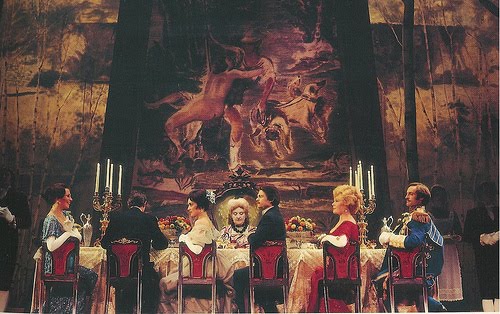
One other quibble – Madame Armfeldt would NEVER allow a formal dinner at her house to be held as a picnic on her lawn. It would be far too gauche for someone of her status, especially considering that in the first scene of the second act she is mortified at the prospect of guests finding them “squatting on the ground like bohemians.” It’s completely incongruous to the character – it’s Madame Armfeldt’s house and she wouldn’t allow it. Period. But oh, that book and score. So sublime, and always so lovely to see it onstage.

– While I blogged at length about the 50th anniversary of The Sound of Music, I neglected to mention that another iconic 1959 musical celebrated its golden anniversary this month. Only one week after the final Rodgers and Hammerstein musical opened at the Lunt-Fontanne, Bock & Harnick’s Fiorello! opened at the Broadhurst Theatre. The musical about Mayor Fiorello H. LaGuardia was a big hit, running 795 performances, winning the Pulitzer Prize for drama. Star Tom Bosley won the Tony for Best Featured Actor in a Musical as the charismatic “Little Flower.” And for the only time in Tony history, there was a tie in the Best Musical category with The Sound of Music and Fiorello! sharing the honors.

It’s interesting to note that as far as musical theatre is concerned, both fall short of a third nominee that came up empty handed at the Tonys in 1960, Gypsy – which is the most artistically successful of the three. SOM got the smash hit film version, but that improves on the muddled stage libretto but brings in audiences based on their experiences with Julie Andrews. Fiorello! contains a beautiful score, but is perhaps too topical for today’s audiences who consider LaGuardia an airport and a high school. It was the first-ever musical staged by City Center Encores! but seems unlikely for a Broadway revival unless one of the non-profits were to do it.

Oleanna and Superior Donuts have announced their closing notices. Both are productions worth seeing. The former doesn’t surprise me as much, the subject matter is difficult and that in itself would make it a hard sell. However, I would have expected Donuts to remain open through the Tonys. I highly recommend seeing both before they close on January 3, especially the latter for the breakthrough performance of Jon Michael Hill. You will one day want to be able to say you saw him when. Other shows haven’t posted notices but seem to be having some trouble. That Bye Bye Birdie is succeeding where Ragtime and Finian’s Rainbow are struggling suggests to me that perhaps there is no God. Or at least serves as a reminder that life is far from fair.

– Yet another Thanksgiving has come and gone. Stopping briefly to be reflective, I find myself looking back on the year and the reasons for which I am thankful. I’m thankful for my general good health, shelter overhead and food. (Cue “We Gather Together…”) But getting past the obvious I’m grateful for every opportunity I have had to see and experience theatre. (Yes, even the bad…) I’m also so fortunate to have such a group of eclectic and diverse friends. I’m especially grateful that I get to go to the theatre with these folks, and consider so many of them personal friends. To think it all started because I decided to blog on this site; I am sincerely humbled that you even care what I think let alone that you read what I write. Also, I must mention the new friends who I have met through Twitter and Facebook, one of the most positive aspects of new media and social networking. I look forward to continuing the fun times and conversation with all of you.

"Forbidden Broadway: Behind the Mylar Curtain"

Whether tackling a mega musical or a mega ego, Forbidden Broadway has been a staple of the Broadway scene for almost three decades. The small off-Broadway revue has thrived on poking fun at NY theatre with their inventive costumes, wittily knowing lyrics and this general sense of tongue-in-cheek fun. While the show has closed up shop (for now) earlier this year, its legacy continues with the release of the new book Forbidden Broadway: Behind the Mylar Curtain by FB’s creator Gerard Alessandrini, assisted by Michael Portantiere. Together, they have assembled this coffee table sized book which details the history of the franchise, offering brief analysis and selections from some of the parody lyrics and scenes he has written over the years.

It’s most fascinating to look back at the show’s humble origins. Alessandrini was a waiter and maitre d’ at Avery Fisher Hall in the early 80s while Richard Burton was reviving Camelot at Lincoln Center. From word of mouth on how drunk the actor was onstage (and off), he wrote “I Wonder What the King is Drinking Tonight.” With his friends Nora Maye Lyng and pianist Pete Blue, the show was first performed at open mic night at Palsson’s in 1981. It gradually grew into a steadier gig, with four actors, a piano and that mylar curtain. Alessandrini also relays how a ruthless evisceration of Lauren Bacall in Woman of the Year (“I’m One of the Girls Who Sings Like a Boy”) brought the show to the attention of Rex Reed, and by extension the entire NY theatre community. Alessandrini is at his best when discussing the early history of the show. He does offer some running commentary throughout the book, but he doesn’t nearly go as in depth as one would like.

More interesting than his recollections is the opportunity to see his lyrics in print. There have been enough lyrics, updates and revisions to warrant a two-volume tome, but here you get the best of the best. It’s especially nice to see some of those that were never recorded (i.e. Woman of the Year). As someone who grew up on the recordings alone, it’s interesting to note that the lyrics in print do not necessarily correlate with those on disc. (I’m also grateful that three of my favorite parodies are reprinted here: “I Couldn’t Hit the Note,” “Super-Frantic-Hyperactive-Self-Indulgent-Mandy,” and one of the most brilliant, “Gagtime.”) However, the some of the interesting contributions to the book come from FB alumni, including Broadway staples Ron Bohmer, Dan Reichard, Brad Oscar, Barbara Walsh, Dee Hoty, Bryan Batt and Christine Pedi. These actors offer their perspective and fond memories of what it was like to be involved with the show and to work with Alessandrini.

There are a great deal of pictures throughout, most notably in a tribute to the late Alvin Colt, the Broadway costume designer whose visual gags were sometimes just as funny, if not funnier than the parody at hand. There’s also a Hall of Fame of sorts showing the various celebrities who had come to see the show over the years (who knew Myrna Loy was a fan?) However, not all is perfect. There is a major issue I have with the book and one that makes me feel a little bit too much like a cranky old schoolmarm. But there are copious amounts of typographical errors, both in the commentary and in the lyrics. I stopped counting well into the double digits; it proved to be an overwhelming distraction for me as I read. For a book that retails at $24.99, I just think there should be some consideration given to proofreading by the publishing house.

"Girl Crazy" at Encores!

I’m always grateful for Encores! and have made an effort to see everything they do from here on out regardless of whether or not I’m really interested in seeing it. Truth be told, while I have always enjoyed the 1992 revisal Crazy for You, I have never been that enamored with its predecessor Girl Crazy. The show opened on Broadway in 1930, and made stars out of both Ethel Merman and Ginger Rogers (remember them?). The admittedly politically incorrect script is ripe with exceptionally weak humor, things that were most likely barely passable back when it opened. However, the book emulated many other popular musicals of the era – the script was an excuse to get from one number to the next. When someone got the idea to revive the show, they took a look at the material and realized it wouldn’t fly. That’s when Ken Ludwig, Mike Ockrent and Susan Stroman came on board and the end result was the 1992 “new” Gershwin show.

So if you’re going to present a weak musical that calls for star power to carry it, it’s in your best interest to find tried and true musical comedy performers. Across the board, with one notable exception, the cast fell far short in successfully delivering the material. As a result, this production was only particularly interesting as a textbook example of early musical comedy. While the score is known for its standards (“Embraceable You,” “But Not For Me,” and the energetic “I Got Rhythm”), it’s not the Gershwin’s best.

Real-life couple and TV stars Chris Diamantopoulous and Becki Newton were the top lining stars (of whom I admittedly had never heard) and weren’t quite up to the challenge. Granted Encores allows for five days of rehearsal, and the actors are required to carry scripts, but the lack of chemistry between the two was blatant. He fared better than she; he had a better way with a melody but she was lost at sea in what felt like a community theatre calibre performance. Marc Kudisch made little impression, but perhaps its because his song “Treat Me Rough” is rather awkward. Ana Gasteyer seemed uncomfortable as Frisco Kate, the Merman part, she can sing the hell out of anything but was so mechanical. She mimicked the famed 16 bar note that made Merman a star, but it felt more like a robotic chore than musical expression.

The lone bright spot: Wayne Knight. The former Seinfeld star was the only person onstage who really understood his material and the only one who looked like he was having any real fun. His engaging manner was the only performance that really reached out across the footlights into the audience. His reprise of “But Not For Me” complete with impressions of Rudy Vallee, Jimmy Durante and others brought down the house. Director-choreographer Warren Carlyle, whose Encores! production of Finian’s Rainbow has settled in at the St. James Theatre on Broadway, fails to create a cohesive ensemble, and his choreography was surprisingly dull.

However, as is the case with many obscure Encores! entries, the evening belongs to the music. The orchestrations by Robert Russell Bennett were given superlative treatment by musical director Rob Fisher. Musically, the real highpoints were the overture (heard on the My Favorite Broadway: The Leading Ladies telecast and soundtrack), entr’acte (which involved a trumpet solo by Fisher) and the swinging exit music. That original orchestra pit had Glenn Miller, Tommy Dorsey, Benny Goodman and Gene Krupa among its players. And on opening night, George Gershwin himself conducted.

Roxie and I couldn’t help but follow the loose connections between Girl Crazy and its successor Crazy for You. Character names, songs and a western motif found their way into the later show though it was turned into a tap-happy backstager with some of Susan Stroman’s finest musical staging. Added to the mix at the City Center was the delightful Mylinda Hull who was in the PaperMill Playhouse production of Crazy for You, a recreation of the completely Broadway staging and telecast on PBS, who was on board here as a daffy receptionist. The musical comedy has a come a long way, as evidenced by these related libretti. The earlier show is flimsy and thin, while the later show has followed the conventions that have been established through the Golden Age and beyond, with sophistication and propulsion of plot, character and comedy.

Now my question: when will we see a first class revival of Crazy for You?

"Five Minutes, Mr. Welles"

“What is your favorite film of all time?” (Spoilers ahead)

Not the easiest question to answer. When I’m asked, an immediate list pops up in my head and from Vertigo to Gone with the Wind and The Godfather. However, I’ve found that when asked that question there is one particular film that always pops into my head: Carol Reed’s 1949 The Third Man starring Joseph Cotten. A certain Mr. Orson Welles took part in the film, providing the unique character called Harry Lime, who makes one of the most famous entrances in film history. Cotten, who is drunk, is calling out to an unseen figure in a dark doorway after midnight in Cold War Vienna, only to have a disgruntled neighbor throw open the shutters revealing his best friend, who was supposed to be dead, standing there with a casual smirk on his face. All underscored by Anton Karas’ famed zither.

I love the film; from beginning to end. Whenever it’s on I find myself stopping what I’m doing to watch it, and even upgraded from the first Criterion DVD release to their second more comprehensive 2-disc edition. It’s doubtful that Joseph Cotten was ever better (okay, Shadow of a Doubt perhaps…) as the rather innocent Holly Martins, a hack alcoholic writer who arrives in Vienna to join his best friend, only to discover he had died. Alida Valli played the woman in both their lives. Trevor Howard is the droll British MP officer who is out for the truth about Lime. The way the film is staged and shot, with Robert Krasker’s brilliant Oscar-winning cinematography, combined with the story and characters always manages to strike the right chord with me. The film was co-produced by David O. Selznick and British-based Alexander Korda, giving the film the unique distinction of being on both the AFI and BFI’s top 100 movies list, clocking in at #1 on the latter.

Welles was notoriously difficult on the set, often evading crew members and avoiding shooting on his own whims. When he refused to film in the Vienna sewers, only working in soundstages in London. Numerous doubles were used in location long shots, including the assistant director. In a scene where his hands were needed for an important show involving a sewer grate, Welles was nowhere to be found and director Reed’s hands were used instead. However, Welles greatest contribution to the entire film was in a scene toward the climax of the film on a ferris wheel for which he wrote his famous “cuckoo clock” monologue.

Actor Vincent D’Onofrio first played Orson Welles in a brief cameo appearance in Tim Burton’s biopic Ed Wood, though his voiced was dubbed by another actor. The actor later wrote and starred in this short film called Five Minutes, Mr. Welles, a tongue-in-cheek film noir homage to the famed auteur relayed the (fictionalized) moments leading up to the filming of his most famous scene in The Third Man. It unfolds rather like a small two person one-act play, with Janine Theriault playing his personal assistant. Have a look: