How to Make Rahadlakum…

Several weeks ago I posted Eartha Kitt’s entrance to end all entrances in Timbuktu!, and have been led to this video of Kitt performing the second act number “Rahadlakum.” Stopping midsong, Kitt delivers the most tantalizing monologue about how to make the concoction. Kitt, to the accompaniment of the percussion section mesmerizes the entire audience with her recipe turning every ingredient and instruction into a double entendre. The song in Kismet was also a suggestive showstopper, only it was a duet assisted by the chorus. In Timbuktu, the song becomes a solo for Kitt, cutting most of the actual song but extending the performance by several minutes with her new monologue and stopping the show in the process.

I did a little searching around about “radhadlakum.” It is apparently a bastardization of the Turkish term “rahat loukoum,” whose literal translation is “rest for the throat” but is more commonly known as Turkish delight. After this you may never be able to look at your spice rack the same way again… Enjoy:

"The Play That Changed My Life" Contest!

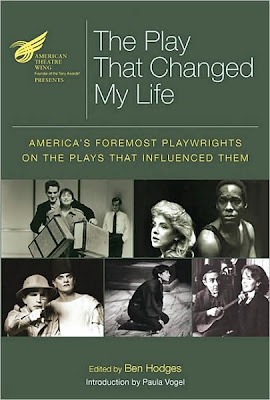
What was the play that changed your life? That’s what the American Theatre Wing asked several contemporary playwrights for its upcoming release of The Play That Changed My Life: America’s Foremost Playwrights on the Plays that Influence Them, which takes a look at that moment in these artist’s lives that turned them on to the theatre. Nineteen playwrights have contributed to the book, which will be released by Applause books this December. The choices may surprise you, as it covers the gamut of David Henry Hwang seeing Equus in San Francisco, to young Edward Albee seeing Jimmy Durante and the star elephant in Rodgers and Hart’s Jumbo at the Hippodrome in 1935 (I personally love the randomness of that one – it just goes to show you never know what sort of theatre experience will be the one that propels a person’s life). The project was the brainchild of the Wing’s Executive Director Howard Sherman and is edited by Ben Hodges (Theatre World), with an introduction by Paula Vogel. I can only hope that this will be the first in a series of volumes (actors, composers/lyricists, directors, designers, producers, etc).

However, The American Theatre Wing is curious to know the play that changed your life. They have announced an online essay contest in conjunction with the book’s release:

“What show had the greatest impact upon you, when you saw it in the course of your life, and most importantly why it meant so much to you. Entries (limited to 350 words) will be judged based on their creativity, their clarity and perhaps most importantly, for how they convey your passion for the theatre.”

So tell ATW about the play that changed your life – those few hours in the theatre, at any age, in any theatre, that had the greatest impact on your life and your perception of theatre — and have the opportunity to share your story with the thousands of visitors to the American Theatre Wing’s website while getting the chance to win an autographed copy of The Play That Changed My Life and other theatrical books from Applause Publishing.

The contest entry period is from Monday, November 2nd until Sunday, November 29th. To enter, visit the American Theatre Wing online. The final expert panel judging the contest includes ATW Board of Directors Chairman and President of the Rodgers & Hammerstein Organization, Ted Chapin; Applause Books’ Editorial Director Carol Flannery; award-winning playwright David Henry Hwang; and former Time Magazine arts editor and divine theatre blogger, Janice Simpson. Additional prizes will be given based on voting by the general public, which will continue through December 11.

In the meanwhile, here’s what two Tony-nominated leading ladies had to say about the theatre experience that forever changed their lives:

Martha Plimpton:

‘I think it was in a strange way kind of a natural progression, you know? My mother was an actress, everyone in our lives were in show business, I grew up in the theatre world in New York, my mother was in the original company of Hair. So it just kind of came naturally, it just kind of evolved. And by the time I was eight years old it was already sort of a foregone conclusion. If we weren’t in the theatre – we went to the theatre constantly. So it just seemed like a normal thing to do with your life. It didn’t seem odd or different or strange or far away at all. I think in the early years of the Park, the Delacorte, there were things that we saw there that made me just sort of mesmerized. I couldn’t tell you the first one, but I do remember seeing Raul Julia in Threepenny Opera at Lincoln Center and thinking, “That’s cool.” And then when I was a little older, I guess about sixteen or seventeen, I saw John Malkovich in Burn This. And that was a performance that made me feel like that was a perfectly legitimate thing to want to be an actor — almost even respectable, possibly.’

Allison Janney:

‘There’s one that comes to mind right now, which for some reason always does, even though there have been many plays I’ve seen that have had a powerful impact on me: my mother took me to see Miss Margarida’s Way with Estelle Parsons and I just remember being blown away by that, by her performance. I was confused by it; I was like, “Is she a real teacher?” I was just giddy with that play and I’ve always sort of had a secret desire to do it, even though I probably wouldn’t be right for it. I just remember that having a big impact on me. I thought it was really fun — I was shocked by it and I think I was just young enough that I just thought she was a crazy woman up on stage and that kind of intrigued me, and I loved that play’

Linda Lavin in "Broadway Bound"

Since the announcement of the cancellation of Neil Simon’s Broadway Bound at the Nederlander, I am sorry audiences won’t get the chance to see Laurie Metcalf dive head first into the play, which garnered a Best Actress in a Play Tony for Linda Lavin in that original 1986 production. Here is a performance of a scene from that year’s Tony Award telecast with Lavin, and that production’s Eugene, Jonathan Silverman.

"Brighton Beach Memoirs" – An Elegy

Watching the family of seven in Brighton Beach Memoirs trip over one another, share dinners, get into squabble and fights and sort through the chaos of daily living made me smile knowingly as I recalled my own childhood. My mother, my father, my three brothers and myself lived together in a house in suburban Westchester, with rampant Irish Catholicism and its trimmings in lieu of Judaism. My father worked as a firefighter and house-painter while my mother tended to the household and make some extra money by babysitting neighborhood kids. Our financial situation was never as dire as the Jerome family, but I think back and wonder how we ever managed to survive together in the house, as I found myself sharing a bedroom with my brothers while six of us sharing two bathrooms. This is never more evident than when all of us reconvene at the family home and we find ourselves near claustrophobic. The chaos of my youth has turned into warm memories of days gone by.

It’s disappointing, but not surprising to discover that The Neil Simon Plays are closing up shop tomorrow after an unfortunately brief run at the Nederlander. Brighton Beach Memoirs and Broadway Bound were to play in rep, with David Cromer making his Broadway directorial debut (and whose Our Town continues at the Barrow Street Theatre). However, ticket sales have been poor; last week’s average ticket price was $21.32. When the show opened to mixed to positive reviews last Sunday night, the writing was all but on the wall.

Originally I had planned to wait to see both shows in marathon, since The Norman Conquests proved that a full day at the theatre is most exhilarating. However, when I started to hear from the rumor mill that Broadway Bound would be canceled, I took the opportunity to see Brighton Beach Memoirs this past Tuesday. Much like my experiences with Coram Boy, The Lieutenant of Inishmore and Souvenir, I find myself looking back on a show that deserved a better fate and a longer run.

Loosely based on Neil Simon’s childhood, the plays are 2/3 of a trilogy (the other being Biloxi Blues) about the growing up of Eugene Jerome, a precocious kid from an impoverished Jewish American family in the Brighton Beach area of Brooklyn who simultaneously dreams of playing for the New York Yankees in the World Series and becoming a writer. The shows opened in the 1980s, where they were some of the longest running plays of the decade (with Brighton running for 1,299 performances) and established Matthew Broderick’s career (for better or for worse) and garnered Linda Lavin a Tony award (for Broadway Bound).

Cromer has directed his ensemble with pinpoint precision, finding great emotional depth in a play that could easily be played for cheap laughs. Showcasing the humanity of its story and its characters, these characters are fully-formed, dimensional and part of an American family, which also happens to be Jewish. Nowhere is this more evident than in the triumphant, ultimately moving performance of Laurie Metcalf as matriarch Kate who runs her harried household with tough love and a consistently stern exterior. However, it is in the nuance and specificity of Metcalf’s choices that make her a stand-out among the ensemble. There is a particularly striking moment as she descends the staircase while having a breakdown, leading into the first major argument she’s ever had with her sister. Her obvious one-liners and zingers come from a place of deep emotional resonance. Nazism is rapidly expanding in Europe, talk of war becomes more and more prevalent and all the while, she is left to make sure that a family of seven is sheltered and fed. Kate Jerome is a woman who is moving forward with the weight of the world on her shoulders. I only hope that the Tony nominating committee will remember her performance come June.

If Metcalf’s Kate is the rock upon which her family is built her performance is beautifully complemented by Dennis Boutsikaris as her husband Jack, the heart of the household. Jessica Hecht is virtually inrecognizable as Kate’s widow-turned-wallflower sister who lives with them and gradually finds the strength to become an effectual mother to her young daughters (Grace Bea Lawrence and Alexandra Socha). Santino Fontana is winning and winsome as Kate’s eldest son Stanley, who means well but often lands himself in trouble.

Then there is Noah Robbins. The young actor is nineteen years old and making his professional acting debut, let alone first appearance on Broadway. As the alter ego for the playwright, his character guides the evening as an observational narrator, a testament to the uncanny writing ability that he and other family members espouse. (And by extension, Mr. Simon himself). It was especially touching to see his wisecracks and commentary rounded out by his coming of age, and the metaphoric end of his childhood. With the show’s closing, I only wish him the best of luck as he embarks on what could be a most promising acting career.

It is disheartening for the show to fold so prematurely. The plays that are attracting the stars these days tend to be anything with major movie stars. It’s unfair that the show should suffer the stigma of a 9 performance run, but that is unfortunately part of the unpredictable nature of show business. It just seems as though there wasn’t great audience interest in these seminal Neil Simon works. Cromer is establishing himself as a director of merit in the New York scene, and his work here is consistent, compelling and often moving. One of the things I was most impressed was how he and his actors found a way to tell a nostalgic story without getting lost in a sea of diabetes-inducing sentimentality.

After the curtain call of Brighton Beach Memoirs, I turned to Noah and commented how much I was looking forward to seeing the second play. I feel for the entire ensemble, particularly Mr. Robbins and his Broadway Bound counterpart Josh Grisetti, a fresh-faced off-Broadway up and comer who won a Theatre World Award for last season’s Enter Laughing. One made an auspicious Broadway debut, and the other was poised to do the same. Beg, borrow or steal to get a ticket to see this one before it closes tomorrow afternoon – you won’t want to have missed it.

The question has been brought up whether or not Mr. Simon is still relevant to Broadway audiences, as his works have been met with indifference in recent years. I think it’s still to early to write him off just yet – he’ll be represented this spring at the Broadway Theatre with the revival of Promises, Promises, for which he wrote the libretto.
Marilyn Horne: "C is for Cookie"

Over on Twitter, SarahB posted a clip of Renee Fleming on Sesame Street performing a version of “Caro Nome” that used opera to teach children how to count. Jim Henson’s shows were rather extraordinary in how they introduced children to all sorts of eclectic performers, especially those from the worlds of opera and Broadway. The show is remarkable in its intelligence and incorporation of music and art in educating children.

I watched Sesame Street when I was really young, but would found myself watching it again when I was a little older and my mother took to babysitting younger neighborhood kids after school. One thing I remember quite vividly was how amused we were by Marilyn Horne’s rendition of that perennial favorite, “C is for Cookie”:

"Finian’s Rainbow" Shines on Broadway

The powers that be behind the Roundabout revival of Bye Bye Birdie, the new textbook example of how not to revive a second-tier Golden Age property, should look to the St. James Theatre to learn a thing or two. The seemingly unrevivable Finian’s Rainbow has made its way back to Broadway in a loving, vibrant production that illustrates the enchanting wit and charm that made the show a resounding success in its original production.

The musical, last seen on Broadway in 1960, has had something of a problem in receiving a full-scale revival. The libretto by Fred Saidy and lyricist Yip Harburg is generally considered the deal-breaker in resuscitating the show. While it combines elements of fantasy and whimsy with a satiric look at racial bigotry and capitalism, the book has long been considered dated, and rightly so. It is dated. Finian’s Rainbow was a period satire written in 1947 that surprised audiences with its storyline, which included a white racist senator being transformed onstage into a black man, with the use of black face. The stage trick worked for a 1940s audience, but would prove disconcerting to our more racially aware society. There’s also a leprechaun turning mortal while looking for a stolen pot of gold, a mute who communicates solely through dance, among other hijinks.

The Encores! presentation brought in resident script doctor David Ives to condense the problematic book, but in doing so left much to be desired as too much of the story was stripped away. A brand new adaptation has been arranged for the Broadway transfer, executed by Arthur Perlman which is a considerable improvement. While it doesn’t completely smooth out the script’s roughest edges, it manages to make them somewhat more palatable. (And I do love the exchange between Finian and Og involving popular musical theatre lyrics of the time).

Kate Baldwin is effervescent as Sharon McLonergan, a feisty colleen finding herself transplanted from her native Ireland to Rainbow Valley, Missitucky on her father’s whim. Sharon’s first song of the evening is the popular “How Are Things in Glocca Mora?” and Baldwin’s simple, lucid interpretation is the most spellbinding I’ve ever heard. Cheyenne Jackson is her paramour Woody, the town’s hero, who cuts a dashing figure and sings well, but is, dare I say it, wooden. Jim Norton ties together the entire production as Finian McLonergan, who incites chaos by stealing a pot of gold from a leprechaun in one of the more outrageous get-rich quick schemes known to drama. With a twinkle in his eye, and a skip in his gait, Norton appears to be having the time of his life.

There has been some recasting of roles since the Encores concert. Christopher Fitzgerald brings considerable comic charm and impishness to the leprechaun Og, and is a versatile improvement over his predecessor. David Schramm (Roy from Wings) plays Senator Rawkins with a vivacity reminiscent of the late Burl Ives, while his counterpart Chuck Cooper has a field day with the second act number “The Begat.” (It boggles my mind that no one ever thought of double casting the part before). Audience favorite Terri White belts out the rafter-shaking “Necessity,” repeating her duties from the Encores concert. However, one major difference – her performance on Broadway (as written and staged) was more of a genuine supporting turn rather than the glorified cameo it was at Encores.

Warren Carlyle’s staging and choreography are full and energetic, with “If This Isn’t Love” practically stopping the show. His earlier work from the Encores! production has been expanded and adds a certain clarity to what is essentially a convoluted story. He has the light touch necessary to bring his cast of 30 above and beyond what is normally expected from this show, and it would be interesting to see his work on top tier Golden Age material. (I wonder if he might be the man for Carnival!). The costume and lighting design are sumptuous, however, the set design by John Lee Beatty is surprisingly unattractive. There is a lovely patchwork show curtain, but the unit set is a gaudy extension of the Encores set up, which is unfortunate since the orchestra was moved to the pit.

As it was at Encores, the real star of the evening is the music of Burton Lane and lyrics of Yip Harburg. Harburg was known especially for his word play, and his tongue in cheek playfulness with the English language is complemented by Lane’s sophisticated use of melody. I dare you to leave Finian’s without one at least one of those songs running through your head. I’ve always admired its score. Harburg’s lyrics are always superlative (even his work in the flop Darling of the Day is better than most contemporary successes) and Lane is one of our most underrated composers (I enjoy On a Clear Day and even Carmelina). The score is one superb musical delight after another.

I should confess, I was never a big fan of Finian’s Rainbow. It’s story and script have left me rather cold over the years, and that certainly wasn’t helped by the tepid film adaptation or Ella Logan’s bizarre idiosyncratic performance as Sharon on the original cast album (one of the rare occurences where I prefer a revival album to the original). However, the vivacity of this production has made me reassess my opinion of the entire show, as I find myself hoping to make a return visit.

When the show played the City Center last March, I still wasn’t entirely convinced that it was worthy of a Broadway run. (The only Encores! I’ve ever felt was ready for Broadway was the superlative No No Nanette from 2008). However, in bringing Finian’s Rainbow to the St. James, much care has gone into making it a fully realized evening, and one with warmth to spare. For whatever quibbles there are with the script, the polish and poise in Carlyle’s production is enough to keep you smiling long after you’ve gone home looking for your own rainbow.

"Like rearranging the deck chairs on the Titanic…"

Whole songs and chunks of dialogue disappeared and new material had to be learned. Sets and costumes changed. “It was Dunkerque,” recalls [Patricia] Routledge. “I never knew how I would get to the end of the show. Sometimes I didn’t know which way I was facing.” Adds [Ken] Howard: “I couldn’t sleep or eat. I found it hard to focus my mind on what I was doing onstage. I became a zombie, an automaton.” But, says Howard, the endless changes that were made in the show were only “like rearranging the deck chairs on the Titanic.”

– The two stars of 1600 Pennsylvania Avenue on the chaos of the experience in an informative article documenting the show’s failure from the May 31, 1976 edition of Time Magazine.

Quote of the Day: Dee Hoty Edition

What musicals should be revived soon on Broadway? 1600 Pennsylvania Avenue, Rex and, yes, Whorehouse Goes Public, in rep with the first Whorehouse. THAT would be swell. Like the Chicago rediscovery, I believe someone will put that show up & really nail it.

From her Playbill Cue & A feature. Don’t agree so much on the Whorehouse Goes Public, but clearly classy Dee Hoty has some estimable taste. Perhaps she’d want to play the First Ladies? This also leads me to wonder… did she also see the original Broadway production…?