On the Town: April Edition

First off, some good news. The Drama Desk Awards committee has decided to reinstate the award for Outstanding Orchestrations, nominating Bill Elliott (Nice Work If You Can Get It), Larry Hochman (Death Takes a Holiday), Martin Lowe (Once), John McDaniel (Bonnie & Clyde), Michael Starobin (Queen of the Mist), and Danny Troob (Newsies). There was a considerable uproar from practically the entire Broadway community as well as theatre fans, with a grassroots campaign to try to rectify the situation. Blogs from Mr. Starobin and Jason Robert Brown went viral, Drama Desk president Isa Goldberg’s inbox was flooded with emails, and an online petition garnered over 3000 signatures, including many of Broadway’s best and brightest. I am relieved to see that all this action had a positive impact, and am glad to see the award reinstated. Congratulations to all the nominees, and all orchestrators, period.

Encores! presented Rodgers and Hammerstein’s Pipe Dream, an unusual failure based on the Steinbeck novel Cannery Row. While there are some lovely tunes in the score (and some gorgeous Robert Russell Bennett orchestrations), there is almost no musical there. Something about bums and prostitutes on the California coast living near each other.  The central conflict between the two would be lovers (a scientist who lives by the sea and a failed prostitute…I think) is that they are two stubborn to admit they love each other. The rest involves colorful characters, including a warm Madam, some bums and a character named Joe the Mexican. I doubt we’ll ever see this show staged again, so it was interesting to hear it at City Center. Will Chase and Laura Osnes played the lovers. Both sang well, but there wasn’t much for them to play. Stephen Wallem and Tom Wopat provided some amusement. The evening belonged to Leslie Uggams, who brought that big voice and charm to the proceedings. Her understated performance of “All At Once You Love Her” brought down the house. I was in hysterics during the last ten minutes, as everything suddenly rushed to the finale. There may have been a musical in Steinbeck’s novel, but it certainly wasn’t for R&H. A live cast album will be released by Ghostlight this summer. This excites me, as this might make it more financially feasible for other Encores! shows to be recorded.

Apparently I did the impossible: I won The Book of Mormon lottery. I was down in the city filming the Leap of Faith video for Patty and Emily, and decided to try. The girls were seeing a different show that night so they offered to help. My pal Russ Dembin joined us, as well. I was delighted and surprised to hear my name called. I entered not expecting to win, but rather to just get an entry in for the upcoming fan performance in June. One thing I’ll never forget is the look on the Lotto Guy’s face as he called my name and as I went to perk up, Patty and Emily started shaking their tambourines. It was the first and only time I’d seen him nonplussed this afternoon. Anyway, I made my way forward, and from the way everyone working the lottery and box office treated me, you’d have thought I just had my first child. I can honestly say I’ve never had a nicer time on line to buy tickets. This marked my first time seeing the hit musical, and my second time playing The Book of Mormon lottery.

Since it’s almost impossible to get into the show, I made the conscious choice a year ago not to listen to the original cast album. While hearing the score hadn’t impeded my enjoyment of, say, Urinetown or Avenue Q, I decided that I wanted to go in fresh. The only thing I knew was the translation of the phrase “Hasa Diga Eebowai” and the song “I Believe” from the Tony telecast. Most of the original cast is still in the show, and are likely staying put for a while. Andrew Rannells will likely never have a better role in his career, at least one that displays his considerable talents so effectively. Jared Gertner was on for Josh Gad, but considering how funny Gertner is it didn’t detract from the experience. When I wasn’t laughing, I was smiling one of those silly, ear-to-ear types, just basking in the joy emanating from the stage. And I just wanted to hug the Tony-winning Nikki M. James, she anchors the show with so much sincerity and heart.

The show is expertly crafted with great tunes and winning characters. Hats off to the writers for crafting an exceptional book, building the show to a gut-bustingly hilarious payoff in (“Joseph Smith American Moses” sent me to another plane entirely). Profane, for sure, but with a rather wonderful message. I’ve made up for lost time with the cast album in the days since, finding my appreciation and laughs growing with each subsequent listen. One of the cool things about being a lottery winner: I was sitting front row dead center, right behind musical director/conductor Stephen Oremus, whose conducting is a show in itself.

On the opening night front, there were something like 12,000 opening nights on Broadway this month. An exaggeration, but as sure hell felt like it. I attended one of them: One Man, Two Guvnors, the hardest I’ve laughed at a show since, well, The Book of Mormon. James Corden stars as the charmingly corpulent harlequin in this delicious update of an ancient commedia dell’arte imported from London with its original cast intact. (A band, The Craze which provides the skiffle music heard before and during the show is made up of American performers). Mixing the low comedy with improvised bits and audience participation, the show is nothing less than an all-out riot. Corden dominates the evening, but he is supported by a brilliant ensemble. Special mention to Daniel Rigby, Oliver Chris and especially Tom Edden for inspired bits of hilarity. I won’t say more, as I don’t want to spoil the fun. Just know that by intermission, my sides ached from laughter and I want to go back again and again. Also, you’re going to want the original London cast album. Trust me.

Now. Here. This. has since closed, but I’m glad I got a chance to see the new show from the [title of show] team at the Vineyard. Jeff, Heidi, Susan and Hunter were back and in glowing adorkable form as they shared personal memories, from hilarious to embarrassing to devastating. I can’t say the new show is an instant classic like their first Tony-nominated outing, but it was a joy to see all four performers together again and hear them sing and dance and quirk up a storm. I was especially moved by the segment about grandmothers, having a reaction similar to that at Love, Loss and What I Wore – their memories unlocked my own. I hope they all continue to give us more to see over the years. The quartet exudes such good will, that it is hard for me not to cheer them on. I hope a cast album is forthcoming. (You heard me, Ghostlight).

Tomorrow comes the Tony nominations and all the insanity that awards season brings. Good news: Hugh Jackman is getting a special Tony Award. I don’t know why these awards bodies decide on whims to delete important categories, especially the still-defunct Special Theatrical Event category that the Tonys had for a mere ten years. Since Mr. Jackman is ineligible to be considered in any category, and has done so much for the Broadway community, it is nice to see him so honored. More good news: Bernadette Peters is deservedly receiving the Isabelle Stevenson Award for all the charity work she has done on behalf of Broadway Barks and BC/EFA. I look forward to both acceptance speeches. (And for God’s sake, let them perform!)
“Leap of Faith”

In a nutshell, the new musical Leap of Faith is ultimately The Music Man meets 110 in the Shade in a revival tent. The show is not quite the train wreck that word of mouth might have you believe, as there are a many good things on stage (namely the exceptional cast). However, by journey’s end I was left feeling that something was missing. It’s more disappointing to me that with all that talent on stage and off Leap of Faith isn’t a more tremendous experience. I have never seen the 1992 Steve Martin film on which the show is based, but that’s neither here nor there. A shyster evangelist finds himself stranded in a town and sets to work conning the folks suffering for lack of rain. One woman in the town (here also the sheriff) has doubts, as well as a paralyzed son. On the third day, things come to a head.

The show is anchored by its dynamic leading man, Raul Esparza, who carried the evening on his shoulders. Jonas Nightingale, the cynical shyster evangelist is a tough-sell anti-hero but Esparza is more than game, creating in a memorable and energetic star turn. Jessica Phillips has beauty and heart, as well as a lovely voice as Marla, the Town Sheriff and Jonas’ love interest. The divine Kecia Lewis-Evans is so good and sings so thrillingly as Ida Mae, I want to see her above the title in her own Broadway show. Leslie Odom Jr and Krystal Joy Brown bring remarkable voice and presence as her children, often leading the spirited ensemble pieces. Rounding out the principal cast are Kendra Kassebaum and Talon Ackerman, who aren’t given much in the way of songs or fully realized characters.

Alan Menken, now with three shows running currently on Broadway, wrote the music while Glenn Slater wrote the lyrics. Mr. Menken has a field day with the gospel infused revival numbers (especially anything that Lewis-Evans sings) but the show has so many of them that they begin to run together.  Some of the lyrics, such as the lead-in verse to “People Like Us,” are just awful. Mr. Slater’s other lyrics may not be as terrible, but they build on cliches and lack imagination. The unimaginatively titled “Jonas’ Soliloquy” allows Esparza to really sock home the eleven o’clock spot, but the song lacks the distinction that makes other such powerhouse moments (eg. “Rose’s Turn” or “Lot’s Wife”) so indelible.

Robin Wagner’s scenery is disappointingly realistic and unimaginative (nothing says “Broadway musical” like a gas station) while William Ivey Long has come up with some eye-popping choir robes for the Angels of Mercy, as well as Jonas’ mirror jacket. The book, by Janus Cercone (also the film’s screenwriter) and Warren Leight, doesn’t quite know what to make of itself. The structure smacks of desperation; the conceit of setting the musical at the St. James feels rushed and uncertain. So much of what is written feels like tired tropes, both in plot and character. I don’t know if the show can be saved, but I think the authors should continue to work on it as they have the potential for an even better show to take out on tour. Or perhaps, this is one for the Times Square Church.

An Open Letter to the Drama Desk Awards

To Whom It May Concern,

Four years ago, a beautiful production of Rodgers and Hammerstein’s South Pacific opened at the Vivian Beaumont to acclaim and plaudits all around. One of Lincoln Center’s boasts was the full size orchestra in the pit.  The first of many thrilling moments came about one minute into the show’s overture. During a thrilling swell of the “Bali Ha’i” motif, the Beaumont stage retracted to display 30 musicians. I was fortunate enough to be at the opening night of this production, and witnessed for myself the cheers and tears (my own included) from an appreciative house. As the final notes played, the audience roared their overwhelming approval. While the melodies are the creation of Richard Rodgers, the man ultimately responsible for this stirring overture was the brilliant orchestrator Robert Russell Bennett.

It was brought to my attention earlier today by Drama Desk-winning orchestrator and arranger Stephen Oremus via Twitter that the Drama Desk committee has unceremoniously dropped the Best Orchestrations Award from this year’s honors. I can’t help but express my great displeasure at this decision. No official reason was given, and I can understand that, because there is no discernible excuse for this short-sighted and disrespectful snub.

I admire orchestrations. I admire orchestras. I love hearing how a melody is colored by instrumental arrangement, whether it be the romantic sweep of South Pacific or, say, the buoyant percussiveness of Irma La Douce or the big brassy “Broadway” sound of Mame. There is craft and artistry involved here. A composer doesn’t just hand a song to the conductor and the musicians can just magically play it. That might be the sort of thing that passes muster in ancient movie musicals, but the reality is that a song goes through a considerable gestation between the composer’s pen and the orchestra pit (with a nod to vocal and dance arrangers as well; other unsung heroes).

Orchestrators must understand the size, the scope, the intent and the economy involved in building a show from the ground up. Some composers know precisely how they want their show to sound, and may even be gifted in orchestrating themselves, and some may not know a quarter note from a hole in the ground. Orchestrator Hans Spialek likened the task to painting: “with the exception that in musical theatre one man (the composer) furnishes a sketch from which another man (the arranger) paints the musical picture the audience actually hears.” It is rare that a composer does his or her own orchestrations. Arranging a score for an orchestra is hard work, it is time-consuming and a composer generally must be free to revise and write new songs as a show develops.

While I have had varied reactions to the musicals of this season, I didn’t have any complaints with the orchestrators. I’ve heard work by the likes of John McDaniel, Larry Hochman, Doug Besterman, Michael Starobin, Martin Lowe, and Bill Elliott, among many others. We have seen show orchestras get smaller and smaller. More and more, it seems that musicians are hidden offstage or in another room (or building) entirely. Many of these orchestrators are forced to make less sound like more, itself a marvel of invention and craft. I can’t help but feel that this snub is just another step in the marginalization of live music in musical theatre.

Orchestrators are artists. They deserve the recognition and respect they have earned through their hard work. I do hope you reconsider this egregious decision.

Sincerely,

Kevin D. Daly
Theatre Aficionado at Large

PS: Every one of you would benefit from reading Steven Suskin’s essential The Sound of Broadway Music, a meticulously researched and informative book on musical theatre orchestration.

“The Sound of Music” – Carnegie Hall

Carnegie Hall presented the Rodgers and Hammerstein classic The Sound of Music on Tuesday evening as a gala fundraiser for the venue. In previous years, the Hall has presented similar concerts of Carousel and South Pacific. While this evening’s presentation of the score was not as memorable as those two previous outings (that Carousel wasn’t recorded is simply a crime – it was a dazzling success), it was a pleasure hearing those gorgeous songs performed live with the Orchestra of St. Luke’s.

Inspired by actual events, The Sound of Music was originally a stage vehicle for Mary Martin and later a blockbuster film starring Julie Andrews. It tells the story of a young postulant who becomes governess to seven children under the stern command of their Naval officer father. Throw in some feisty nuns and some evil Nazis and you’ve got the ingredients for a spectacular audience favorite.

The orchestrations in the program are credited solely to Robert Russell Bennett, but there were several pieces that sounded like Irwin Kostal’s arrangements for the film, including main title which was used as an overture for the evening (the stage show begins promptly with the haunting “Preludium”), “Do-Re-Mi” and the lower key version of “Climb Ev’ry Mountain.” I was pleasantly surprised to see the score presented in its original 1959 order. Maria and the Mother Abbess shared “My Favorite Things” in the Abbey, while Maria sang “The Lonely Goatherd” during the thunderstorm, etc. For the concert, “I Have Confidence” was added and “Something Good” replaced “An Ordinary Couple.”

Laura Osnes made for a sweet if somewhat bland Maria, singing well but without the spark that has made others so indelible in the role. Tony Goldwyn was a vocally weak and colorless Captain. Met Opera mezzo and fan favorite Stephanie Blythe gave the evening’s master class in singing, with a stirring rendition of “Climb Ev’ry Mountain.” Brooke Shields couldn’t quite handle the vocal demands of Elsa, but carried herself with grace and glamour, earning exit applause. (Fans of the film may be surprised how much more politicized and nicer the character is on stage). Patrick Page practically purred his way through Max’s lines. Veanne Cox, Cotter Smith and Reed Birney were on hand for smaller roles, while Daniel Truhitte, Nicholas Hammand, Kym Karath and Heather Menzies (of the film) made brief cameos. Special mention to the Women of the Mansfield University Concert Choir, who supplied breathtaking renditions of the liturgical music in the show.

Gary Griffin staged the concert (performed completely off-book), but while the evening was well-paced, the energy was inconsistent. David Ives provided the concert adaptation of Howard Lindsay and Russel Crouse’s original book, which didn’t make much of a case for a full-fledged revival. Joshua Bergasse provided the small amounts of choreography seen throughout the evening, most notably the “Laendler.” A misstep was using projections of Austrian pictures and site specific locales from the film against the back wall of the Stern Auditorium’s stage. These pictures, presented in a sort of widescreen panorama distracted from the performers. The cast wore concert attire that suggested at character; the only dirndls to be found were those audience devotees who dressed up.

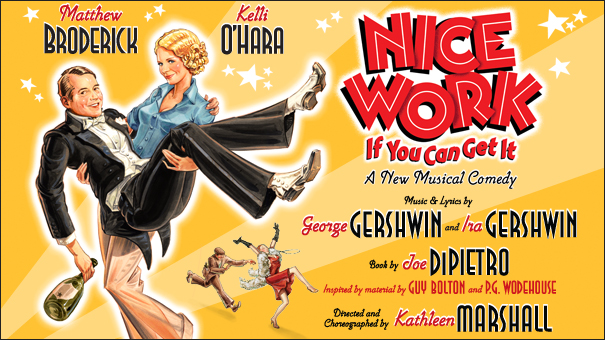
“Nice Work If You Can Get It”

 605x340_2

Nice Work If You Can Get It isn’t particularly groundbreaking and it feels like the sort of show you’ve seen time and again (fans of My One and Only and Crazy for You will probably agree), but the new musical (a loose overhaul of the 1926 musical Oh, Kay! with a new plot and characters) for all its old-fashioned sensibilities, is much to my surprise, delightful. One of those fizzy champagne (or in this case, gin), check-your-brain-at-the-door comedies with gorgeous costumes, scenery and (most especially) songs.

The book (by Joe DiPietro) is chock full of 20s silliness. The plot is negligible; something about bootleggers hiding their stash at a ritzy 47 room Long Island mansion. Farcical complications ensue with lots of colorful characters along the way. Like those period shows, the scenes are a breezy set-up for one knock-out song after another. In this instance, they are the songs of George and Ira Gershwin (with one DeSylva lyric tossed in for good measure) and the evening becomes a daffy trip through the American songbook, with 20 or so of their tunes represented.

Matthew Broderick is playing the milquetoast millionaire playboy at the center of the story. The star has a certain stiffness and drollness that at first struck me as odd, but I soon warmed to the performance. Mr. Broderick has a meager singing voice which works well with the period, while his dancing leaves something to be desired. Surprisingly, I rather enjoyed him (and faithful readers will recall the last time I saw him on stage). Kelli O’Hara plays the gorgeous tomboy Billie, who gets to sing “Someone to Watch Over Me” (with a subversive twist) and “But Not for Me.” While the role has Sutton Foster written all over it, Ms. O’Hara is a gem. I particularly enjoyed her disastrous attempt at seduction “Treat Me Rough” and her masquerade as a Cockney maid (Which reminds me: Ms. O’Hara’s next Broadway outing should be My Fair Lady, not the Lincoln Center production of The King and I). I also enjoyed seeing her and Broderick recall 30s musicals with an extended dance all over the set in “S’Wonderful.”

Estelle Parsons makes an eleventh-hour appearance as Broderick’s deus ex machina Mother, in a brief but winning cameo. Jennifer Laura Thompson makes vapidity irresistible, particularly in her clever bubble bath production number “Delishious.” Michael McGrath scores big laughs as the bootlegger turned butler, while the always-reliable Stanley Wayne Mathis plays a genial police officer. Robyn Hurder and Chris Sullivan are on hand as a comic couple with a combined IQ of 45. While the twosome are funny, their duet of “Blah, Blah, Blah” is unnecessary. The scene-stealer of the night is Judy Kaye. The Tony-winning soprano plays the Duchess Estonia Dulworth, a temperance-pushing battle-axe who sets speakeasies on fire in the first act, and swings drunkenly from a chandelier in the second (in the evening’s funniest scene and biggest showstopper).

Derek McLane’s sets and Martin Pakledinaz’s costumes are the best kind of eye candy. Bill Elliot’s orchestrations are the best I’ve heard in quite some time  and are very much of the period and a joy to hear. If a cast album is recorded – and one should be – I hope they record the exit music. David Chase has supplied some glorious vocal arrangements. Kathleen Marshall directed and choreographed, her musical staging very much in vogue with the period (and not a tap shoe in sight). There are no big production numbers like Anything Goes or Crazy For You, but her best work is in the smaller, more intimate pieces.

While not as dazzling as the Encores! No, No, Nanette (still the best production of a 20s/30s musical comedy I’ve ever seen), there was enough crowd-pleasing charm and style in Nice Work If You Can Get It to keep me smiling from start to finish.

At Large Elsewhere: The “Leap of Faith” Unofficial Street Team Edition

April has been an incredibly busy month for me, but Patty and Emily asked if I would help them out with another video for their website and I dropped everything for the opportunity to work with them again. (I was a tourist on their Newsies walking tour about a month or so ago). This is the latest entry in their new series “Unofficial Street Team,” in which the girls become ebullient if somewhat overzealous champions for their favorite shows. In this latest entry, I play high-strung Jujamcyn executive Jacob Cohen who needs to correct some misinformation the girls are giving out about Leap of Faith.

%CODE1%

“Clybourne Park”

The Pulitzer and Olivier winning new play Clybourne Park now finds itself on Broadway for a sixteen week engagement at the Walter Kerr. Taking his cue from Lorraine Hansberry’s A Raisin in the Sun, playwright Bruce Norris explores racial attitudes in America before and after the Younger family inhabit the house on Clybourne Street.

The first act is set in 1959, and depicts the residents of the neighborhood trying to convince the departing couple from selling their home to a black family (the Youngers of Raisin in the Sun). The second act moves the action forward 50 years, with a tacky white liberal couple moving into the now predominantly black neighborhood. The structure reminded me of Norman Lear’s  classic All in the Family and its forgotten short-lived 90s follow-up 704 Hauser, a sitcom which found a liberal African-American couple living at Archie Bunker’s home.

The ensemble is quite strong, especially Christina Kirk, Annie Parisse, Jeremy Shamos, and Frank Wood. Pam McKinnon’s staging is exceptionally sharp, mining the nuance and humor for all she can. Special mention, too, to Daniel Ostling’s excellent set (which undergoes an exceptional transition during intermission).

Though entertaining and thoughtful, Norris’ play isn’t as devastatingly funny or cutting as it either wants to be or should be. There are some great moments and a series of intentionally shocking racist jokes in the second act, but I couldn’t help feel that the play fell short. Don’t get me wrong, issues regarding racism in a “post-racial” America must be addressed, but Clybourne Park feels more like an assignment for a dramatic writing class than a fully realized play.

“The Mikado” – Collegiate Chorale

The Collegiate Chorale offered a starry and exceptionally well-sung concert staging of The Mikado at Carnegie Hall on April 10 under the direction and baton of Ted Sperling. This marked my first time seeing the classic Gilbert and Sullivan operetta, though I am familiar with some of the more famous songs (and am a fan of Mike Leigh’s essential Topsy-Turvy, which details the fascinating gestation of the original production).

The Mikado is set in Japan, but in reality the characters and situations are a direct send up of mid 19th century England. The silliness of the show, its delightfully flippant point of view on death and execution and farce make for a pleasant evening. The concert staging doesn’t lend itself well to the comic nature of the libretto, so the opening was a bit slow. But after a bit, everything clicked and the audience was treated to an engaging comic romp.

Kelli O’Hara and Jason Danieley were in top form as Yum-Yum and Nanki-Poo. O’Hara held the audience rapt with her gorgeous rendition of “The Sun Whose Rays” Chuck Cooper was a well-sung Mikado, while Steve Rosen added some laughs as “Pish-Tush.” Jonathan Freeman was delightfully droll as Poo-Bah. Amy Justman and Lauren Worsham added stellar support, especially when they joined O’Hara for a spirited rendition of the famous “Three Little Girls.”

However, the evening belonged to Christoper Fitzgerald and Victoria Clark. As Koko and Katisha, they all but leveled the house with the climactic “There is Beauty in the Bellow of the Blast,” capping off an evening of mass hysteria from the two actors. Fitzgerald sang an updated version of the famed “A Little List, with references to tweeting, Kardashians and Newt Gingrich. This ruffled the feathers of a few purists who grumbled about it during intermission (and incidentally were also added to the list), but in spite of their misery, it was highly entertaining. He later scored major laughs with “Tit-Willow.” Clark entered like a harridan, with garish makeup, tussled hair held back from her eyes with chopsticks, and walked away with the show in her pocket. Her entrance was such a surprising contrast to the stately concert attire, she stopped the show before she even opened her mouth. Then she opened her mouth and proceeded to steal every single scene she was in.

The only unfortunate aspect of the night: that the Collegiate Chorale didn’t record this wonderful concert, with its illustrious chorus. It deserves to be heard again.

“Sweeney Todd” – West End

Sweeney Todd 2012

There is a revival of Sweeney Todd currently playing London’s West End. If that news alone isn’t enough to get you on the first plane to England, let me explain further: there is a astounding revival of Stephen Sondheim & Hugh Wheeler’s epic Grand Guignol musical currently playing the Adelphi Theatre starring Michael Ball and Imelda Staunton.

Sweeney Todd is in my top three shows of all time; and I’m excited to see any production. And if I could, I would get on the next plane back to London to see this Jonathan Kent directed production again. Dark, unnerving and anchored by two strong central performances, this is a West End revival not to be missed, and a transfer to Broadway should be a no-brainer. The 1979 musical, considered by many (including yours truly), to be Sondheim’s masterpiece tells the story of a vengeful barber who transforms into a blood-thirsty killer, along with his enterprising accomplice and lover, Mrs. Lovett.

Ball is virtually unrecognizable as the deadly barber, both physically and vocally. In fact when he made his first appearance I wasn’t sure whether or not I was seeing an understudy. Admittedly, he wasn’t the draw for me to see the show and my expectations were low but I was more than surprised: Ball is astonishingly good. In the first scenes, we see the “bleeding nobody” brooding with rage, making his mental snap at the end of the first act quite chilling. His “Epiphany” was so intense that for the first time I wasn’t so sure if Mrs. Lovett was going to live to the end of the first act.

Peter Polycarpou plays the Beadle as a social climbing kiss-up rather than some bizarro creep. Peter Howe offers an unsettling portrait of warped piety and deviant sexuality as the Judge. James McConville is absolutely devastating as Toby. Gillian Kirkpatrick scores big as the Beggar Woman. Less effective are Lucy May Barker (think about the name) and Luke Brady as Johanna and Anthony, with lackluster renditions of “Green Finch and Linnet Bird” and “Johanna.”

However, for as good as Ball is in the title role, it is Imelda Staunton who makes this production a must-see. I knew we were in for something different when Staunton whipped out a dirty, empty glass bottle to use as a rolling pin in “The Worst Pies in London.” Her Lovett is unlike any other I’ve ever seen, more naturalistic and pragmatic. She didn’t play up the more comic aspects of the character, but still managed to be funny and find laughs in the most unexpected places. I know the show by heart, and Staunton kept surprising me right to the very end; a performance so indelible I can vividly replay it in my mind. Moments come to mind: her reaction to opening the trunk (which made a delighted audience applaud), the terror on her face during “Epiphany,” the chilling look on her face at the end of “Not While I’m Around,” and the master class of her final scene.

The dynamic between Staunton and Ball was extraordinary, with their scenes together the most memorable. Charged with sexual energy, their showstopping rendition of “A Little Priest” was less music hall romp than full out foreplay. This chemistry makes the finale all the more tragic. When the orchestra played the final chord, I sat there in awe for a good beat before bursting into euphoric applause.

Director Jonathan Kent has set this Sweeney in the 1930s. I’m not sure that the change in time period really adds anything to the piece, but it definitely doesn’t detract. The staging is much more traditional than John Doyle’s recent revival, but I knew as the opening “Ballad” was sung among the characters to each other as working class workplace gossip around London, that we were in for an stellar evening. His production is dark, stark and deliciously violent. Anthony Ward’s set is appropriate dark and eerie, and places the famed factory whistle right on stage. Ward’s costumes evoke the dirt and grime of a seedier side of Fleet Street, and serving the director’s vision quite well.

This production is billed as a strictly limited season, running six months through September 10th. It must be seen to be believed.

A cast album was recorded before performances start and was released in the theatre at or around opening night. Since it wasn’t available anyplace else, I made it a point before seeing the show to pick up a copy. It’s an impressive account of the production, specifically preserving many of Staunton’s finest moments – both spoken and sung. The recording sounds incredible, with some of the show’s sound effects audible (particular the furnace crackling in the final scene, and some truly hair-raising throat slittings). The major flaw is that for some reason the album is one disc. That’s unfortunate, but it doesn’t prevent the album from being a must-have.