“High”

Matthew Lombardo’s new play High closes today after only 8 performances, despite the megawatt presence of star Kathleen Turner. The concept is fascinating. A “been there, done that” addiction counseling nun with the mouth of a sailor tackling the case of a teenage meth addicted male prostitute. Adding to the complications is the priest, whose ulterior motives become clearer as the play progresses. However, the resulting play isn’t as fascinating, failing to offer the insight and nuance one would hope for. However, in spite of its shortcomings, High remains compulsively watchable.

Turner – in her first Broadway outing since her triumphant Martha in Who’s Afraid of Virginia Woolf? – is Sister Jamison, a takes-no-guff nun unlike any I’ve ever known in my life (and I was brought up in Catholic school). Ms. Turner commands the stage with every fiber of her being, coolly decked out in lay clothes that make her look like a Chase Bank teller. She’s a recovering alcoholic who harbors some deep seated regrets that inform the plays ideas of redemption and forgiveness. Turner rises above the banal dialogue and weak jokes to create an intriguing portrait of a most unlikely nun. She’s a fountain of energy and while perhaps a bit too theatrical at times, the Tony-nominated star is never short of fascinating.

Her scenes partners are Stephen Kunken as Fr. Michael, her superior and newcomer Evan Jonigkeit who plays an exceptionally troubled young addict named Cody. There are ulterior motives involved – including all-too-convenient revelations (the priest is the addict’s long lost uncle). Kunken, whose character is the most understated of the three, anchors the play and serves as the catalyst for much of the action, butting heads with Sister Jami, but also covering up her falls off the wagon. Kunken gives Fr. Michael a profound sense of dignity and moral obligation, which leads him – an experienced head of a substance abuse center – to bend and break rules and ultimately enable his nephew’s addiction.

Mr. Jonigkeit has given an exceptional debut performance as Cody, for whom the deck has been stacked: unwanted by his addict prostitute mother, raped by and pimped out by her boyfriend, beaten, abused and emotionally neglected. While his performance early in the first act was pitched too high, Jonigkeit eventually walked away with the show with his riveting portrait of an addict. He simultaneously demands the audience’s sympathy and revulsion. There was a particularly terrifying scene at the end of the first act where a high Cody removes his clothes and sexually assaults Sr. Jamison. I think the nudity was a bit gratuitous, but the intent behind the scene was chilling. (It was a relief to me when she overpowered him and body slammed him). In spite of the show’s failure, I think Jonigkeit will be a young performer to watch, especially considering how well and played opposite Ms. Turner.

There is nothing unpredictable about this downbeat play, with one minor exception – when Cody confesses his sins to her (which required more than a stretch of my imagination), she rejects him on learning the truth and at the moment when he needs comfort most, which is about as far from the compassion expected of someone in the religious order. It offered the most fascinating moment for Turner in the entire play, and one that showed the highly skilled actress at her most riveting.

The main problems go back to the text. The idea, like I said, is interesting. But too much of the dialogue feels like the cliches we’ve heard in other pieces about addiction and veers too easily into the melodramatic. There are no real surprises and you know how the play will end from the first scene, the rare attempts at humor only go so far (he stretches the joke of Sr. Jamison’s foul language too far) and the curtain line felt rather cheap.Sister Jamison’s confessional monologues in between scenes feel tacked on. Also, in terms of the conflict between a nun and priest, I was too often reminded of the far more riveting Doubt. The tension between Fr. Michael and Sr. Jamison never reaches the fever pitch as it does between Fr. Flynn and Sr. Aloysius, but there are parallels in the struggle to reconcile one’s duty with one’s faith and the moral ambiguity of the religious life.

I didn’t see Looped, Mr. Lombardo’s play about Tallulah Bankhead that played 33 performances last season, but I am familiar with his Tea at Five, the one woman vehicle he wrote about Katharine Hepburn. In both Tea at Five and High, the playwright tends to go for style over substance – offering strong female characters, divas in their own right (Kathleen Turner as a nun? No way she’s going to be a shrinking violet) but little depth. However, because the idea behind the play is so fascinating, I do think that Mr. Lombardo was perhaps several drafts away from a more finished work. I wish it was that finished play that had played the Booth Theatre.

“Lovely Ladies, Kind Gentlemen”

The other night I settled in to watch the film adaptation of The Teahouse of the August Moon, an East meets West comedy about the 1946 occupation of Okinawa by the American military. I’ve never read John Patrick’s play (based on the novel by Vern J. Sneider) and I’m sure that productions are few and far between for this once celebrated Tony and Pulitzer Prize winner, so I decided to watch it on a whim. I shared this info on Twitter as I started watching, but soon found myself distracted by the unexpected responses I received regarding the failed 1970 musical adaptation of the play called Lovely Ladies, Kind Gentlemen, which played three weeks on Broadway. (The musical’s title comes from the first line of the play).

When the original play opened in 1953, David Wayne won Best Actor in a Play Tony for his portrayal of the Okinawan Sakini (and was replaced by Burgess Meredith and Eli Wallach). The 1956 film star Marlon Brando in the same role. For the musical, Kenneth Nelson (The Fantasticks) was hired.  The musical featured a cast of 45 actors, 12 of whom were Asian American. The Oriental Actors of America picketed the theatre on opening night, accusing the production of discrimination and incensed that no Asian actors were auditioned for the role of Sakini. (Miss Saigon went through something similar when Jonathan Pryce was cast as the Engineer).

The score was written by Stan Freeman (I Had a Ball) and Franklin Underwood (his sole Broadway credit), with a book by playwright Patrick. Marc Breaux supplied the choreography to Lawrence Kasha’s direction. Clive Barnes wrote in the New York Times, “If the music of a musical doesn’t work, if the lyrics don’t sing, and if the book is best left unread – you have an awful lot of strikes against you.”  Barnes unintentionally caused a bit of chaos by opening his review by stating “Oh dear, I come to bury Lovely Ladies, Kind Gentlemen, not to praise it.” which led to a picketing of the NY Times building by the cast and crew.

With the reviews mostly negative, a closing notice was posted immediately but taken down when the cast and crew agreed to a pay cut. The creative team dispensed with royalties while the Shubert Organization offered assistance in the form of a reduced rental rate for the Majestic Theatre. Producer Herman Levin wrote a lengthy letter to the editor chastising Barnes and blaming the show’s inevitable failure on the critic.

The show eked out a run of 19 performances. Nelson moved to England and never returned to Broadway. David Burns died onstage a mere two months later in the Philadelphia tryout of 70, Girls, 70. Burns, an audience favorite who received raves, would receive a posthumous Tony nomination for Best Actor in a Musical, one of two Tony nominations Lovely Ladies, Kind Gentlemen received (the other was for Freddie Wittop’s costumes). No cast album was made.

Here is “Simple Words,” a lovely duet between Ron Husmann and Eleanor Calbes and the second act musical comedy turn “Call Me Back,” a rare glimpse into a long forgotten musical:

%CODE1%

Ginger Rogers as Mame

While watching this clip, I realized that Angela Lansbury never transferred any of her Tony award winning performances to London’s West End. She starred in the original London production of Gypsy in 1973, but that production transferred to Broadway the following year. Sheila Hancock would be the West End’s first Mrs. Lovett in Sweeney Todd. While Lansbury was appearing on Broadway in Dear World, an Oscar winning Hollywood legend was opening in Mame in the West End: Ginger Rogers. A few years earlier, Rogers had been a Broadway replacement in Hello, Dolly!

The production ran for a little over a year at the Drury Lane Theatre. Lawrence Kasha restaged Gene Saks’ direction while Onna White recreated her own choreography. No original London cast album was made (though there are rumors that one was recorded but never released, as singing was never Rogers’ strongest suit). The show was less rapturously received in London than it was on Broadway, with many of the critics agreeing that the evening hinged on Rogers’ personality and star quality (for better or for worse). Margaret Courtenay was Vera, Burt Kwouk (from The Pink Panther films) was Ito and Julia McKenzie was Gloria Upson. Ms. Rogers was supposed to star in a French version of the show, but that fell through. She later appeared in the role again in Houston (in the round, no less) in late 1971, about the same time she toured in Coco.

This is a performance of the show’s famed title song on the Royal Variety Performance. Ginger doesn’t sing or speak a single word, but dances up a storm. She brings glamour and beauty to the part, even if it’s not quite the real thing.(Special thanks to Steven C. Cates for bringing this clip to my attention).

%CODE1%

Here’s a short newsreel covering the pre-production and opening night, with some color film of Ginger looking quite stunning in Robert MacIntosh’s fabulous costumes.

%CODE2%

Funny Women: Patricia Routledge

One of the joys of Netflix (and possibly its downfall as well) is finding shows streaming in their entirety. One of these shows is the British hit Keeping Up Appearances starring the one and only Patricia Routledge as the one and only Hyacinth Bucket, the irrepressible social climbing snob. While the writing is rarely up to the quality of the cast, the show is often quite funny with Hyacinth getting carried away with herself and foiled by her down-to-earth relatives and friends. One of my favorite episodes is the one where she was desperate to get a part in a local production of The Boy Friend and spontaneously burst into song at the drop of a hat.

Routledge was the subject of an episode of the BBC series Funny Women, which profiled some of the funnier female stars of British stage and television, including Maureen Lipman and Prunella Scales. I relish in every opportunity I have to see Routledge’s film and TV work, as I was not yet born when her stage career was at its peak in the mid-70s and early 80s. Even if the shows themselves failed (as was the case with her Broadway career), critics and audiences fell in love with the vivacious comic soprano. She won a Tony for Darling of the Day, which lasted 31 performances in 1968 (and should be the next Jule Styne score heard at Encores!). The star could have taken the audience home in her pocket after her memorable “Duet for One” in the otherwise loathed 1600 Pennsylvania Avenue (which ran only 7 performances).

The half hour episode briefly touches on her whole career, but focuses mostly on her TV work featuring interviews with the Ms. Routledge, Alan Bennett, Michael Frayn, Nigel Hawthorne and TV leading men Clive Swift and Dominic Monaghan. One of the things I especially loved was that people came up to Hawthorne after a gala performance and exclaimed “I never knew Patricia Routledge could sing!” I’ve had the same conversation myself many, many times. (And I would just love to have the entire clip of her singing “I Want to Sing in Opera”). Enjoy.

%CODE1%

%CODE2%

Three from the “Applause Libretto Library Series”

While the American musical was at the peak of its popularity, the publishing industry took notice and would publish libretti, especially Random House. Released in hardcover editions, the books presented the entire text of the musical play (spoken and sung) with simplified stage directions to help maintain the narrative. I have a few of these – and in some cases (Candide, Follies), these editions are the only window original script.

It didn’t seem to matter whether the show was a mammoth or minor success, and in some cases even a failure. I have copies of Gypsy, New Girl in Town and The Apple Tree and whenever I can find these vintage copies I pick them up. When I was in college I got to read Anyone Can Whistle’s hot mess of a book thanks to the published copy sitting in the stacks of our library. Many of my first experiences with a stage musical’s text came from these editions. While I was introduced viscerally through film adaptations, I was curious enough to venture to my library to find the book form. The first libretti I read were The Music Man and The Sound of Music and as someone who was unaware of how a show was adapted (and in some cases bowdlerized and bastardized – I’m looking at you Freed Unit), I was surprised to see how different the shows were in their original stage incarnations. Having not seen some of the productions myself, these texts filled in the gaps between songs on many an original cast album.

As the musical fell out of vogue, it seems that the major publishers lost interest. Where Random House has lost interest (major publishers tend to take on smash musicals in lavish and expensive special coffee table editions), Applause Theatre and Cinema Books and Theatre Communications Group have taken up the effort. Between the two of them, many contemporary musicals have been published in text form. (Dramatist’s Play Service and Samuel French also publish libretti, but those are more detailed copies specifically designated for actors).

Recently Applause released three new editions. Classic Rodgers and Hammerstein shows Oklahoma! and The Sound of Music have rarely been out of print, but receive new trade paperback editions as part of the Applause Libretto Library Series. There are new introductions from R&H’s Ted Chapin, who comments that the text is taken verbatim from the original Random House editions. While Oklahoma! will continue to be performed as it was originally written, it is not the same for The Sound of Music, as all subsequent revivals have been influenced by the immensely popular film adaptation and incorporating those changes. Rereading The Sound of Music, there is one way in which the stage show intrigues me – there is no rivalry between Maria and Elsa. In the stage show, Elsa (not a baroness, but a shrewd, stylish CEO) has far more interesting dimensions and for one thing actually likes Maria. The break-up has more to do with the differences between her and the Captain over the impending Nazi takeover. Both editions contain photos from their various productions, revivals and film adaptations.

The third entry is the recent smash Avenue Q, the little off-Broadway musical that could (and did). The 2004 Best Musical winner was previously published as part of a lavish (by puppet standards) hardcover book, but this new edition is text only and a little easier on the budget.  The tongue is still planted firmly in cheek, even in book form: there’s a Puppet Police warning in lieu of the regular disclaimer about performance rights (which, incidentally, are available from MTI). Librettist Jeff Whitty has written an afterword in which he discusses the changes that have been made since the show’s original off-Broadway run, including those for the London run, the aftermath of Gary Coleman’s untimely death and the famous George Bush shout out in “For Now.” More enigmatically, Whitty mentions that he deleted one word from this published script, but won’t elaborate what it is. (Perhaps there are some Q aficionados out there who could figure out what it is?)

The Libretto series continues with two more contemporary entries: The Last Five Years and Memphis. I can tell you, it makes this musical theatre nerd a happy camper.

“How to Succeed in Business Without Really Trying”

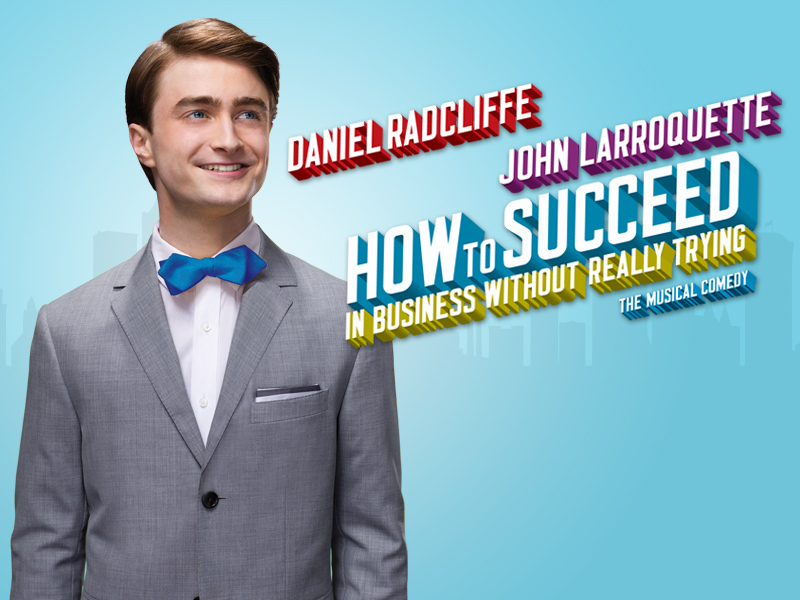
How to Succeed in Business Without Really Trying originally opened in 1961 to across the board raves, a slew of Tony Awards and a rare Pulitzer win. A satire of corporate America, the show featured a book by Abe Burrows, Jack Weinstock and Willie Gilbert about an ambitious window-washer as he climbs the corporate ladder at the World Wide Wicket Company. The musical is based on an unlikely source: Sheperd Mead’s same-titled send-up of “How to” books published in 1952. The show was a mammoth success, running 1417 performances at the 46th Street Theatre and made Robert Morse a star. The musical also featured the last score from veteran composer Frank Loesser. The show is vibrant and funny, a clever send-up of social and gender mores of the Eisenhower era with an endearingly spry and morally unscrupulous hero. While the men connive and scheme their way to the top, the women connive and scheme to land a well-to-do husband – with all tongues firmly planted in cheek. The show is back on Broadway, this time at the Al Hirschfeld Theatre in a highly entertaining revival that is destined to make it a hit show once again.

When it was announced that Daniel Radcliffe would be starring in a 50th anniversary revival, I think most people were curious whether Harry Potter can sing and dance. And I am sure there are some who wondered if the young actor, who had never done either before could carry a show. And carry it he does with considerable energy and likability. The young star makes an instant connection with the audience and sings with a pleasant, if light, tenor. I’ve noticed some criticism about his singing but I have to counter that Finch was never written to be a singer’s role. Morse (original Broadway and film), Warren Berlinger (original London) and Matthew Broderick (1995 revival) were never noted for great singing either. It’s the character and how he’s played that counts especially with this show and Mr. Radcliffe is superb (and his American accent is exceptionally good). Oh, and he is also one hell of a dancer.

Co-starring with Radcliffe is five time Emmy winner John Larroquette making a smashing Broadway debut as J.B. Biggley. His singing is more of a bluster, but his comic creation works exceptionally well. Christopher J. Hanke was a more low-key nemesis than usual as Bud Frump, but not without some humorous moments (giving him the last cup of coffee in “Coffee Break” was inspired) but his singing voice sounded quite ragged. Robert Bartlett scores big in double duty roles as Mr. Twimble and Wally Womper. Michael Park offered stolid support as Mr. Bratt, who leads “A Secretary is Not a Toy” which contains one of my favorite theatre lyrics: “Her pad is to write in and not spend the night in.” CNN journalist Anderson Cooper makes a Broadway debut of sorts, voicing the unseen narrator (Walter Cronkite did the honor in 1995) but it doesn’t land as well as it could or should.

As for the ladies, Rose Hemingway makes her Broadway debut as Rosemary Pilkington, Finch’s love interest. Ms. Hemingway is pleasant but lacks that something extra special that sets Rosemary apart from the rest of the secretarial pool. Tammy Blanchard is an absolute riot – I think I laughed at every single line she delivered – stealing every one of her scenes as bombshell cigarette girl turned secretary Hedy LaRue. Mary Faber’s Smitty made for a charming sidekick. The fabulous Ellen Harvey as the no-nonsense, takes-no-guff Miss Jones skyrockets into the operatic stratosphere on the “Brotherhood of Man” counterpoint. I’d never heard of Ms. Harvey before last night’s performance, but now I’ll never forget her.

Director-choreographer Rob Ashford has created some memorable moments, particularly his new take on “Coffee Break” and the mammoth showstopper “Brotherhood of Man” (one of the most fool proof eleven o’clock numbers). He cleverly inverted the elevator-based “Been a Long Day” to amusing effect. An added football divertissement after “Grand Old Ivy” was amusing, but entirely superfluous. (Every time I’ve seen the show, this spoof of college fight songs has always proven a crowd favorite – it doesn’t really need help). I was at first worried, because he’s overdone the choreography for the opening number: too busy, too frenetic and unnecessary. But things improved almost immediately. As for tone, the satiric element was there but could have been taken up a notch. This is especially evident with the female characters and their act two opener ‘Cinderella, Darling” which director Des MacAnuff cut from the 1995 revival.

At intermission while waiting on what must have been the longest men’s room line in the history of the amenity, I noticed a great number of the other theater-goers were children. I saw teens and pre-teens almost every place I looked, no doubt brought in by Mr. Radcliffe’s affiliation with the Harry Potter films. (Then again, I can see How to Succeed as a better selling point than Equus). Much to my surprise and elation I noticed how much these kids were enjoying the production – and also how dapper they were all dressed – putting most of the adults in the house to stylistic shame. My slight reservations about the production aside, these kids are in for a real treat: a big old Broadway show executed with style and charm.

%CODE1%

Angela Lansbury sings “Liaisons”

My friends and regular readers are aware of the cool reception I gave Trevor Nunn’s revival of A Little Night Music that played the Walter Kerr last year. I don’t want to rehash all that again as the production is now closed and we can look forward to a better and brighter future as a result, but the highlight of that production to me was Angela Lansbury’s Tony nominated performance as Madame Armfeldt, a performance that I think was the only Tony-worthy aspect of the entire production (and her across the board rave notices seem to match my sentiments). Her character, Madame Armfeldt, has only one song in the show, “Liaisons,” but it is one of the most memorable of the entire score and one of my personal favorite Sondheim songs.

Ms. Lansbury made a special appearance in London at this weekend’s Olivier Awards to help present Stephen Sondheim with a special lifetime achievement award. Having seen this little news item on Twitter, I made it a point to tune in. The awards ceremony, which until this year had been an industry banquet, made significant changes and was televised for the first time in years (while simultaneously airing on BBC Radio 2, which is how I was able to chime in). There were some kinks in the format, as the early half of the evening relied far too heavily on colorless color commentators interviewing winners in lieu of focusing on the stage, but the performances were all quite interesting to hear, as were the incredibly brief but pitch-perfect acceptance speeches.

The award for Sondheim was saved until the very end of the evening, following the presentations of Best Musical and Best Play. Adrian Lester started the tribute by reprising “Being Alive” from his Olivier Award winning performance of Bobby in the Donmar Company of 1996. Cameron Mackintosh spoke at length about Sondheim’s work as well as their personal relationship before the impresario introduced Lansbury, who received a thunderous standing ovation on her entrance.

It seemed for a few moments that Lansbury was only there to present Sondheim with the award, but following his acceptance speech she delivered a staggering performance of “Liaisons.” Enjoy:

%CODE1%

“The Ballad of the Shape of Things”

I have been quite obsessed with this song since I heard Kate Baldwin sing it the other night at Feinstein’s to hilarious effect. The song was written for the fearless comedienne Charlotte Rae by her friend Sheldon Harnick for The Littlest Revue, which played the Phoenix Theatre in 1956. While the show lasted only 32 performances, it also boasted the talents of Joel Grey, Tammy Grimes and Larry Storch and yielded an original cast album. “The Ballad of the Shape of Things” was also later recorded by Blossom Dearie and The Kingston Trio.

Here is Rae recreating the number at a 2007 CD signing (for the reissue of her 1950s album “Songs I Taught My Mother”) at the Lincoln Center Barnes and Noble.

%CODE1%

Kate Baldwin: “She Loves Him”

Picking a favorite Sheldon Harnick song is nearly impossible for me. If I tell you “Ice Cream” or “If I Were a Rich Man” give me a few seconds and I’ll start rattling off practically every other song he’s written. When picking songs for a Broadway itunes playlist, I couldn’t just pick one song and found myself placing every original cast album of his material into mix. That said, I can’t imagine how difficult it was for the divine Kate Baldwin to make the selections for her utterly charming tribute to Mr. Harnick, simply titled She Loves Him, playing Feinstein’s at the Regency from March 8-12, with the 86 year old lyricist appearing as her special guest.

Out of the seventeen selections, all but four had music by the late, great Jerry Bock, Harnick’s long-time collaborator. Together they wrote some of Broadway’s best scores including Fiorello!, Fiddler on the Roof, The Apple Tree and my personal favorite She Loves Me, racking up a few Tony Awards and a Pulitzer. Mr. Harnick has also collaborated with Joe Raposo on the musical version of A Wonderful Life, Richard Rodgers on Rex and others. On top of all this, he contributed his own material (words and music) to many off-Broadway and Broadway revues of the 1950s. Harnick’s lyrics are among the best ever written: character specific, vibrant and literate, brimming with wit and panache.

Kate started off with a bit of a tease, making her way to the microphone with a pad and pencil. Suddenly from the piano came a familiar four note introduction to “Ice Cream.” However, instead of writing a letter to “Dear Friend,” she wrote a letter to “Dear Sheldon,” asking him to be a part of her show with a specialized “He Loves Me.” Other gems soared: “When Did I Fall in Love?” stopped this show of showstoppers,” Ilona took us on “A Trip to the Library” and “I Couldn’t Be with Anyone But You” from A Wonderful Life was just beautiful.

The Tony-nominated soprano also happens to be very pregnant with her first child and her impending motherhood informed many of the selections made throughout the evening, most affectingly in her rendition of She Loves Me’s “Will He Like Me?” With utmost subtlety and without changing a single word, the song — which is in context Amalia’s admitting her apprehensions before her first date with “Dear Friend” — was suddenly a new song entirely. I know it’s Kate’s favorite Harnick song and hers may well be the definitive rendition (all due respect to the delightful Barbara Cook, who was also in the house).

Charlotte Rae’s name came up several times throughout the evening. Like Baldwin and Harnick, Ms. Rae is also an alumnus of Northwestern University. While studying, Rae played Harnick the original cast album of Finian’s Rainbow and encouraged him to be a musical theatre writer. Two specialties he wrote for Rae were on the program, which were of particular interest as Harnick also wrote the music. The first was the clever “The Boston Beguine” from New Faces of 1952, about a sexless romp between a bachelor stenographer and a Harvard Man. (Rae opted to do Three Wishes for Jamie instead and the song put the brilliant Alice Ghostley on the map). The other is the madcap “The Ballad of the Shape of Things,” a devilishly subversive number that was the comic highlight – and a song I’ve been unable to get out of my head all day. (Incidentally, Harnick told the enraptured opening night crowd that it was one of the easiest songs he’d ever written).

Usually when I’m at a show where there is a special guest, the individual might make an appearance for a song or two. Kate brought Sheldon onstage halfway through her set to a tumultuous ovation and much to our delight incorporated him into the rest of the show, starting with a spirited “To Life!” from Fiddler. One of the great memories I’ll always treasure was the opportunity to see Sheldon bring down the house with his own “If I Were a Rich Man” (aside from being a terrific writer, he’s a terrific performer). Together, they also shared the lovely “Dear Sweet Sewing Machine,” a gentle waltz that was taken out of Fiddler during the pre-Broadway tryout. They finished with a stirring duet of “In My Own Lifetime,” a haunting anthem from The Rothschilds. For their encore they shared “Sunrise, Sunset” from Fiddler.

The evening was directed by Diana Basmajian, Kate’s frequent collaborator who also did magnificent work on the star’s first appearance at Feinstein’s, helping to shape Kate’s vibrant patter and find the story in every song. They devised an amusing framing device with Kate finding (and in some cases facetiously stretching for) parallels between herself and Sheldon with an unbelievable combination of poise and self-effacing humor. Scott Cady served as musical director and pianist, Andrew Sherman was on woodwinds (apparently almost all of them) and John Beale was on bass; a perfect trio.

I simply cannot stress how magical this night this was; a joyous occasion that you secretly wished would never end. If anyone from PS Classics is paying attention, this must be Kate’s follow up recording to “Let’s See What Happens.” She Loves Him belongs on CD for everyone to hear. In the meanwhile, I have a ticket for the last show on Saturday night and I hope you’ve gotten your tickets as well. You don’t want to miss the best show in town.

And while I’m at it, Kate Baldwin needs to be Broadway’s next Amalia in She Loves Me. It’s been 18 years since the last revival — and we’re long overdue.