The Year of Living Cinematically

Another year has gone by, and I have kept up my list of films watched in their entirety for the calendar year. Same premise, same Moleskine. No TV movies or miniseries are included. The only difference from last year’s list is that I’ve marked the films which I’ve never seen before with an asterisk.

Love Actually (2003) 1/1
Anne of the Thousand Days (1969) 1/4
*Death at a Funeral (2007) 1/6
*The Spy Who Came in From the Cold (1965) 1/7
*Burn After Reading (2008) 1/8
His Girl Friday (1940) 1/9
*Back to Bataan (1945) 1/10
Topkapi (1964) 1/19
The Philadelphia Story (1940) 1/21
*Morning Glory (1934) 1/21
The Little Foxes (1941) 1/24
Network (1976) 1/26
Good News (1947) 1/27
*Doubt (2008) 1/28
Vertigo (1958) 1/30
*The Big Sleep (1946) 1/31
The Bachelor and the Bobby-Soxer (1947) 1/31
The Purple Rose of Cairo (1985) 2/1
101 Dalmatians (1961) 2/2
Once (2007) 2/2
Seven Brides for Seven Brothers (1954) 2/2
*The Big Chill (1983) 2/2
Tootsie (1982) 2/2
*Twelve O’Clock High (1949) 2/3
*The Day the Earth Stood Still (1951) 2/5
*Be Kind, Rewind (2008) 2/5
*Red River (1948) 2/5
*Radio Days (1987) 2/6
Guarding Tess (1994) 2/7
*Lars and the Real Girl (2007) 2/8
*Only Angels Have Wings (1939) 2/9
*Made for Each Other (1939) 2/10
My Fair Lady (1964) 2/11
*Five Easy Pieces (1970) 2/13
Barefoot in the Park (1967) 2/15
*Darling (1965) 2/16
*Slumdog Millionaire (2008) 2/17
*Ghost Town (2008) 2/23
*Julius Caesar (1953) 2/24
*The Public Enemy (1931) 3/6
*Watchmen (2009) 3/7
Howards End (1992) 3/13
*Milk (2008) 3/21
*Vicky Cristina Barcelona (2008) 3/22
*Synecdoche, New York (2008) 3/23
The Lord of the Rings: The Fellowship of the Ring (2001) 3/25
Pinocchio (1940) 3/31
East of Eden
(1955) 4/2
Some Like it Hot (1959) 4/5
So Proudly We Hail (1943) 4/5
Paper Moon (1973) 4/6
Never on Sunday (1960) 4/9
Key Largo (1948) 4/10
*The Actress (1953) 4/11
The Rose Tattoo (1955) 4/13
*Zelig (1983) 4/13
Mrs. Doubtfire (1993) 4/15
The Trouble with Angels (1955) 4/18
Anatomy of a Murder (1959) 4/18
The Rainmaker (1956) 4/20
Stalag 17 (1953) 4/26
North to Alaska (1960) 4/27
The Goonies (1985) 5/3
*Last Chance Harvey (2008) 5/8
Inherit the Wind (1960) 5/11
*Star Trek (2009) 5/11
Raiders of the Lost Ark (1981) 6/1
State Fair (1945) 6/1
The Quiet Man (1952) 6/2
*The Hangover (2009) 6/5
The Godfather (1972) 6/13
Splendor in the Grass (1961) 6/22
*Hairspray (2007) 6/23
Last Chance Harvey (2008) 6/23
*You Can Count on Me (2000) 6/25
Amadeus (1984) 6/26
It Happened One Night (1934) 6/27
Stagecoach (1939) 6/28
Saboteur (1942) 6/30
*Rooster Cogburn (1975) 7/1
*The Lost Patrol (1934) 7/2
The Wild Bunch (1969) 7/3
Roman Holiday (1953) 7/4
*Mary, Queen of Scots (1971) 7/5
Clue (1985) 7/6
Animal House (1978) 7/10
*Untamed Heart (1993) 7/11
Meet Me in St. Louis (1944) 7/12
*Fast Times at Ridgemont High (1982) 7/13
*Harry Potter and the Half-Blood Prince (2009) 7/15
A Night at the Opera (1935) 7/16
I Confess (1953) 7/17
Harry Potter and the Prisoner of Azkaban (2004) 7/17
*The Iron Giant (1999) 7/19
Notorious (1946) 7/20
The Court Jester (1956) 7/24
*The Baxter (2005) 7/29
*Please Don’t Eat the Daisies (1960) 7/30
Doctor Zhivago (1965) 7/30
The Parent Trap (1961) 7/30
*The Paper Chase (1973) 7/31
*Monster House (2006) 7/31
Imitation of Life (1959) 7/31
Oklahoma! (1955) 7/31
*Walk Hard (2007) 8/2
*Little Nellie Kelly (1940) 8/6
*For Me and My Gal (1942) 8/6
*In the Good Old Summertime (1949) 8/6
*The Courtship of Eddie’s Father (1963) 8/7
The Awful Truth (1937) 8/10
*Happy-Go-Lucky (2008) 8/16
*Chocolat (2000) 8/28
*Troll 2 (1990) 8/30
*The Texas Chainsaw Massacre (1974) 8/30
*Gran Torino (2008) 8/30
*Babette’s Feast (1987) 9/5
The Bachelor and the Bobby-Soxer (1947) 9/7
Sweeney Todd (2007) 9/11
Where Eagles Dare (1968) 9/12
How to Succeed in Business Without Really Trying (1967) 9/13
Invasion of the Body Snatchers (1956) 9/18
*Bad Little Angel (1939) 9/21
*A Perfect Couple (1979) 9/25
The Grass is Greener (1960) 9/26
*Lovers and Other Strangers (1970) 10/8
Halloween (1978) 10/31
Big Trouble in Little China (1986) 11/5
*Sunrise at Campobello (1960) 11/8
*Tell It to the Judge (1949) 11/15
Reds (1981) 11/17
*Li’l Abner (1959) 11/26
Elf (2003) 11/30
*Susan Slept Here (1954) 12/11
*Invictus (2009) 12/14
*Bolt (2008) 12/14
Miracle on 34th Street (1947) 12/15
Gone with the Wind (1939) 12/15
*George Washington Slept Here (1942) 12/19
*The Bride Came C.O.D. (1941) 12/20
White Christmas (1954) 12/21
Going My Way (1944) 12/21
Holiday Inn (1942) 12/22
Bad Santa (2003) 12/23
*Christmas in Connecticut (1945) 12/25
Scrooged (1988) 12/25
The Lion in Winter (1968) 12/25
It’s a Wonderful Life (1946) 12/25
*Brideshead Revisited (2008) 12/26
Orange County (2002) 12/26
*The Fisher King (1991) 12/26
The Taking of Pelham One Two Three (1974) 12/27
Fiddler on the Roof (1971) 12/27
Star Trek (2009) 12/29
Adventures in Babysitting (1987) 12/29
The Simpsons Movie (2007) 12/30
Edward Scissorhands (1990) 12/30
The Dirty Dozen (1967) 12/30
The Thin Man (1934) 12/31

"Love, Loss and What I Wore"

Truth be told, had I not been invited to see it I probably wouldn’t have seen Love Loss and What I Wore. I’m not really the target demographic for this production, currently playing off-Broadway at the West Side Theatre/Downstairs. From what I’ve read, it didn’t seem to be the sort of show that would appeal to me. However, I am very glad that I found myself seated in the theatre for last Sunday evening’s performance. The play, written by Nora and Delia Ephron based on the book by Ilene Beckerman, features a rotating cast of five actresses recalling the various memories triggered by various articles of clothing and accessories, under the direction of Karen Carpenter.

I know very little about maternity clothes, shopping for bras and prom dresses or the frustrations stemming from a purse or shoes, so I wondered if would fully appreciate the situations and stories being relayed. Leaving the play, I was stunned at my own preconceived notions. The play was both hilarious and touching, but I also found great appreciation at the daily rituals and indignities women have to endure in Western society when it comes to their appearance. I’m usually done clothes shopping within a half hour; the only thing I ever bother trying on is pants. So I am stunned to hear that women find themselves facing hours upon hours of shopping in order to find clothes and accessories that are just right.

The play is performed as a staged reading, so there is a certain casualness to the proceedings that only heightens the intimacy between the actors and the audience, with many audience members expressing themselves vocally from their seats (the mere mention of Eileen Fisher got one of the biggest reactions of the night). The stories and monologues feel more like you are attended a party, picking up fragments and anecdotes as you work your way through the room. This is further intimated by the simplistic staging: the ladies remain seated on stools, with scripts on stands for the duration, smartly decked out in all black attire (a color choice given its due praise in the play).

Kudos to the Ephrons and Carpenter for shaping an evening that is often funny and often moving, but without becoming unnecessarily maudlin or overly sentimental. So many of the subjects touched on in Love, Loss are not unfamiliar and have often been beaten to death by the Lifetime and Hallmark networks. However, the proceedings are kept smart, savvy and the familiarity of the stories breeds universality rather than cliche.

Mary Louise Wilson serves as a sort of narrative base for the evening. She relays the life of a singular woman through cardboard drawings of the individuals wardrobe, essaying memories of childhood, love, lust, family, failed marriages, motherhood, and getting older with a certain casualness. She also got one of the biggest laughs instructing the audience on how to draw oneself (they include an insert in the Playbill so you can do it yourself, and they post them on a bulletin board in the lobby). Wilson

The other four actresses portray a wide variety of characters. Mary Birdsong brought her unique comic sensibility to her different women, but shone especially as a woman languishing in a loveless relationship for eight years. She and Lisa Joyce have one of the more affecting bits of stage business as they tell two seemingly separate stories simultaneously, only to gobsmack the audience with a twist that ties the two together seamlessly. Jane Lynch, who is well known for her comedic skills from her various film and TV appearances has the opportunity here to display her depth and range as she recounts one woman’s battle with breast cancer in the most moving segment of the evening.

And on top of all this, there’s Tyne Daly. The Tony-winning actress is simply sublime delivering a comic monologue about purses, and how they become a reflection of the individual but she’s also endearingly saucy as a southern woman recounting her romance with man in prison. Daly (sadly, no relation) is as warm and effusive onstage as you would hope her to be. On top of it, she makes it all look so innately easy. As much as I loved all the ladies, I found myself looking forward to all the moments directly involving her. However, there was a sense of camaraderie between the actresses. When one was working, the others were watching her; listening and genuinely appreciating what the other was saying.

A new cast is taking over this coming week, but pay that no mind. Part of the novelty behind this simple staging is that so many acclaimed actresses will have the opportunity to step in over the next few months. The show has been such a success that is has already extended itself into March. Kristin Chenoweth, Rhea Perlman, Debra Monk, Michele Lee and Capathia Jenkins are just a handful of the actresses who will be rotating in and out of the show over the next couple of months. (You can check out the cast rotation on the show’s website).

Since I didn’t know what to expect, I wanted to make sure that I brought someone with me who I feel would feel a connection to the material. When Roxie proved unavailable, I turned my good friend Dana, a savvy thirty-something with whom I used to work. I didn’t expect or know that the Jane Lynch monologue about breast cancer would hit as home as it did. But it matched detail for detail, save for the type of cancer. She had what she later referred to as a “moment” there, and it proved a very personal moment for the both of us as I considered how I fortunate I was to have this particular person in my life. She already has plans on bringing her mother and sister back to see the show.

After the show, I was talking to the show’s exceptional associate general manager, fellow blogger Jodi Schoenbrun-Carter. She, my friend and I were espousing the virtues of Love, Loss and What I Wore and she casually mentioned her husband retaining a particular item of clothing. For the example, she said “an old flannel shirt.” Suddenly, as though a light switch was turned on, I remembered that I actually keep a worn, XL flannel shirt in my old bedroom closet at my parents’ house. I acquired this shirt in ninth grade, and often wore it as a jacket, and used it for a production of The Wizard of Oz I appeared in my senior year. I’ve never worn it since that show, but because of its personal importance I’ve held onto it. Hanging alongside that shirt, are my Boy Scout uniform, college graduation gown, and a vintage 1970s Nino Cerruti sports jacket (total non-sequitur – my oldest brother bought the exact same jacket – same size, color, etc. around the same time unbeknownst to either of us until a year later). So gents, if you find yourselves wary of seeing the show, just remember – you can substitute purses, heeled shoes and maternity clothes with briefcases, fishing boots and tuxedos and you’ll find that you can start culling up memories of your own.

The Loss of the Mark Hellinger Theater


It’s hard for me to fathom what the theatrical world was like twenty years ago, long before Broadway shows started using twitter and Facebook for publicity. A time when the American musical was considered near-extinct and the British imports were in vogue. News was broadcast on radio or television. Or you’d wait for the morning (or evening) papers. You didn’t have All That Chat available to get an instant account of a first preview, or the latest information from out of town. It was a time when friends called other friends to dish about what they had seen as opposed to posting it anonymously on message boards. Times Square was still a few years away from Mayor Giuliani’s clean-up. Twenty years ago, I was six years old and didn’t know what Broadway was, let alone where it was. It was during this time that the crown jewel of Broadway houses, the Mark Hellinger Theater, was in the first year of its lease to the Times Square Church.

Tonight I discovered by chance that as an alumni of my college, I could still access their library databases, one of which included the archive of the New York Times from 1851-2006. The search results contained scanned images of the original articles as they appeared in print, often with accompanying photographs. The collection is concise; you can pretty much find anything you want to know. So I started having a look around and checked out some a few musicals I find interesting.

Some of the titles in my search were Coco, Illya Darling, Dear World, and of course, 1600 Pennsylvania Avenue. As I was looking through these articles, which cover everything from first announcement to closing notice, I realized that most of the shows I was researching were musicals that played the legendary Hellinger up on W 51st Street.

Last November, a few theater bloggers and I made a pilgrimage to the theater where we were awestruck at the beauty of its interior – with its opulent ceilings and proscenium, as well as its jaw-dropping two-tiered lobby. The theater famously housed the world premiere of Casablanca in 1942 and its most recognized legitimate tenant was the original production of My Fair Lady in 1956. The theater is classified as a landmark by the City of New York, a designation which was instituted for most buildings in the area as a direct result of outrage over the demolition of the Morosco, Bijou and original Helen Hayes Theaters in the early 1980s. In case you’re curious, they were razed to make way for the gargantuan Marriott Marquis Hotel.

So into this database I entered the terms “Mark Hellinger” and “Times Square Church” and found several articles detailing the transition of the theater from the Nederlander Organization to the TSC.

According to a news item by Mervyn Rothstein on February 9, 1989, the theatre was to be leased to the TSC for $1 million per year for five years. The announcement came while the Peter Allen musical Legs Diamond, the latest in a string of failures at the venue, was still running (or rather, limping). The TSC was to start occupying the theater once that musical closed (the show announced its notice a week later, shuttering on February 19).

James M. Nederlander, chairman of the Nederlander Organization is quoted in the article, defending the decision:

“There’s no shows being produced. We have to keep the theaters filled. We’ve got the Gershwin with nothing in it. We’ll have the Nederlander [the previous space occupied by TSC] as well. We don’t have anything on the horizon to put in the theater.”

“We want to keep the theater as a legitimate theater. It’s a short-term lease – five years is short term for me. It’ll pass before you know it. If someone comes up with a show at the end of the term we’ll put the theater back in. It’s just a question of product. If I had a show, the show would have gone in. In show business, you have to take the first booking.”

Rocco Landesman, of Jujamcyn, expressed surprise, but understood and appreciated the economics behind the decision, adding that if he were offered that deal, he would have likely accepted. Independent producer James B. Freydberg; however, expressed considerable outrage at the move,

“It certainly makes it clear to me that they’re in the real-estate business and not the theater business. As a producer, I would like to feel that the theater owners are really in the theater business first. It’s also really not looking into the future. If Cats is to continue to play, and Les Miserables and The Phantom of the Opera, and with Aspects of Love and Miss Saigon coming, there are going to be fewer large musical theaters available. And if one of the larger and better houses is going to be locked away for five years, it shows very little insight into the future of the theater.”

The next article I encountered from May 24, 1989, discussed the difficulties the Nederlander organization was having filling its many New York theaters, with the powers that be (Mr. Nederlander and Arthur Rubin) resorting to filling the Gershwin Theater, Broadway’s largest house, with concerts by major celebrities like Barry Manilow and Patti LaBelle. In the difficult economic times, the group was losing a lot of money investing in failures, while the rival Shubert organization seemed to have booked all of the major, long-running British megamusicals in their best houses.

By this point, the TSC had taken up residency in the Hellinger, while many other of the Nederlander Theaters such as the Lunt-Fontanne, Neil Simon, New Amsterdam, Palace, Brooks Atkinson, Harris and the eponymous Nederlander were all dark or undergoing construction. (The Harris Theater on 42nd Street never reopened and was demolished to make way for Madame Tussaud’s). In an article that ran the following week, it was announced that things were so desperate for the Nederlanders that they were considering a deal to convert the Lunt-Fontanne into a cineplex. At the end of this article (dated June 1), Mr. Nederlander denies that the Nederlander Theater was to become a discotheque saying, “The deal fell through.”

Rothstein reports on January 10, 1990 about the postponement of Miss Saigon to spring 1991 by impresario Cameron Mackintosh. The producer felt that there was no appropriate theater available for the show, and is quoted as saying, “It’s a fairly open secret I’ve been hoping to go into the Mark Hellinger Theater. I think now that’s unlikely.” There would have been an 18 month wait as a 52-story hotel was being erected over the space, which involved ripping out the original dressing rooms. The wait was not something conducive to Mr. Mackintosh’s plan. The piece also states that he tried to buy the theater, “I think anybody and their wife would like to purchase the Hellinger. But the Nederlanders made it quite clear they’re not interested in selling, and I don’t blame them.” The article ends with a rumor that Les Miserables would transfer out of the Broadway Theater into another Shubert house to make room for Miss Saigon (Les Miz moved to the Imperial that October, where it ran for over twelve years).

The Mark Hellinger Theater was sold to the TSC sometime in fall 1991, according an article in the Times on December 7, 1991. No details of the sale were officially announced, but it was estimated that the Hellinger was worth between $15 and 18 million. This time, vice-president Rubin went on the record,

“I’m a theater person and I hate to see any theater go. It’s a question of economics. We can’t fill the theaters we have, and the city has not given us tax abatements when the theaters are dark.”

The pastor of TSC, Rev. Donald Wilkerson only told the newspaper that “The theater is landmarked and it will remain the same.” In fact, having been inside and seeing the work that has been done, the interior has been painstakingly maintained in all its original splendor.

Alex Witchel had offered more information about the sale, including James Nederlander’s statement on the matter as well as the journalist’s own opinion on the matter in her December 13, 1991 “On Stage and Off” column.

Mr. Nederlander said, “It’s a sign of the times. The church had three more years on their lease and there are no productions around now to fill the theater. We have enough musical houses – a surplus, as far as we’re concerned. If you haven’t got anything to put in it, what can you do?”

Ms. Witchel asks the question, “Why not sell the theater to legimate theater operators?” as opposed to the outside TSC, adding that Mr. Nederlander admitted that at one time or another Michael Bennett, Cameron Mackintosh and the Jujamcyn organization had all expressed interest in purchasing the theater, but “that the price was never right.” As per the article, the final sale was priced somewhere around $17 million. Rocco Landesman makes yet another appearance in the saga, offering that the price they received was more than most theater operators could afford, adding one pearl of wisdom: “What this proves is that landmarking a building doesn’t save a theater.” Nederlander compared the treatment of theaters in NYC to those in London, which receive tax abatements when the houses are empty. Witchel goes on to mention that Mr. Nederlander’s woes continued with the total failure of Nick & Nora, which not only turned off the lights at another one of their houses, but also cost Mr. Nederlander his $1.5 million investment.

Hindsight really is 20/20, isn’t it? If the Nederlanders hadn’t sold off the house, they would have had another large-scale venue which would have been perfect for the Nederlander housed productions of Show Boat and Sunset Boulevard. Hell, while I’m speculating, it would have been a formidable place to house the original production of Ragtime as well as many other significant musicals. But the TSC remains firmly ensconced in the Mark Hellinger Theater; a thriving religious community that has several thousand worshippers each week. Offices have been established and a great deal of the church’s money has been spent to accommodate the landmark statutes.

Will the Mark Hellinger Theater ever be restored as a legitimate theater? The easy answer is no. The TSC has been settled in for over twenty years and unless they were seeking to upgrade to an even larger venue, it makes very little sense for them to go anywhere. However, I like to hold onto a glimmer of hope that one day we might get the space back. Meaning no disrespect to those who worship and the powers that be at the TSC, but St. Patrick’s Cathedral is a church, the Mark Hellinger is not. It’s my quixotic wish that at some point in my lifetime the theater will be restored to legitimacy as a Broadway house.

It’s ironic that now, in what is the worst economic crisis the country has seen since the Great Depression, that there doesn’t seem to be any shortage of plays and musicals filling up the theaters in Midtown. So if you’re ever in New York, and have some time to kill in the area, I highly suggest taking a walk up to 51st and Broadway to have a look inside. When you do, you’ll understand why I mourn the loss of this indelible part of our theatrical history.

My First Time

Well, at least it was the first time I judged. My earliest show memory is a vague recollection of a local production of Peter Pan. However, my earliest memory of seeing theatre, processing it and making a discerning opinion about it was a local semi-professional production of Annie when I was eight years old. Or at least I think I was eight. Whenever it was, the details surrounding my seeing said production aren’t as important as the impact it had on me.

I spent nine years as a student in Catholic elementary school. I was a pretty good student who was especially taken with music, something not lost on the music teacher, this terrific nun named Sr. Rose Marie. Had she not been called to the convent, I think she would have been a major Broadway soubrette, standing by for Angela Lansbury in Mame, etc. (If I think of one, I usually think of the other – they both are altos with distinctive timbres). I later learned that she was also a big fan of musical theatre, having seen the original production of South Pacific, among others, and she gave me some of my first cast albums (yes, records). She encouraged me to learn about music, watched as I started to play piano by ear and challenged myself to sing Schubert’s “Ave Maria.” I also joined the school choir, which she directed. She has had an enormous impact on who I am as a person, and as a student of music and theatre.

Oh, and some fun trivia: Sr. Rose Marie was part of the chorus that sang for Richard Rodgers when the composer visited Manhattanville College to research liturgical music for The Sound of Music in 1959.

But I digress… Anyway, my first year in the choir we were treated to a Christmas field trip, as a sort of thank you for all the holiday singing we’d been doing (the perennial favorite: the nursing home & senior center circuit). In fact, where we were going and what we were doing was a well-hidden secret from all of us. We didn’t really care much, as you can expect – getting to skip class and leave school is always a joy.

Well, details surrounding the production are sketchy. I was familiar with “Tomorrow” (is anyone not?) and had heard of the comic strip. I’d never seen the movie and was never into the strip itself (those Annie characters creeped me out with those dead eyes…) and would still rather read Calvin and Hobbes and Peanuts. The musical also explained to me for the first time why Annie was living with Oliver Warbucks.

So, the show got underway. Nice overture – still a knock-out with those trumpets. There were orphans, and an earnest redhead girl who couldn’t have been much older than myself who came out to sing what I would later learn was “Maybe.” Almost immediately I felt this sense of disdain; there was something about this that didn’t strike the right chord. She was the heroine, but why didn’t I like her? My disdain started to grow to sheer dislike as the first act progressed. Perhaps she was too cloying, too sweet for this orphan (if you look at Andrea McArdle’s performance from the Tony telecast, she at least supplied some sass). I cannot explain with clarity what it was about her performance that I disliked so much, the most vivid recollection is the garish wig they shoved on her at the finale (I’ve seen fake clown wigs that were more effective).

However, I knew the show wasn’t a total loss when this slatternly middle-aged woman, clasping a flask, whistle around her neck, entered and started tearing things up. Suddenly I was paying attention. The impression this woman made on me – an actress of whom I have no recollection. (My ticket stub and program are long lost). But it was she who single-handedly saved the afternoon from being a total bore. She had the best lines, the comic delivery and in the battle of Annie vs. Hannigan, I wanted Hannigan to win. I don’t know if that speaks more about this production or myself, but c’est la vie.

When all was said and done, I didn’t have much to say about the score, the book, the performances – except for this actress. And since the show was a surprise and essentially a group Christmas gift, it would have been rude for me to speak up and say I didn’t like it. On the bus ride home, I have what is my earliest memory of experiencing a headache. Coincidence…?

So much did I dislike the musical, I didn’t bother with either film version nor have I seen the show live. However about ten years down the road, the Broadway’s Lost Treasures series started airing on PBS and one of the clips was the original Broadway cast performing on the Tony awards. That was when I first experienced the magic of the late, great Dorothy Loudon, and made it a point to familiarize myself with the score, which has grown on me. I’ve always been so impressed that she took what is a comic supporting role and made it a star turn (not to mention winning the Best Actress Tony over McArdle).

If it weren’t for Miss Hannigan (and the long-forgotten actress that played her), I may have given up on stage musicals all together. Well, perhaps that’s not quite correct… if it weren’t for Miss Hannigan and Sr. Rose Marie.

Once Nearly Was Mine…


Oh dear readers, how I wanted this for my collection of memorabilia. An original window card of 1600 Pennsylvania Avenue (not a reprint) that I stumbled upon by accident on E-bay a couple of days ago. The show closed in 1976 after a 7 performance run at the Mark Hellinger Theatre, and is a piece that has been well-documented on this site. (My obsession with it is a very well known item of interest). I put in the entry bid at $49.99 and set a small buffer in case I was outbid. Well, I was this evening. And now, the going rate for this piece of musical theatre history is now $500.00, a sum much more than my piggy bank can afford. So we’ll hold out until next time…if there is a next time. I’m not Don Pardo and you’ve not been “Spanning the World.”

Celebrating Bea Arthur


I have never felt the necessity to attend a memorial service for any celebrity or theatre star. With most actors and creators I admire, I usually recall their work and appreciate the legacy that is left behind. In most cases, I have never encountered the person except through their work, so I don’t generally feel a personal connection.

However, today was different. This afternoon at the Majestic Theatre, the theatre and TV community gathered to celebrate the life of the one and only Beatrice Arthur. The actress, who died this past April at the age of 86, was more than actress and comedienne; she was an icon. Her statuesque presence, her incisive cutting way with a line or glare and that baritone voice were part of the unique package that make an unlikely star of the working actor at the age of 50.

As a child I knew who she was. She was that really funny one on The Golden Girls. I think I may have seen an episode or two around the time I was ten, but in all honesty the show didn’t hold much ground with me then and I carried on with my life. My appreciation for Bea Arthur started around the time I was fifteen years old and TV Land started airing reruns of Maude, the landmark show featuring the staunch eponymous character that propelled the respected New York actress into television stardom.

Watching these reruns of this daring, controversial series, I began to appreciate what it meant to be funny. Bea could be funny without doing much of anything. One lengthy glare was a enough to reduce the studio audience to gales of unstoppable laughter. Maude Findlay was the greatest feminist of Tuckahoe, NY and liberal to a fault. She took on every cause imaginable, with the show tackling alcoholism, drugs, menopause, plastic surgery, infidelity, the difficulties of marriage and homosexuality. Oh, and of course that famous episode where Maude decides to have an abortion. One of the funniest things I’ve ever seen in my life was Bea Arthur throwing an overcoat at Adrienne Barbeau in the episode “Nostalgia Party.” (It has to be seen to be fully appreciated. Unfortunately five seasons of the series remain unreleased on DVD). When I finished with Maude, I moved onto The Golden Girls when I was about 16 going on 17. And of course, there were the original cast albums of Mame and Fiddler on the Roof.

My comic sensibilities were shaped by two individuals: my father and Bea Arthur. I learned from Bea that sometimes doing nothing was funnier than a quip and even dared to hold an extra couple of beats for impact, and while I will never be as funny as she, I certainly learned how to get a laugh. Upon hearing that there would be a memorial service, I figured that she was such an important part of shaping my interests that I would really like to go.

I arrived at the Majestic Theatre around 10AM, mildly surprised to find myself about thirtieth on line. That soon shrunk a bit as it turned out there were several tourists who thought it was the queue to purchase tickets for Phantom (boy, would they have been in for a surprise…). We were informed the house would be opening at 12:30. As that time approached, the line for the public stretched from the Phantom marquee to Shubert Alley (possibly farther, but I wasn’t about to step out of line to see). After they let in those with invitations, they opened the doors to the public.

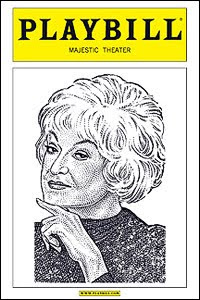
We were led down into the lobby and handed a Playbill that sporting a sketch of Bea from Just Between Friends on the front. On the press line, I caught the vivacious Tyne Daly being interviewed. I also caught sight of Karen Akers, Charles Busch and Julie Halston. The seating was general admission with various seats reserved for VIPs and press. I managed to snag a really nice seat in the center orchestra, at about Row M. (One of the most interesting things about the orchestra section at the theatre is the unusual rake in the seating). Onstage was a large projection screen with a large publicity shot of Bea that was seen in the advertising for Bea Arthur on Broadway. There were two podiums on each side of the stage, as well as grand piano center stage. Easy listening favorites of Sinatra were piped into the theatre as people were seated.

The house was abuzz with theatre folk conversing with one another – total strangers around me sharing their favorite Bea moments. Most talked of The Golden Girls, but I overheard some talk of Maude and Fiddler. Friends and VIPs milled about in the front orchestra section. About 1:10PM, the house lights are dimmed and applause started and grew in intensity before anything happened. (I’ve officially conquered the Majestic. Take that, POTO!). Suddenly Dame Edna was heard over the PA, as they played the pre-show recording made for the Australian run of Bea’s one woman show.

Immediately following, the afternoon’s host and Bea’s closest friend, Angela Lansbury, emerged from the wings in a sophisticated white pantsuit and to a full house standing ovation. The five time Tony-winner was very gracious, but quickly calmed the audience down. After a beat she began to speak, “I have a little secret I’d like to impart that I hope doesn’t give you too much of a start…” Ms. Lansbury then stepped center stage where she proceeded to sing her pal’s signature song from Mame while a slideshow of photos was presented on the screen behind her. After a brief introductory, in which she welcomed everyone and joked how Bea would likely disapprove of the whole event, she presented Norman Lear to the audience.

Lear, the groundbreaking producer of practically every important sitcom of the 1970s, talked about seeing Bea Arthur in the 1955 off-Broadway Shoestring Revue where she sang the song “Garbage.” He kept her in mind when he was working on other projects, including The George Gobel Show in the 1960s. He called her and asked her to fly out to guest-star as Archie Bunker’s liberal cousin Maude in a one-shot appearance on All in the Family. Well, the rest is history. Lear commented, “I’ve lost a lot of friends recently, but no one seems less gone and more alive than Bea.” He was the first of many to talk about her way with timing and understanding the essence of comedy. Lear maintains that out of all the laugh-makers he’s worked with over the years, none have made him laugh like Bea.

Sheldon Harnick, the lyricist for both Shoestring Revue and Fiddler on the Roof was next, and he talked about writing “Garbage,” to spoof the dramatic torch songs with inane lyrics, which she performed with “her unerring sense of comedy.” Another Shoestring alum, Chita Rivera, emerged to talk about the joy they shared as colleagues and commented, “The one thing I wanted Bea to stop was walking down 9th Avenue in her bare feet.” Her disdain for footwear was a running topic throughout the afternoon. Rivera also said, “She would allow you to imagine what she was thinking – now that was really funny.”

Angela came back onstage to talk about first getting to know Bea while they prepare for Mame in 1965. She said that while they were always “Bosom Buddies” onstage, they really became bosom friends in later years, after both had successful TV series. They ended up living near each other in California, and their children became friendly. Lansbury got quite emotional as she recalled her husband, Peter Shaw’s final illness and how Arthur was there with food, comfort and her friendship during those difficult days.

Next up was Bea’s sister, Kay Gray, who talked about Bea’s three passions – Cary Grant, show business and animals. She talked about how her big sister was there to advise her, teach her to jitterbug, started chain smoking at 12 and ran away to sing with a band at 13. When Ms. Gray was going to visit the set of Maude, she told her sister to give her a part – that she could play her younger sister. When she arrived on the set, Bea told her in that inimitable style, “When you’re on my show, you’ll be my OLDER sister.” Six weeks before Arthur’s passing, her sister was with her in her bed. The two were sharing memories and stories. Arthur turned to her sister and said, “I’ve had a wonderful life. I’ve done everything I ever wanted to do.” Later, Arthur’s two grown sons, Matt and Daniel Saks, spoke fondly of their loving, down-to-earth hands-on mom, who wasn’t above flying in a pen pal to be a prom date and who was happiest when throwing their weddings.

Rosie O’Donnell recalled the night she met Bea – at a Manhattan restaurant where she and her brother drunkenly sang the Maude theme song to her. When they finished, she held the trademark beat before bursting out in a gale of laughter, hugging Rosie and the two became friends. She told her “I know you. You’re a funny kid.” O’Donnell got emotional as she discussed how Bea Arthur’s portrayal of Maude Findlay “taught my generation how to be a feminist.”

Bea’s co-star on Maude, Adrienne Barbeau was next. The actress recalled her total acceptance on the set, with Bea the first to arrive and the last to leave. The up and comer one time asked the star about her acting technique – if there was something that Arthur relied on when she was having difficulty creating a character. Bea said, “Oh shit, darling. You just say the words as though you mean them.” Probably the best acting advice I’ve ever heard. Then Charlie Hauck, one of Maude’s writers recalled the actress’ spontaneity, down to earth charm and how she saved a dog in the middle of Sunset Boulevard only for them to discover it belonged to Barbra Streisand.

Zoe Caldwell was neighbors with Bea Arthur when both ladies resided in Pound Ridge, NY. The acclaimed actress tore up the theatre with her distinct, dry deliver turning the mundane into the hilarious as she recalled their relationship. She spoke fondly of their friendship, saying that they were in Pound Ridge and they needed each other. Arthur assumed the role of big sister in their friendship and doled out advice and suggestions—often what play or movie to see. Her reasoning: “It will be good for you.”

“Then,” said Caldwell, “she’d come along to make sure you got the right thing from it.”

One of these suggestions was to go see Katharine Hepburn in Coco. Bea opined, “We’ll sit front row center…so we can’t escape. We will watch her and watch her and watch her.” Caldwell said, “And we watched her…and watched her…and watched her… and Bea had to cry. *pause* It wasn’t a sad musical…but we cried all throughout. *pause* I suppose it was good for us…”

Carol Arthur DeLuise was introduced and she discussed Larry Gelbart, the famed writer who died this past Friday. Gelbart had been invited to Bea’s memorial but had to decline due to his ill-health. However, he did send a letter which Mrs. DeLuise read, that recalled seeing The Threepenny Opera off-Broadway and said, “She could do with a punch or a line what Ethel Merman could do with a song.” Then Miss Coco Peru, a drag performer and close friend of the star was asked to recreate “A Mother’s Ingenuity,” a hilarious piece that is included in Bea’s one woman show (and on the show’s album as “The Soup Ladle.”)

Jerry Stiller and Anne Meara came on and honored Bea with their old routine. They jokingly talked about themselves, but kept the audience in stitches for a good ten minutes. The script supervisor of The Golden Girls recalled special moments with Bea, and was in charge of getting the ladies to sign photographs. On one afternoon during the height of Bobby McFerrin’s popularity, he successfully dared her to sign “Don’t worry, Bea Arthur.”

And then there’s Rue McClanahan. McClanahan had the opportunity to co-star with Bea in both Maude and The Golden Girls and offered a window into the compassionate, caring maternal woman. When Rue’s mother died of a heart attack, McClanahan found herself alone on Thanksgiving the day after the funeral and called Bea. The star had McClanahan come to her house where she put her in bed, fed her and made sure she was comfortable.

While the audience was still dabbing their eyes at this heartfelt remembrance, Rue switched gears and talked about Bea’s bawdier side, claiming that she was not quite herself after she’d had a few drinks. At the opening night of Bea Arthur on Broadway, Rue and her husband were invited to the show and after party. Her husband went over to introduce himself to Bea, who was sitting at a corner table with her back to everyone and thanked her for the invitation. Bea turned and looked at him for one of those trademark beats, then grabbed him and drunkenly slurred, “I love Rue… Betty’s a cunt.” The anecdote was so unexpected and the laughter so intense that McClanahan (whose impersonation was the best of any of the speakers) could barely restore order.

The afternoon progressed with speakers from PETA and the Ali Forney Center, representing two causes that were near and dear to Bea’s heart: animal and gay rights. Dan Matthews, the vice president of PETA, talked of finding himself – a staunch vegan activist – in Arthur’s kitchen helping her prepare a meatloaf (after she gave him a withering glares). Carl Siciliano, executive director of the AFC talked about how Bea really committed herself to helping the organization, donating money and raising awareness. She even flew to NYC while suffering from illness to perform a benefit performance of her one woman show to raise money for them. The Center, which provides shelter for homeless LGBT youth, is naming a residency in her honor. Other speakers included Daryl Roth, who produced Bea on Broadway and Billy Goldenberg, Bea’s long-time friend and collaborator.

Interspersed throughout were clips of Bea at her finest: singing “My Way” on Maude (with a line reading that has stayed with Norman Lear for over thirty years: “Better than Fontizou…?”) as well as a montage from The Golden Girls, including Bea’s favorite when she and Estelle Getty dressed up as Sonny and Cher for a mother-daughter contest. Billy Stritch was on hand to sing her favorite song, Coleman-Leigh’s “It Amazes Me” and Angela presented her Emmy-nominated guest appearance on Malcolm in the Middle.

Finally, Angela introduced Bea herself, in an audio-video montage of her many fine moments, which included “Bosom Buddies” from the 1987 Tony telecast. The afternoon ended with Beatrice singing the elegiac and uplifting “The Chance to Sing,” the eleven o’clock number from Goldenberg’s musical of Harold and Maude. The audience then rose in standing ovation to salute the star. For the two and a half hours, we were treated to a few tears, some ribaldry and endless laughter – the kind of gathering you would expect when Bea Arthur is involved. And you know what? I think she would have approved too.

In Her Own Words: Patricia Neway on "The Consul"

While I was aware that the 1960 television production of Gian-Carlo Menotti’s opera The Consul was released on DVD by VAI, I didn’t know until very recently that they also released a 2-CD soundtrack recording of the telecast. A 2-LP original cast album was made by Decca in 1949 and languished in the vaults for many years. The good news, it’s also been made available on CD, in a boxed set including Menotti’s two other operas, The Medium and The Telephone. The bad news – they are not officially remastered by the original recording companies and editorial reviews comment on their lack of good sound quality. (Come on, Decca. Get on the ball!)

As I listened to the stirring, haunting score I read through the brief liner notes and found this recollection of the original show by the star Patricia Neway.

This is what the acclaimed soprano had to say about The Consul:

The experience of preparing and presenting The Consul was unique. The opera was produced on Broadway with the usual schedule of eight performances of a week and was called a musical drama instead of an opera in order not to discourage a broad audience.

After Gian-Carlo chose his singers there were backers’ auditions in which several cast members did scenes without sets or costumes. Guests were invited as prospective backers to the homes of prominent people who hosted the evenings. It was exciting and challenging for all of us. I have one vivid memory – Gian-Carlo handing me a penciled musical manuscript and telling me that I was to sing it at the next backers’ audition two days later. It happened to be at the home of Virgil Thomson, the composer and formidable critic on the Herald Tribune, at his apartment in New York City’s historic Chelsea Hotel. The first line of the manuscript read “To this we’ve come,” Magda’s aria at the end of the second act! I didn’t have time to absorb all that I was dealing with, but when I finished singing it I was trembling from head to toe. It was my first realization of what a powerfully moving role I had been trusted with and what a remarkable work The Consul was.

When we started regular rehearsals with the whole cast, we had the privilege of working with Gian-Carlo as composer and director. It was inspiring to have his genius guiding us. As we got close to opening, my colleagues and I would discuss what we thought was ahead of us. Many thought that we would have an artistic success but only a moderately successful run considering the seriousness of The Consul’s subject matter and its tragic outcome.

On opening night there were no questions anymore. The opera was a phenomenal success – the ovation after Magda’s second act aria seemed to go on forever – the reviews were ecstatic – there were awards and accolades – but most of all there were those people from the audience who came backstage with tear-stained faces to thank me for telling their story. The more we performed The Consul the more I realized it was, above all, a work of enormous compassion and depth.

It is impossible for me to express what a rich experience The Consul has been for me through the years, or to thank Gian-Carlo enough for the privilege of creating his first Magda.

To this day I meet people who saw it and tell me how much The Consul moved them. That generation is passing and I am deeply grateful to VAI for releasing this video so that future generations can experience this enduring work.

-Patricia Neway, 2004

Auntie Maim

Blessed Mother of Maude Adams, what fresh hell is this?

From Variety:

‘[Director Luca] Guadagnino said he and Swinton aspire to remake “Auntie Mame” as a “rock-n-roll, super funny, super mainstream movie.”

They would set their “Mame,” which is about a boy growing up as ward of his dead father’s eccentric sister, in the present-day.

“This is an SOS for Warner Bros. to give us the rights for this remake, which only Tilda could do justice to,” he added.’

You know I have nothing against a revival of Auntie Mame and/or Mame. Or even a filmed remake of either property. However, this isn’t exactly how I pictured a re-emergence of the timeless character. In any incarnation, Mame is a period piece, and continues to work well in said period. Her effusive spirit is something that comes out of the Roaring Twenties, survives the Crash of ’29 and continues into the Big Band Era: living life to the fullest and fighting the Establishment and stuffy provincial bigots along the way.

Elements of Auntie Mame could work today, but I hardly consider her “rock-n-roll.” Mame Dennis Burnside is more than a character, she’s a force of life. A living embodiment of Bohemianism and sophistication that I think most people would love to have in their lives. Not to mention, Tilda Swinton strikes me as all wrong for the part. Swinton is certainly an eccentric personality as attested by her Hefty bag fashion sense on Oscar night, and she leads a rather Bohemian lifestyle as evidenced by her open relationship with both husband and lover. I am pleased that she considers Auntie Mame one of her favorite films, but there is no need for her to reinvent the wheel.

Is there anyone who could bring savvy sophistication like Rosalind Russell, Greer Garson or Angela Lansbury? It’s harder to cast the role of Mame because the character for all it’s glorious lines and costumes, is static. Mame never changes, which is essential to her Mary Poppins-esque way of popping in and out of her nephew’s life. The actress who can successfully play Mame should be patrician, open-hearted and sympathetic. It takes more than a good delivery of a zinger to make a Mame.

I would rather sit through the leaden 1974 film version of Mame with Lucille Ball than see the rape of a classic.

"The Happy Time" – An Appreciation

I’m not sure why I didn’t delve into The Happy Time around the time I was first discovering Cabaret, Kiss of the Spider Woman, Woman of the Year and Chicago. John Kander and Fred Ebb made an indelible mark on Broadway, with a collaboration that spanned almost 40 years, producing some of the most respected musicals this side of the 20th century. Somehow when I was touching on the hits, I overlooked this 1968 gem.

To be honest, The Happy Time isn’t a great musical. It suffers from (what else?) a weak libretto by N. Richard Nash that’s very loosely adapted from Samuel Taylor’s play. But Kander and Ebb wrote a score that is very much unlike any other they wrote. Their musical scores were usually edgier and grittier than most, delving into darker cynicism shaped by directorial concept. However, this one has a romanticism and lightness that if a far cry from a seedy Berlin nightclub, a Windy City or South American jail cell or an ice skating rink.

The story concerns a jet-setting, prodigal son photographer who returns to his French-Canadian hometown St. Pierre to reconnect with his family, turning their lives upside down. His curmudgeonly father continues to criticize – when not looking at his “dirty pictures,” while his nephew worships him. Meanwhile, he reconnects with a former love, who has grown into a practical, focus (read: grownup) schoolteacher.

The musical was produced by that Abominable Showman David Merrick and directed and choreographed by Gower Champion, who won Tonys for both assignments. Robert Goulet, who won his Best Actor Tony for his work here, starred alongside David Wayne and newcomer Michael Rupert. Julie Gregg was Goulet’s love interest and old pros George S. Irving and Charles Durning played Goulet’s brothers. The production opened at the Broadway Theatre on January 28, 1968 to decidedly mixed reviews. Many found favor with the actors, but great fault with the script. It closed after 286 performances and bears the distinction of being the first musical to lose a million dollar investment.

However, the show, though mired in relative obscurity, has found a new life in recent years. Goodspeed Opera House showcased the first revisal in 1980. A production at the Niagara University Theatre in 2002 enlisted Kander and Ebb to help further revise the book and score, restoring cut scenes and songs. The composing team declared this the definitive performance version of the show and was used in the 2007 Musicals in Mufti concert and the 2008 Signature Theatre revival in Virginia.

RCA recorded the original cast album which showcases what was so wonderful about the original production: its music and lyrics. Goulet gets the choicest material, notably the lilting title song that opens the show and the act two opener “Walking Among My Yesterdays,” the most beautiful song about nostalgia I have ever heard. Wayne charms with “The Life of the Party” and Rupert makes an auspicious Broadway debut with the charming “Please Stay” and the rousing “Without Me.” All three score with the eleven o’clock number “A Certain Girl,” which to my ear is about as close to Jerry Herman territory you’re likely to find Kander and Ebb. For those who are wondering, Goulet is at a vocal peak here; his confident and assured baritone ringing out quite clearly with none of the Vegas stylings for which he later became quite notorious.

Now, I’m not saying that The Happy Time is their best score, but it certainly ranks as my personal favorite. This original Broadway cast album gets more airplay than any other Kander & Ebb score. A little caveat: here’s a clip from the 1968 Tony Awards. Goulet sings the title song, then joins Wayne and Rupert on “A Certain Girl.” Ohhh, for the days when Tony performances lasted eight minutes… Enjoy.

%CODE1%