Quote of the Day: Julie Andrews Edition

The Mark Hellinger Theater on West 51st Street was originally built by Thomas W. Lamb in the 1930s as a movie palace for Warner Bros. Herman Levin, our producer, took a gamble when he chose the venue as a home for My Fair Lady, since, before our occupation, it had been a bit of a white elephant and was situated a few blocks uptown from the main Broadway area. But it was a beautiful theater, especially the front interior of the building, the lobby being exquisite and ideally matching the elegance of our show. Though a little shallow backstage, it was one of the largest and best equipped of the New York theaters, and it had a seating capacity of eighteen hundred people.

Much later, in 1970, the Nederlanders purchased it, but after a string of flops, they leased and eventually sold it to the Times Square Church in 1989. Various parties have tried to reclaim the building as a legitimate theater in the years since, but to no avail – which is truly a shame, since Broadway must and should preserve every great theater it can.

– Julie Andrews in her memoir Home, now available in paperback.

More Melina

It was Broadway in the 1960s, so a trip to see Ed Sullivan was obligatory! Here Melina sings “Piraeus My Love” (pretaped). Then she comes out to witness “Illya Darling” yet another one in a long line of big 60s title songs choregraphed by Onna White, with a tag of “Never on Sunday.”

And they all go to the seashore!

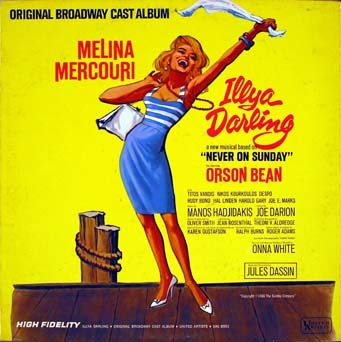
I’ve been obsessed with the CD release of Illya Darling. I received the album the other evening and have been unable to listen to anything else. The show was a musical adaptation of the hit 1960 comedy Never on Sunday about a Grecophile from America traveling to Greece in search of a lost ideal, something he finds in a carefree prostitute in Piraeus and tries to reform her. The film was directed and written by Jules Dassin, who also appeared in the film as the American (probably due to the budget constrictions). The film was an unexpectedly huge success, as it was a small independent produced for $150,000 and released through United Artists. The film turned Melina Mercouri into an international superstar and a sex symbol at the age of 40 (suck it, Hollywood!). The score and the Oscar-winning title song were composed by Manos Hadjidakis, which also took on a popularity of its own. Dassin and Mercouri received Oscar nominations; he for writing and directing, she as Best Actress.

The musical opened at the Mark Hellinger Theatre in 1967 directed by Dassin and starring Mercouri. Orson Bean was Homer, the priggish American and Hal Linden made his Broadway debut. In an unusual move, two other actors from the film reprised their roles for the stage show: Titos Vandis and Despo (who was playing the earthy, older prostitute named Despo). The show received mostly negative reviews, but managed to play 320 performances based on Mercouri alone (who received nothing short of love letters). The musical was nominated for six Tonys, including Best Musical and Best Actress in a Musical, but went home empty-handed.

The cast album was released on record by United Artists, the company that had distributed the original film as well as the other Dassin-Mercouri smash hit Topkapi. For whatever reason, the songs were placed out of order on the LP, most likely to fit the time constraints (which is why material was left off the album). Well, Illya had remained a vinyl collector’s piece for 42 years until this week when Kritzerland released it. There had been word of a release from DRG, but it kept getting postponed and postponed. But now it’s finally here. Kritzerland founder Bruce Kimmel has worked considerably on the album, restoring the score to its show order, improving the sound for CD and restoring two cut bits, one of which is the show’s opening number. When I first read that “Bouzouki Nights” was not the overture, and wasn’t even the real name of the piece, I was a bit disappointed. It’s one of my favorite tracks and is one of the most joyous instrumental pieces recorded for an original Broadway cast album.

However, as soon as I pressed play on the overture, a delicate and sweeping paean to the bouzouki (an instrument I just love), I was immediately taken with the new recording. Hearing the subtle nuances of Ralph Burns’ masterful orchestrations with such clarity had an unexpected effect on me. I had previously found the cast album on record to be something of a guilty pleasure, but now I was finding myself genuinely enjoying the score. It never achieves greatness but thrives on the music of Manos Hadjidakis and the charming Mercouri. I have never understand why Joe Darion worked as a Broadway lyricist, whose work here is less than stellar. His big show is Man of La Mancha, and don’t get me started on the quality of those lyrics… As it turns out, Sondheim himself was brought in to doctor the lyrics while the show was in previews, but none of his work actually appears in the final show. There’s an amusing anecdote regarding Mercouri and Sondheim in the liner notes, and the reason why she reverted back to Joe Darion’s version of “Piraeus, My Love.” Turns out she dropped his lyric because he “didn’t go backstage every night to pay homage to his star.” I question the validity of this assessment, but it makes for amusing reading, no? Kimmel wrote the liner notes himself and they are concise and endlessly informative.

There are a couple of strong numbers – the song “Never on Sunday” was recycled into the second act (retaining its original character-driven Greek lyric, not that vapid English substitute so widely recorded), a lovely ballad “After Love,” the comic “Medea Tango” showcasing Illya’s warped interpretation of Greek tragedy (this post’s title) and the charming finale “Ya Chara.” On the other hand: in Open a New Window, Ethan Mordden’s tome on 60s musicals, the author calls “I’ll Never Lay Down Anymore” the worst theatre song of the decade. (Like I said, there is not a lot of critical love for the show).

Tangent: The show opened April 11, 1967 on Broadway. Ten days later the Greek military junta took over in Greece. Mercouri became an avid anti-fascist activist almost instantaneously. Being in New York and out of Greece, the junta seized her property and revoked her citizenship. She rallied around the world and became an iconic figure promoting the re-establishment of democracy in her homeland. When asked for comment about the loss of her citizenship, Mercouri said “I was born a Greek and I will die a Greek. Mr. Pattakos (who revoked it) was born a fascist and he will die a fascist!” Mercouri spoke out against the tyranny of Greece in speeches world-wide, leading rallies and marches, singing and recording albums of protest. She was subject to several terrorist attacks and even an assassination attempt, which only made her more determined. When the junta fell in 1974, Mercouri became involved in Greek parliament eventually becoming the first female Minister of Culture for Greece. Her contributions on the political level in Greece made her a national treasure. Mercouri died in 1994 and she was given a state funeral with Prime Minister’s honors. Thousands upon thousands of Greeks came out to mourn. There is a bust of the actress/politician in Athens, right near the steps leading to the Parthenon, for whose preservation as an archaeological park she worked tirelessly. Truly a remarkable life. End tangent.

It’s highly unlikely that the show will ever be revived (even though I was surprised to see it listed on the Tams-Witmark licensing website), so this album remains one of the few links to this rather obscure musical. Here is the song order from both releases to give you an idea how inaccurate the record album was in representing the show. Let me tell you, it makes a difference to hear the score as it should be heard.

The LP release track list:

1. Bouzouki Nights
2. Piraeus, My Love
3. Golden Land
4. Illya, Darling
5. Medea Tango
6. I’ll Never Lay Down Anymore
7. Never on Sunday
8. Overture (Entr’acte)
9. Love, Love, Love
10. I Think She Needs Me
11. Dear Mr. Schubert
12. Heaven Help the Sailors on a Night Like This
13. After Love
14. Yorgo’s Dance
15. Ya Chara

The new CD track-list (and proper show order):

1. Overture (formerly Entr’acte)
2. Po, Po, Po (previously unreleased)
3. Piraeus, My Love
4. Golden Land
5. Yorgo’s Dance
6. Love, Love, Love
7. I Think She Needs Me
8. I’ll Never Lay Down Anymore
9. After Love
10. Birthday Song (previously unreleased)
11. Medea Tango
12. Illya Darling
13. Dear Mr. Schubert
14. Never on Sunday
15. Heaven Help the Sailors on a Night Like This
16. Taverna Dance (Bouzouki Nights on LP)
17. Ya Chara

There were only 1,000 copies of the cast album printed, and the album is almost entirely sold out. But if you’re interested, there are still a few copies left. With this and the recently released Anya, Kimmel has hinted there more to come. Both were recorded on the United Artists label, so perhaps I should keep my fingers crossed for a CD release of the original London cast album of Promises, Promises with Tony Roberts and Betty Buckley…

Hudson Valley Shakespeare Festival 2009 Season

For those of you in the region:

HUDSON VALLEY SHAKESPEARE FESTIVAL ANNOUNCES
2009 ECO-COMIC STIMULAS SEASON

The Hudson Valley Shakespeare Festival has announced its 2009 Eco-Comic Stimulus Season. Designed to bring laughter, joy and relief from the news of the day in a spectacular outdoor setting, the Eco-Comic Stimulus Season offers something for everyone at below market prices.

The season features total mad-cap hilarity; love hiding in plain sight; battles of wit (and the sexes); shipwrecks; marriage; near death experiences; and one of the greatest reunions in all of Shakespeare. It will open with last season’s runaway hit, the impossibly funny The Complete Works of William Shakespeare (Abridged), followed by the romantic comedy Much Ado About Nothing, and the action packed adventure/romance, Pericles.

The Complete Works of William Shakespeare (Abridged), directed by the Festival’s Founding Artistic Director Terrence O’Brien, will open the season on June 20 (previews begin June 16). Much Ado About Nothing, directed by John Christian Plummer opens June 27 and Pericles, also directed by Mr. O’Brien, will open on July 4. The three plays will run in repertory through September 6. Performances begin at 7pm Tuesday, Wednesday and Thursday; 8pm Friday and Saturday; and 6pm on Sundays.

“These are tumultuous times and we know that a lot of people are really struggling,” said Mr. O’Brien. “We hope that our 23rd season will provide a bright spot by giving people an opportunity to leave the news behind for a few treasured hours. I think we have everything you could ask for built into our plan: romance, adventure, comedy, a magical setting and a night out that leaves some money in the bank (or under the mattress)! We may not be able to provide tax relief, but we can certainly provide eco-comic relief!”

The Hudson Valley Shakespeare Festival has inspired and delighted audiences with its vigorously original interpretations of the great works of William Shakespeare for twenty-two seasons to much critical acclaim from The New York Times, The Wall Street Journal, The New Yorker, The Poughkeepsie Journal, The Journal News and numerous other regional and national publications. Founding Artistic Director Terrence O’Brien has maintained a commitment to making the timeless plays accessible to all audiences, relieving the burden of heavy language and over-dramatization that so many equate with Shakespeare. “We want the audience to feel the same way about the plays as we do,” explained O’Brien. “The stories are timeless and we work to eliminate the affectation so often associated with Shakespeare. Our productions are lively, fast-paced and reflect our own excitement. You know it’s working,” he continued, “when you not only have people return season after season but every year they bring more new friends.”

The Hudson Valley Shakespeare Festival, the region’s only professional resident Shakespeare company, makes its home under an open-air tent theater perched high up on the banks of the Hudson River on the grounds of the historic 19th Century Boscobel estate in Garrison, New York. Using the dramatic views of the Hudson Highlands and the sweeping vistas from the elegant lawns of Boscobel as near-perfect stage scenery, the critically acclaimed Hudson Valley Shakespeare Festival presents unparalleled productions with the perfect marriage of theater and nature. Audience members are invited to arrive two hours early in order to enjoy a picnic meal – with one of the most spectacular al fresco views – on the grounds of the estate.

“If you’re searching for the best of all possible times … you’ll have trouble topping the Hudson Valley Shakespeare Festival. I can’t think of another outdoor festival that has a higher overall batting average. Hudson Valley’s deliberately informal productions are a model of cultural populism at its most engaging and effective.” -The Wall Street Journal

TICKETS AND INFORMATION
Ticket prices for all performances are $29-$46. Tickets are available through the HVSF Box Office which opens on April 27: 845-265-9575. Tickets are also available online beginning April 17 at hvshakespeare.org. Discounts are available on most nights for groups, students, senior citizens and children 12 and under. The Festival offers several special packages, including a tour of the Boscobel mansion and Exhibition Gallery plus tickets. In addition discounts at local hotels and restaurants are also available. For packages and information visit the Festival website, www.hvshakespeare.org and are available through the box office.

For more information about the 2009 Hudson Valley Shakespeare Festival, as well as information about their ongoing Education and Community Outreach Programs, contact the Festival at (845) 265-7858.

The Art of the Broadway Musical

I found the 1600 Pennsylvania Avenue window card on this website which is an attempt by Gilbert Sanchez to maintain an online site containing the poster art for Broadway musicals of the 20th century. It’s fun to go through and have a look at each decade (it starts with 1943, the year of Oklahoma! and dawn of the Golden Age) to see how the hits and flops were promoted in style, some varying from the more familiar logos seen on their original cast album. (In particular, take a look at the alternate poster for The Sound of Music with a rather drab background of white and green and a picture of Mary Martin skipping between Rodgers and Hammerstein in her novitiate costume). The site is a work in progress and the author admits such. He’s on the lookout for images for other posters and let’s us know what’s missing from his archive.

The Most Happy Fella

Seth Rudetsky reports that there are plans for a Broadway revival of the 1956 Frank Loesser musical The Most Happy Fella. The musical, a hybrid of opera and musical comedy was a big success, though it probably would have fared better had it not opened six weeks after the juggernaut My Fair Lady). Loesser took on the chores of both book and score, adapting Sidney Howard’s Pulitzer Prize winning play They Knew What They Wanted by dropping the sociopolitical elements and heightening the romance with impressive results. The basic story line is about a waitress who strikes up a correspondence with an elderly Italian vineyard owner Tony in Napa. When she asks for a picture, he sends a snapshot of his handsome foreman fearing she will reject him due to his age. The night she arrives to meet him, he is nearly killed in a car accident. In spite of her humiliation regarding the mixup, she marries Tony before he goes under anesthetic and ends up in the arms of the foreman. And this is only the first of three acts!

The show starred the operatic baritone Robert Weede, Jo Sullivan (later Loesser), Art Lund and that belter extraordinaire Susan Johnson. The show won no Tony awards, ran 676 performances and was never made into a film (unfortunately). There have been several revivals including one in 1979 that aired on PBS and a Lincoln Center produced import of a scaled-down, 2-piano revival originated at the Goodspeed Opera House. Most recently, the show was part of the City Opera lineup though that particular production was not well-received by critics or audiences.

I have a particular fondness for the score, combining the best of both worlds with soaring ballads and arias as well as memorable comedy and production numbers. The original cast album was produced for Columbia Records by Goddard Lieberson. Instead of releasing the usual one-LP record that was the norm for theatre music, Lieberson insisted on recording the entire show. It marked the first original cast album to be released on three LPs in a boxed set with the show’s souvenir program. (A highlights LP was concurrently put out as well; I have both). With the exception of a small scene, a few lines of dialogue and a bowlderized lyric here or there (they weren’t allowed to say “son of a bitch” on the record), the recording is the practically the entire musical making for a satisfying account of the original definitive performances.

Trivia for TV lovers: This musical was featured prominently on one of the final episodes of I Love Lucy in which the foursome comes into town for dinner and a show only to discover that Lucy has mistakenly ordered tickets for the earlier matinee performance. Shenanigans ensue at the Imperial Theatre (not the real one, obviously). The episode even presented a few snippets from the cast album during audience scenes. (The way they present the show it seems as though Desilu had some stake in the stage show).

Here are those leads appearing on Ed Sullivan in 1956:

This is just awesome…

One of the unexpected joys of today. Some Julie Andrews flavored guerrilla theatre at the Central Station in Antwerp, Belgium. (Thanks, Kari!)

Addendum: Turns out this was done on the morning of March 23, 2009 sponsored by a local station that’s hosting a reality show to cast Maria in a new production of the musical. Anyway, this is my favorite flash mob. Enjoy.


Cloris

The irrepressibly unstoppable Cloris Leachman seems about able to do or say anything. After bringing herself to the pop culture forefront in the last season of “Dancing With the Stars” with her outrageous antics, Leachman has just released her autobiography, Cloris. The book is a rather madcap retrospective about her life and career, which includes the pre-Broadway production of Come Back, Little Sheba, Shakespeare with Katharine Hepburn, a stint in South Pacific, one of the many mothers on TV’s “Lassie,” her Oscar-winning performance in The Last Picture Show, and of course her Emmy-winning turn as the balletic narcissist Phyllis Lindstrom on “The Mary Tyler Moore Show,” and the spin-off series “Phyllis.” Oh yeah, and all those Mel Brooks’ movies.

Cloris is never short of entertaining whether she’s recounting her experiences in various shows, musing over acting technique, discussing her friendship with Marlon Brando and the Kennedy clan, et al. She reveals a great deal of her close relationship with her always encouraging and free spirited mother and also her strained relationship with her seemingly distant father. College time at Northwestern University with classmates Charlotte Rae (whom she would later replace on TV in “The Facts of Life”) and Paul Lynde. Winning Miss Chicago and as a result winning third in the Miss America Pageant. Who knew that she was the one responsible for Julie Harris starring in I Am a Camera? There is a sense of bewildered honesty as if she can’t believe her own life either. She has fond memories raising her five children, and utter heartbreak at the devastating death of her son Bryan to drug addiction.

Leachman has written the book with her ex-husband, George Englund, with whom she maintains an incredibly close relationship. While a brisk read at 289 pages, the book is more ennervating for Cloris’ flighty stream of consciousness in relaying the facts of her life. It wouldn’t be Cloris if it weren’t in her charming, witty and bemused style. It’s worth picking up to have a glimpse at a show-biz legend showing no signs of slowing down and always looking for the next challenge. It sounds nuts, but I challenge her to take on the role of Violet Weston in August: Osage County. (If she can be swirled around a dance floor by her ankles, she can raise hell on those stairs).

Meanwhile, for the lovers of Mame and Jerry Herman out there, here is the title theme song of her show Phyllis, an amusing send-up of the musical’s title song.