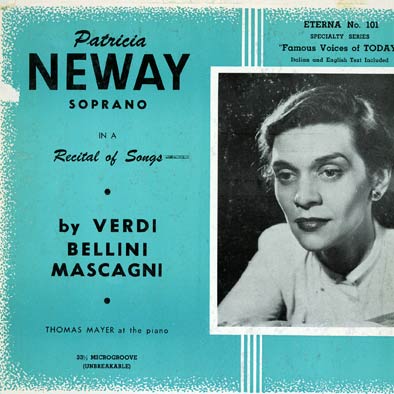
Patricia Neway (1919-2012)

Patricia Neway - Lady M

Operatic soprano and Tony-winner Patricia Neway, best known for her associations with Gian Carlo Menotti and Rodgers and Hammerstein, died peacefully in her home in Corinth, Vermont on January 24, 2012 of natural causes. Ms. Neway was 92.

Born in Brooklyn, in 1919, Neway studied at the Mannes College of Music, making her professional debut in the Broadway chorus of Offenbach’s La Vie Parisienne in 1942. Her first leading role in an opera came courtesy of a 1942 production of Cosi fan Tutti with the Chautauqua Opera. Neway performed regularly with the NYCO from 1951-1966, making her debut in the world premiere of Tamkin’s The Dybbuk and originating The Mother in Weisgall’s Six Characters in Search of an Author (opposite Beverly Sills). The soprano was featured soloist of the Opera Comique in Paris from 1952-54, singing Tosca and Katherina Mihaylovna in Risurrezione, as well as principal singer in the first two seasons of the Festival dei Due Mondi in Spoleto, Italy.

A self-proclaimed hybrid, Ms. Neway famously helped Menotti bring opera to Broadway. She created a sensation as Magda Sorel in the Pulitzer Prize winning original Broadway production of The Consul, in which she stopped the show with the climactic aria “To This We’ve Come.”  She would go onto sing the role in the opera’s London and Paris premieres, and later recreated the role for television in 1960. Her association with Menotti continued as the Mother in Maria Golovin, a role she premiered in Brussels in 1957, which she later played on Broadway and with the NYCO. Neway also appeared in NYCO productions of The Medium and Amahl and the Night Visitors.

Most notably, Ms. Neway originated the role of the Mother Abbess in The Sound of Music opposite star Mary Martin, introducing “Climb Ev’ry Mountain” to the public. She won the Best Featured Actress Tony for her efforts. In the 1960s, her association with Rodgers and Hammerstein continued with revivals of The King and I (Lady Thiang) at Lincoln Center and Carousel (Nettie Fowler) at the City Center. Neway also appeared in a 1967 TV version of the latter starring Robert Goulet. (I’m not one hundred percent positive, but I think Ms. Neway is the only person to have played these three roles in major NY productions).

The dramatic soprano retired to Corinth, VT where she lived with her husband John Francis Byrne, who passed away in 2008. Speaking with Ms. Neway’s niece today, I learned that the soprano enjoyed her life immensely, from the success of her career to the privacy of her retirement.  On February 25, Vermont Public Radio will be live streaming a retrospective on the soprano’s career.

“Follies” – The New Broadway Cast Recording

Follies - NBCR

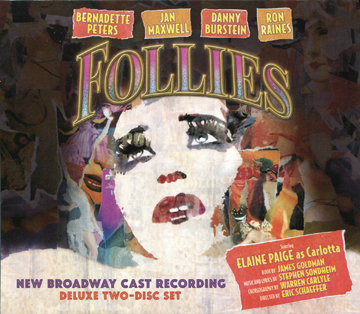
Though the acclaimed revival of Follies will end its limited engagement on January 22, the landmark production has produced a staggering cast album, recorded by PS Classics and is without question a must-have and must-hear. The lavish 2-disc set captures is almost complete, capturing most of the score (more on that later) with its original orchestration intact (rare for any musical these days, most especially for a Sondheim show). It also may be the greatest album PS Classics has ever released; regardless of whether you agree with me or not, it is a spectacular achievement.

There are already four official recordings of Follies available on the market. There’s the devastatingly truncated original that preserves some incredible snippets of the performances (particularly Alexis Smith’s “Could I Leave You?” and Dorothy Collins’ “Losing My Mind”), the original London cast with its considerable changes, as well as the famed live concert recording Follies in Concert (or as I think of it, Follies without Context) and the most complete reading of the score, including cut material, the 1998 PaperMill production.

This latest Follies is as essential as these four. While I can’t say the album is definitive (the production and this recording lack the dance specialty “Bolero d’Amore”), it comes quite close. The album carefully captures the show in a way that in some ways improves upon the stage production, most specifically the inclusion of elements from the original 1971 libretto. In effect, the album is more like a radio play. Much of what is spoken is contained on separate tracks so you can program those out if you’re not a fan of that on cast albums (and knowing the friends I have, there are many who are not).

The disc captures the best of what’s onstage: Danny Burstein’s staggering portrayal of Buddy Plummer, with “The Right Girl” and especially “The God-Why-Don’t-You-Love-Me Blues.” Jan Maxwell’s brittle sophistication shines through, and the way she lands “GUESS!” in “Could I Leave You?” is one of the most satisfying things I have ever heard. Bernadette Peters tones down some of the more neurotic aspects of her onstage character for a more solidly sung performance on disc. Meanwhile, Ron Raines lends gravitas and his large baritone voice to Ben Stone’s mid-life crisis.

Onto the featured players, Elaine Paige sings a socko “I’m Still Here,” while Terri White tears into “Who’s That Woman?” which includes all the ad libs tossed around during the dance sequences. Rosalind Elias and Leah Horowitz are in glorious voice on “One More Kiss” while Susan Watson, Don Correia, the glamorous Mary Beth Peil and Jayne Houdyshell tear into the Montage trio. Every song is a gem, and each one has been recorded with great care.

One of the stars of this production, and subsequent recording, is the 28 piece orchestra conducted by James Moore. This production marked the first time I had seen a Sondheim production on Broadway using the original orchestration, and does it make all the difference. Kudos to Tommy Krasker and the team at PS Classics, as this recording brings out the colors and nuances in Jonathan Tunick’s brilliant charts with great clarity.

The double disc album is beautifully packaged by PS Classics, with a lavish booklet including an essay from NY1’s Patrick Pancheco, a personal note from album producer Tommy Krasker and a plot synopsis by Sean Patrick Flahaven. Also included are the show’s complete lyrics, as well as the dialogue heard throughout. Interspersed are some stunning photographs of the production. I don’t remember the last time a cast album was as stunning to look at as well as hear.

“And Eve Was Weak”

I suppose you can make a case that Carrie is the greatest musical flop in history. I’ll let you decide what I mean by “greatest.” The adaptation of Stephen King’s novel, with a book by Lawrence D. Cohen and score by Michael Gore and Dean Pitchford, was first produced by the Royal Shakespeare Company in Stratford, England in early 1988. A story of the high school outcast with the crazy religious fanatic mother from hell and telekinetic powers was a popular bestseller and a Oscar-nominated horror film starring Sissy Spacek and Piper Laurie.

The musical proved to be far less than successful. Reviews were mixed in England, and the show was plagued by considerable technological problems. Yet the show continued to Broadway only two months later where it closed after 5 performances amidst some of the most scathing pans known to theatre. Ken Mandelbaum even called his essential book on flop musicals Not Since Carrie (and I implore to you read it if you haven’t; it’s fascinating, informative and entertaining). The score is something of a legend, and has an ardent group of fans. For more of the dish, read Mandelbaum’s book, you can read about the horror story that was the musical’s tenure on Broadway.

While I don’t care for much of the show (not available on cast album, but there is a sound system recording of the Broadway run that has made it’s way to seemingly everyone), the numbers for Carrie and her mother are actually quite arresting, their duets and Margaret’s solos especially. If the rest of the score had been half as good as these numbers, Carrie’s fate might not have been worse than death.

Linzi Hateley was cast as the title character and with her youthfulness and large belt voice managed she emerged mostly  unscathed from the entire ordeal, even winning a Theatre World Award. More curious: Barbara Cook was cast as Margaret White, in her first book musical appearance since the fast failure of The Grass Harp in 1971. After part of the set  nearly decapitated her, Ms. Cook made the decision not to continue with the production after Stratford. For NY, Betty Buckley (also the gym teacher from the film version) was cast. I can’t think of more of a divergence in styles, from Cook’s soprano to Buckley’s fiery belt, but that’s the way it was.

Here is a glimpse into both performing “And Eve Was Weak,” the first number where we really get to see Margaret White go off the deep end.

Barbara Cook

%CODE1%

Betty Buckley (excerpt)

%CODE2%

Pretty soon New York will revisit this darker chapter in its history, when MCC Theatre revives the notorious Carrie in a revised version that will address the issues that made it an embarrassing and high profile failure in the 80s. Tickets are hard to come by, and it is one of the more anticipated offerings of the winter, with performances starting January 31. Marin Mazzie and Molly Ranson, who did a reading a couple years ago, will star. It’ll be interesting to see if Carrie has a better time at the prom the second time around.

Bringing Back ‘Man with a Load of Mischief’

Man with a Load

I first heard of Man with a Load of Mischief a couple years ago while reading a discussion on essential cast albums not available on CD. The small off-Broadway musical, which had been a hit in 1966, starred two favorites: Reid Shelton, the sonorous baritone known mostly as the original Daddy Warbucks in Annie and the lovely Virginia Vestoff (Abigail Adams in the original Broadway company and film adaptation of 1776). I set off on the task of finding a copy of the not-so-easy-to-find album and when I did, I found myself quite enchanted.

Man with a Load of Mischief is a chamber musical based on a play by Ashley Dukes with a book by Ben Tarver, and a score by Tarver and John Clifton. It opened off-Broadway at the Jan Hus Playhouse in late 1966 to great notices and proved to be something of a sleeper hit that season, running for 241 performances. Set at an English countryside inn in the early 19th century, as an accident between two coaches brings four strangers together for the night. The innkeeper and his wife are of the older, doddering sort who wish to play matchmaker, thinking the Lady of one coach and the Lord of the other would be well suited for each other. However, she longs to be away from the noble lifestyle, and he is interested in currying favor. The saucy maid and a mysterious valet complicate matters further. The score brims with wit and charm and after the first time I listened to the album, I listened to it twice more.

The jaunty melodies are tuneful and delightful, with a small but sharp orchestration reflecting the early period setting of the piece. The lyrics, too, are also worthy of note, both clever and earnest. There are several songs I enjoy, notably the frolicsome Maid’s “Once You’ve Had a Little Taste,” but I was not prepared for the drop dead gorgeous “Come to the Masquerade” sung by Shelton toward the end of the first act. I was floored, and have found myself listening to that song and its reprise on repeat.

The show was recorded by Kapp Records, but with time it seemed that the show slipped from the radar. The musical has not been forgotten and there are ardent fans of Mischief. The show was presented by Musicals in Mufti in 2003 with Diane Sutherland as the Lady. Ms. Sutherland appeared on the subsequent studio album, but I confess the recording is marred by the use of a synthesizer. While it is more complete, it ultimately lacks the charm and voices of the original.

Just a couple months ago, while browsing the Drama Book Shop with SarahB, I found a copy of the vocal score. I hadn’t known that the writers had only recently published the score for the very first time. I was uber-excited to see it there, because it’s another step for the work to be performed and revived. (Enough cannot be said for what the exposure a cast album and a readily available libretto/score can do for a lesser known title).

Well, Clifton and Tarver have taken it upon themselves to try and bring the show back to New York. In order to get a jump start, they have put together a movement on Kickstarter to raise funds for a backer’s presentation. Any contribution is welcome, but I’d like to point out to musical theatre enthusiasts, for $25, you can get a specially remastered copy of that prized 1966 cast album. There are other enticing items for those who are able to contribute more (including tickets to the backer’s audition, autographed rarities and other gems.

Their goal is $30,500 by January 6. Mounting anything in NY, from a musical to a horse, is not cheap and money is needed to pay those who would be working behind the scenes, as well as the space necessary for rehearsals and presentations. As of right now, they have reached $29,422. Almost 96% of the goal. Not bad for a little show that could, eh? I have never considered myself a backer of anything, but I couldn’t resist the chance to help this small show, one that I enjoy so much, make its way back to the stage so I can have an opportunity to see it. And so I can get a remastered copy of the cast album.

The Year of Living Cinematically

Another year, another year of cinematic viewing. Things have gotten a bit fancier and more accessible now that I have blu-ray player and access to Netflix streaming. Incidentally, my viewing of films has gone down this year as I’ve found myself catching up a bit more with various television shows, most notably Pushing Daisies and The Dick Van Dyke Show, to name a couple. The same rules apply: every title was watched in its entirety and an asterisk indicates a film watched for the first time.

*The Thin Red Line (1998) 1/1
*True Grit (2010) 1/3
*Modern Times (1936) 1/4
*The Young Victoria (2009) 1/18
*Black Swan (2010) 1/22
*The Kids Are All Right (2010) 1/23
*Rabbit Hole (2010) 1/28
*The King’s Speech (2010) 1/28
Days of Heaven (1978) 2/4
*The Madness of King George (1994) 2/5
*Scott Pilgrim vs. the World (2010) 2/12
*Toy Story 3 (2010) 2/17
*Let Me In (2010) 2/18
*Due Date (2010) 2/22
*The Fighter (2010) 2/25
*La Cage Aux Folles (1978) 3/3
Z (1969) 3/4
Slap Shot (1977) 3/7
*Agnes of God (1985) 3/7
The Bridge on the River Kwai (1957) 3/13
*Ong-Bak (2003) 3/14
Howards End (1992) 3/16
Dial M for Murder (1954) 3/16
*Grown Ups (2010) 3/17
*Royal Wedding (1951) 3/19
Psycho (1960) 3/20
The Killing Fields (1984) 3/20
*The Boys: The Sherman Brothers’ Story (2009) 3/23
*Grumpy Old Men (1993) 3/24
*The Cove (2009) 3/27
Gentlemen Prefer Blondes (1953) 3/27
*Decision Before Dawn (1951) 3/28
The Manchurian Candidate (1962) 4/2
*Exit Through the Gift Shop (2010) 4/6
*The Town (2010) 4/8
*Joan Rivers: A Piece of Work (2010) 4/8
*The Whales of August (1987) 4/8
*Garbo Talks (1984) 4/9
Arthur (1981) 4/10
The Last Picture Show (1971) 4/12
*Marvin’s Room (1996) 4/15
*Sweet Charity (1969) 4/15
*The Teahouse of the August Moon (1956) 4/17
*Dr. No (1962) 4/18
*Head (1968) 4/22
*Drive, He Said (1971) 4/23
*Jane Eyre (1944) 4/26
The King’s Speech (2010) 5/6
The Turning Point (1977) 5/8
*Tangled (2010) 5/18
*Hereafter (2010) 5/21
*Beauty and the Beast (1946) 5/21
Taxi Driver (1976) 5/22
*Jesus Camp (2006) 5/24
Topsy-Turvy (1999) 5/31
The Prince and the Showgirl (1957) 6/5
*Big (1988) 6/11
Fanny (1961) 6/12
*Inside Job (2010) 6/16
*Love in the Afternoon (1957) 6/17
*The Fog (1980) 6/19
10 (1979) 6/20
The Big Country (1958) 6/21
*Le Cercle Rouge (1970) 6/21
*Paths of Glory (1957) 6/22
The Social Network (2010) 6/23
The Enforcer (1976) 6/27
*The Last Metro (1980) 6/29
*It’s Kind of a Funny Story (2010) 7/2
The African Queen (1951) 7/3
True Grit (2010) 7/4
*Just Go With It (2011) 7/7
The Pajama Game (1957) 7/13
*The Sand Pebbles (1966) 7/16
The Sound of Music (1965) 7/19
*The Tillman Story (2010) 7/20
Far From the Madding Crowd (1967) 7/20
The Philadelphia Story (1940) 7/21
Doctor Zhivago (1965) 7/22
*Repulsion (1965) 8/5
*Shutter Island (2010) 8/13
*Carol Channing: Larger Than Life (2011) 8/17
*Cedar Rapids (2011) 8/29
*The Killing (1956) 8/30
*Killer’s Kiss (1955) 8/30
*Waiting for Superman (2010) 9/6
How to Marry a Millionaire (1953) 9/7
*Conan O’Brien Can’t Stop (2011) 9/14
*The Beaver (2011) 9/15
*The Darjeeling Limited (2007) 9/18
*Animal Kingdom (2010) 9/28
The Red Shoes (1948) 10/1
*Skidoo (1968) 10/3
The Lion in Winter (1968) 10/10
Shakespeare in Love (1998) 10/12
*Running with Scissors (2006) 10/13
Hannah and Her Sisters (1986) 10/13
*The Tree of Life (2011) 10/16
The Best Years of Our Lives (1946) 10/18
All About Eve (1950) 10/21
*The Phantom of the Opera (2004) 10/24
The Monster Squad (1987) 10/25
The Addams Family (1991) 10/25
Poltergeist (1982) 10/25
*An American Werewolf in London (1981) 10/26
Reds (1981) 10/27
The Shining (1980) 11/4
Halloween (1978) 11/4
*Attack the Block (2011) 11/8
*Tower Heist (2011) 11/10
The Night of the Hunter (1955) 11/14
Some Like It Hot (1959) 11/14
Rushmore (1998) 11/23
Twelve Angry Men (1957) 11/23
The Music Man (1962) 11/23
Black Narcissus (1947) 11/24
Invasion of the Body Snatchers (1956) 11/26
*The Muppets (2011) 12/1
From Here to Eternity (1953) 12/7
The Bishop’s Wife (1947) 12/12
Elf (2003) 12/15
Miracle on 34th Street (1947) 12/19
*Fitzwilly (1967) 12/19
Gigi (1958) 12/20
*Midnight in Paris (2011) 12/21
Twister (1996) 12/28
The Lady Vanishes (1938) 12/28

My Favorite Performances, 2011

Matthew Amendt – Hamlet. The Hudson Valley Shakespeare Festival celebrated its 25th anniversary with its first-ever presentation of this most famous of plays, with a kinetic, explosive production directed by Terrence O’Brien. Stripped of almost all trappings, this production was among the most compelling I have ever seen, and it was mostly due to Mr. Amendt’s compelling performance as the young Prince of Denmark. Amendt was riveting from start to finish, a towering achievement especially when you consider that he was sharing the stage with some the Festival’s best repertory players. His choices were big and bold, and made Hamlet something he rarely is: sympathetic. I don’t think I have ever heard so rapt an audience at any other Shakespeare performance I’ve attended.

Nina Arianda – Born Yesterday. I have yet to see Ms. Arianda’s breakout performance in Venus in Fur, but will rectify that this February when that show reopens at the Lyceum Theatre, but I am beyond thrilled I got to witness this star-on-the-rise reinvent a classic role (Billie Dawn, made famous by Judy Holliday on stage and to Oscar-winning effect on film). The Kanin classic, which also starred Jim Belushi and Robert Sean Leonard, doesn’t really take off until Billie Dawn makes her entrance. From that point to the end of the play, it was impossible to look at anyone other than Ms. Arianda, a luminous, effervescent vision on or offstage. I ran out of superlatives with which to rave her performance last spring. Nina Arianda is destined for stardom, not unlike Ms. Holliday, and any chance you have to see her live onstage, you need to run, not walk.

Danny Burstein – Follies. I have been a fan of Follies for years, and usually the bulk of attention gets lavished on the leading ladies. However, in this Broadway revival imported from the Kennedy Center, Mr. Burstein makes waves as Buddy Plummer, the sad-sack salesman married to neurotic-bordering-on-psychotic Sally. Behind the smile is immense pain, expressed brilliantly in “The Right Girl” and “The God-Why-Don’t-You-Love-Me Blues.” In short, in a show that features some of the best songs ever heard in a musical, it is Mr. Burstein who rips your heart out. He is a Broadway treasure and this performance is the latest in a line of personal triumphs.

Tyne Daly – Master Class. After seeing Tyne Daly’s most recent cabaret at Feinstein’s and her various characters in Love, Loss and What I Wore, I knew when I heard that Ms. Daly would be cast against type as the great opera diva Maria Callas, it was going to be a must-see performance. I was right; Ms. Daly transformed herself in look and appearance, creating a galvanizing performance that was funny, bold and fearless. As much as I laughed at the humor in Terrence McNally’s play (a highly fictionalized variation on the famed master classes Ms. Callas gave at Juilliard in the ’70s), it was the two aria-like monologues in which Daly as Callas stepped out of the classroom and into her memory. It was rapturous, and the stuff of great theatre. If you missed it here, you can catch Tyne Daly in Master Class in the West End this winter.

Jan Maxwell – Follies. Over the past few months, I have had the immense joy of seeing the Broadway revival of Follies several times including its first preview, opening night among others. Each time, Maxwell’s performance as Phyllis Rogers Stone has grown only more and more fascinating and deeper. From small nuances, like her absolute joy in the Mirror Number, or the way she clutches herself when Young Phyllis says she wants a child in the Loveland transition to the bigger moments like her killer “Could I Leave You?” and a showstopping display of confidence and elan in “The Story of Lucy and Jessie,” Ms. Maxwell is just staggering.

Jason O’Connell – Around the World in 80 Days. Mr. O’Connell has proven with past performances that he is one of the most versatile actors working at the Hudson Valley Shakespeare Festival. This year, he had the opportunity to express the dynamic nature of his range with a riveting portrayal of Claudius in the HVSF Hamlet, but it was his comic tour de force in this delightful farce that really stood out to me as one of the freshest, funniest turns onstage this year. In a variety of roles, Mr. O’Connell was unafraid to go the extra distance for the play and it worked like gang-busters; his fully-committed performance resulted in some of the largest laughs I’ve had all year.

Mark Rylance. Jerusalem. Every once in a while a performance comes along that just wipes me out. The sheer physicality, emotional breadth and staggering fall of Johnny “Rooster” Byron in Jez Butterfield’s new play was nothing short of extroardinary, and it seems almost impossible to think that another actor could do what Mark Rylance did onstage at the Music Box Theatre. I practically had to be carried out of the theatre when it was done, I was so emotionally spent. In a good way. Rylance is a contemporary genius and continually surprises audiences with his chameleon-like way of going from role to role.

Leigh Williams – The Life and Death of King John. One of the unexpected surprises of my theatergoing this year was this fascinating adaptation of one of Shakespeare’s more problematic plays. But in the hands of the New York Shakespeare Exchange, and director Ross William, King John was presented with a contemporary twist that fused Shakespeare with the technology and political climate of 2011. In a mostly excellent cast, it was Ms. Williams’ towering performance as Constance in the first act that held me rapt. A pillar of strength and nuance, Ms. Williams commanded every scene in which she appeared, with dynamite results. I had never heard of Williams before this production, but I look forward to seeing whatever she does from here on out.

It would be remiss of me to recount my favorite performances of the year and leave out the entire cast of The Normal Heart. When browsing through the list of shows I’ve seen this year, I kept coming back to The Normal Heart, and the individual performances of its ensemble, all stellar. Joe Mantello’s impassed Ned was a performance of a lifetime, John Benjamin Hickey was the heart and soul of that show. Meanwhile Ellen Barkin portrayed the takes-no-guff Dr. Brookner with an unsettling bluntness, and her explosion in act 2 is one of the most genuine expressions of rage I’ve ever witnessed in live theatre. Lee Pace, Jim Parsons, Patrick Breen, Mark Harelik and the rest of the company were all so excellent, it was one of the ensemble events of the year and a haunting experience for anyone fortunate to catch this multi-Tony winning limited engagement this spring.

Honorable mentions to those I saw performing as themselves, including Marilyn Maye at Feinstein’s last June (with a terrific song list, a great banter and delicious high kicks during the Jerry Herman encore), soprano Deborah Voight singing musical theatre standards at Carnegie Hall with the Collegiate Chorale (singing some of the best of musical theatre with great fun, but her personal triumph was “My Man’s Gone Now” from Porgy and Bess), and of course Hugh Jackman: Back on Broadway.
“Bonnie & Clyde”

Odds are if you mention the name Frank Wildhorn to a die-hard theatre fan, you’re going to be met with a rather impassioned opinion. While not a critical darling, the composer of Jekyll & Hyde, continues to bring new shows to Broadway with what appears to be continually diminishing returns. I am familiar with some of Wildhorn’s scores, but have not had the opportunity to see one onstage until his most recent, Bonnie & Clyde,  a spirited re-telling of the infamous duo famous for their murderous string of robberies in the 1930s South, and were also considered something akin to folk heroes as well.

While Mr. Wildhorn takes the brunt of criticism for his shows, as his is the *name* that is most associated and marketed with them, it’s not necessarily his fault that this new musical doesn’t really work. In fact, I think his problem is more in the selection of his librettists and lyricists (though I do enjoy The Scarlet Pimpernel). In this case, Mr. Wildhorn is dealing with a libretto (by Ivan Menchell) that contains a dramatically inert first act, in which the audience faces 75 minutes of pure exposition. The number that should serve as the first act finale appears in the beginning of act 2. The songs don’t have clear motivation, and there are often times when I wondered why a character was even singing. The lyrics (by Don Black) are mundane and don’t reveal very much about character. There are songs that range from the abysmal (“Made in America”) to the unnecessary (“When I Drive”) to the familiar (“You Love Who You Love,” a sort of Southern homage to “In His Eyes” from Jekyll & Hyde). The eleven o’clock number is “Dyin’ Ain’t So Bad,” which speaks to the cliched nature of the lyrics in general.

This is even more disappointing than I would have expected because the show’s leads are absolutely terrific, especially the two leading ladies. Jeremy Jordan does what he can with Clyde, but it’s an insurmountable challenge to make him even remotely sympathetic as he’s written like a petulant schoolboy and all attempts at sympathy fail to counterbalance his life of crime. (Excuses that his actions were the product of the Depression don’t interest me; even if that were the case Barrow’s actions were met with a consequence that is unsurprising). He has a strong voice, though he pushes a bit much. Even better is his leading lady, the ravishing Laura Osnes, who radiates star quality from her entrance to exit. She sings beautifully, acts with a compelling sincerity and is on top of all her multiple talents, a visual knockout.

Making a warm, winning Broadway debut is Claybourne Elder, who first caught my attention off-Broadway in Road Show, as Clyde’s brother Buck. Playing his wife Blanche, arguably the most fascinating character in the entire story, is Melissa Van Der Schyff. At a post-show talk back, I discovered that Ms. Van Der Schyff had avoided the film through the show’s genesis, which made it all the more interesting how like her Oscar-winning counterpart in the film (Estelle Parsons), Van Der Schyff walks away with the show.

Louis Hobson sings well as a the police officer in love with Bonnie, but the role as written seems just like all the other unrequited love stories we’ve seenThe musical also features a strong ensemble, most notably the hilarious Marissa McGowan who gets some of the biggest, most unexpected laughs of the entire show with a bit part in a hair salon.

There isn’t much in the way of choreography, but Jeff Calhoun has staged the musical well creating some interesting stage pictures, with the assistance of costume and set designer Tobin Ost, whose multifaceted unit set is one of the most inspired aspects of the musical. Ost’s period costume designs evoke the feel of the time and place, but also manages to recreate iconic clothes seen in images of the outlaws. But you really shouldn’t leave a musical humming the sets.

Hugh Jackman: Back on Broadway

Hugh-Jackman-poster

I’m sure there are some people in the world who have watched Hugh Jackman’s movies or have seen Hugh Jackman onstage and haven’t cared for him. I’m sure there are some who might think that he’s overrated or that Wolverine sings too much, or what have you. I personally have yet to meet an individual who meets this criteria, and frankly I hope I never do. In fact, I think Hugh Jackman haters are a myth; until I meet one in the flesh, I refuse to believe otherwise. Everyone I know who has seen Jackman onstage has fallen under the spell: the man is a triple threat who would make the Pied Piper quit on the spot. The charming Tony winner is a megawatt star, and Broadway is rejoicing to have him back once again.

When I heard the announcement of Hugh Jackman: Back on Broadway, I knew this was a show I had to see. I also knew that critics and audiences alike would be falling over themselves. Hugh Jackman onstage being musical is about as good as it gets. I first saw Mr. Jackman as Billy Bigelow in the spectacular concert of Carousel in 2002 at Carnegie Hall (and unfortunately no one thought to record it; it was, in a word, epic). He returned to NY for his Broadway debut playing Peter Allen in The Boy From Oz the following year. The show, which on the page is not very good, became the hottest ticket in town thanks to one of the greatest star-turns Broadway has seen in years. Our Hugh walked away with every award in sight, up to and including the Tony (if you remember, he received a full-house standing ovation when he won – that’s how much that performance won over Broadway) and he was so much a part of the show that they canceled performances if he wasn’t scheduled to be on, and ultimately closed the show because he was irreplaceable.

The truth of the matter is that whenever Hugh Jackman performs, he immediately commands attention. A true triple threat, Mr. Jackman oozes star quality from the minute he enters to his encore. Mr. Jackman is here to entertain, and entertain he does with songs, anecdotes and interaction with the audience.  He revisits his stage roles, opening and closing act one with his two major Rodgers and Hammerstein performances (“Oh, What a Beautiful Mornin’ from Oklahoma! and a galvanizing “Soliloquy” from Carousel). Peter Allen makes a cameo appearance in the second act for some banter and a wonderfully over-the-top medley of his songs. There’s also the memorable one-person version of the rapid-fire “Rock Island Line” from The Music Man. Mr. Jackman is also dancing up a storm, with spirited choreography from Warren Carlyle (including tap). Each act contains a major dance showstopper. The first represents the conflict between Jackman the song and dance man with Jackman, action star (“I Won’t Dance”). He tops this charmer in the second act with a nine minute medley saluting the movie musical that practically reduced the Broadhurst to rubble.

Also, the star doesn’t stay glued to his script. He has marks to hit, but acts on impulses and whims and is ready for any comment that may come from the audience or strike his fancy (the night I saw him, he pointed out that one of his six back-up dancers had been up since 5am to get her kids to school, get to a soap opera shoot and then perform two shows that day. He also had his dresser come out onstage). It’s this rapport which makes Jackman the entertainer so likable. You feel for two hours this big extravaganza is just for you. The impact is thrilling beyond belief.

I hope someone enterprising decides to record the production for TV or HD movie screenings that have become popular in recent years. While the show is being promoted as a concert and is therefore not Tony eligible, I do hope the stars align for Hugh Jackman to host the the 2012 Tony Awards so he can charm us all once again, but also take home an honorary Tony and give us one of his dance medleys as the telecast’s opening number.

I’m not a big full price spender, as I rarely think any of the shows I see are worth shelling out premium prices. However, with Hugh I say just go for it. Treat yourself, you won’t regret it. In the meantime, Hugh Jackman is the King of Broadway through January 1.