Catching up with “Our Town”

When Katharine Hepburn made her one and only appearance at the Academy Awards in 1975 and the standing ovation subsided, she motioned to the audience to sit down and thanked them profusely. But she immediately followed that with, “I’m also very happy that I didn’t hear anyone call out, ‘It’s about time.'”

When I was taking my seat in the Barrow Street Theatre for Friday night’s performance of Our Town, that’s what ran through my mind. The show has been running off-Broadway since last February and for one reason or another I kept putting it off. Truth be told, there were too many visits to Mary Stuart and The Norman Conquests for me to focus on what was going on downtown. Then David Cromer left and, well, I kinda lost interest. I was told I had to see it with him, and his absence sort of made me go “Well…” Now that the show is in its final weeks and Cromer has returned, it was my warden’s reprieve (you wouldn’t believe the looks I got when I said I hadn’t seen it yet).

I went with my friend Russ Dembin, who happens to be a dramaturge and something of an expert on the play. Now this was one of the few dramas that I have never encountered in any form (unless you count that cheap final scene of Next Fall), so I was fortunate to have him with me, feeding me info on the play’s history, various landmark productions (and yes, we talked the Paul Newman TV musical where Sinatra first sang “Love & Marriage” – take a look at the title of the play’s second act). We were seated and I waited, casually checking out the various corners. I just knew where Cromer would be entering and I was not wrong.

However, there were certain things I picked up on – the house lights weren’t lowered. He was in street clothes. This was to say nothing of the “scenery” – two tables and eight chairs, each representing the two major households. During his introduction, which was delivered with the same emotional gravity of a house manager informing the audience of the fire exits, he pointed out various locales in the fictional Grovers Corners. However, I wasn’t prepared when he asked a question. Directly at me, locking eyes with mine. Taking that moment to make me look at the sunrise over the far side of the theatre, I started to see what he was up to as both a director and storyteller – immersing the audience in the world of the play.

The cast was in street clothes, with only rehearsal pieces of costuming like aprons to suggest the time of the play. Everything else was modern – the clothes, the wallets with metrocards in them and the textbooks looked they were picked up from a recently closed NY city school. Questions were given to random audience members, Cromer perched himself around the auditorium to observe the action (that could be intimidating for actors). The play has always been famous for being metatheatrical and Cromer strips away further excesses to get to the point of Wilder’s Pulitzer prize winning play.

His work is especially evident in the cast, who make great use of the performing space. The ensemble is on the whole absolutely terrific. Jennifer Grace is probably twice the age of Emily, but she imbues her with the shy earnestness of a bookish teenager and you buy it. But my personal favorite was Ann Dowd as Mother Gibbs; I just could not take my eyes off of her whenever she was onstage.

The third act was, of course, the apex of the entire production with a stunning flourish of realism in the metatheatrics while Emily relives her 12th birthday. Cromer keeps the proceedings relentlessly unsentimental and that only adds to the poignancy of the moment. Not knowing the play, many folks had told me it had a real downer of an ending. While it’s definitely sad, I felt quite the opposite.  I couldn’t have asked for a better introduction to the piece.

I’m glad I got to see it before it closed and well… it was about time. And after the play was over, I really wanted some bacon. In fact, I still want some.

At Large Elsewhere: Fighting Clean

A few weeks back, Peter Filichia wrote a column called “Fighting Clean,” in which he talked about how he went note for note with a boom-box squatter on his front stoop. The guy came and sat with his radio blasting, so Peter fought fire with The Sound of Music motion picture soundtrack. I immediately related; I did something similar back when I was in college. I love a shout-out and I got a brief one in his August Leftovers column, which contains other similar anecdotes. Here was mine in its entirety:

It was fall 2003 and I was a junior in New Paltz. I was never one for partying, so I usually stayed in on weekends while the rest went out. During the second weekend of this semester I came down with a terrible sinus infection, and a nasty one at that. I could hardly breathe, my head was pounding and was shaking. I lived suite style in the dorms. My roommates were all out getting drunk. I was in bed highly medicated and trying to get some much needed rest. Unfortunately, I was in a corner room, so the wall next to my bed was shared with another suite area entirely (no one we bothered getting to know). Well sir, the neighbors come in around 3:30AM (bars closed at 4) and proceeded to blast their music as loud as possible. I couldn’t even tell you what it was, but it was loud, dissonant and rather angry. (and did I mention loud…?)

Anyway, I was lying there sick and growing increasingly frustrated. When I’d had enough, I started pounding on the wall. They either couldn’t hear me or were ignoring me. My calls to the RAs and night watch crew were unanswered. I couldn’t get through to anyone. So I took it into my own hands. I pulled myself out of bed, brought myself to my desk and very casually flipped through my CD collection. I then set up my computer speakers facing the wall, popped on the original Broadway cast recording of “Evita” and played “A New Argentina” at the loudest volume possible. Within ten minutes not only had the music stopped, they left. I turned everything off, medicated and got back into bed with a smile and slept until I felt human again.

A few weeks later, they pulled the same stunt. I was home by myself again, but healthy. Again, couldn’t get through. So I grabbed my phone, put on my shoes and stormed over to their suite door. I pounded; they opened up the door and with as much authority and attitude I could muster, said “We’ve been getting complaints…” They cut off the music, apologized and I gave them one last disappointed dad glare before heading back to my room. Never had a problem again.

The Time Machine

My buddy Steve is asking folks about the original casts they would have liked seeing on his site. (Be sure to drop over to vote in his poll!) This was originally going to be a post on his comments, but after a while I realized it would be obscene to post this, so I moved it here:

It seems every so often there is a show or a production that entices me to wonder what it was like to be in the house. When I talk to older theatregoers I always ask them about their first show and their favorite show (depending on the time we have). I’ve never been anything but fascinated by the responses I get. And I find I’m always saying, “Gosh, I would have loved seeing that!” So I made what I call my “Time Machine” list. Whenever there’s a new one I just add it to this mental list. It’s ever growing, because the more I read and the more I learn the more fascinated I become. There are countless shows that come to mind as something I would have liked seeing – and almost all of them are original casts.

Even now, I tend to have a preference for original stars. There have been a couple of times where I’ve let some shows pass me by because I wasn’t really interested in the new cast members. If original cast members return for the close, it usually sparks up on my radar again. Case in point: David Cromer in Our Town (which I saw last night, more on that later) and Harvey Fierstein and Marissa Jaret Winokur in Hairspray (I went the day before the show closed). So if there’s a chance to see the originals, yeah I’m there. Are there productions where I would have preferred seeing the originals? Yes: Proof and The Producers. But here’s a short list of some of those shows that were on the boards before I was born that I would love to have seen:

Follies – Of the original Sondheim-Prince collaborations this is the one I’d want to see most, in fact I’d love it if City Opera were able to bring this production back to life in its repertory (they already have Prince’s Sweeney Todd, which along with Pacific Overtures has been preserved for posterity. I’ve watched those brief video highlights from the dress rehearsal which only makes me want to see it more. It is the sort of production that would be unthinkable today and fiscally impossible. It seems that Prince never expected to make money off of this show – and he didn’t. The show closed after 522 performances, losing its entire investment. But oh those costumes, the scenery and the staging. Michael Bennett’s “Who’s That Woman?” is considered by many to be the greatest production number. Ever. That original cast is well-remembered and likely never to be forgotten.

Gypsy – Merman. Lansbury. Daly. It’s one of the of best musicals of all time. Ethel Merman with Jerome Robbins’ original staging (and a smash like none other)? I’d probably be agreeing with Walter Kerr’s assessment that it’s “The best damned musical I’ve seen in years.” The part was tailor made to her talents. Criticisms from the creators be damned, it’s Ethel Merman in her last original role on Broadway belting it like no other and being challenged like she had never been before. I wouldn’t have missed it for anything. I like to think Lansbury was the best from the evidence I’ve seen – balls-to-the-wall, riveting and simultaneously gutteral and alluring. Daly is a superb actress and her cast album doesn’t give her performance its due. I’ve seen a bit on youtube, but I would love to have been in the St. James when she bent over and attacked the stage during “Rose’s Turn.”

Mame – Angela Lansbury is required viewing. SarahB and I would take the time machine all the way to Hotel Paradiso in 1957 to Prettybelle in Boston in 1971. But this is the one out of all of them I want to have been there for. Lansbury ir in her Tony winning, take the town by storm tour de force performance? That score, that staging and choreography – and all of New York falling at Lansbury’s gold lame pajama pants. It was a once in a lifetime opportunity for Lansbury, and forever changed her career and her life (and is the first of her five Tony wins). The cast album remains a desert island selection, but boy I would have loved seeing her with my other favorite Bea Arthur.

My Fair Lady – Lerner and Loewe besting Rodgers and Hammerstein at their own formula? (Well, I suppose it’s debatable, but don’t tell my musical professors that). The musical adaptation of Pygmalion is one of my personal favorites – I played Freddy Eynsford-Hill in my high school production and am quite proud of what I did when I was 17 (and would love the chance to do it again). It’s a shimmering score – Lerner and Loewe’s true triumph. The book is Lerner’s best; none of the shows he wrote before or after ever had a book this strong (of course, he had Shaw to thank there). From the first strains of that overture to the finale, it’s an utter masterpiece. Add to the formula Julie Andrews, Rex Harrison, Robert Coote & Stanley Holloway and I’m done.

She Loves Me – When asked my favorite musicals, I usually give three answers: The Light in the Piazza, Sweeney Todd and this charmer. I saw Piazza on its opening night and have seen various tapes of Sweeney over the years (and was there for its 2005 revival). But I have never had the chance to see this one. It’s original cast album is a sparkling jewel from start to finish. It’s my favorite Bock & Harnick show, with some of their best character numbers which perfectly complement Joe Masteroff’s lovely libretto. Start to finish, nothing but pure love. I listen to this cast album ever New Year and the finale gets me ever time. Barbara Cook’s “Ice Cream” will never be topped.

1600 Pennsylvania Avenue – One of these is not like the other. It’s of course obvious that I would place this one on my list. The show is a notorious flop with an absolute mess of a book but a stunner of a score. Patricia Routledge, a Tony winner for Darling of the Day (we’ll have already stopped there on the way), gets a mid-show standing ovation for “Duet for One.” I mean, how fascinating is that? She stirs up a bored crowd into a manic frenzy over nine minutes of stage time. Then Routledge leaves the stage until the finale and the audience, though titillated, is already sad to see her go.

South Pacific – If I had to choose one of the Rodgers and Hammerstein shows, this would be the one. Yes, it’s my personal favorite of all of them and the revival is fresh in my memory. But can you imagine being there when it was a critical and cultural phenomenon? Four years since WWII ended, folks are still quite well aware of the battles of Guadalcanal, Iwo Jima, etc and there is still a lot of mourning and remembering. This show opens at the Majestic with that cast – still the only production in the history of the Tony Awards to sweep all four acting categories. Sure, I’ve seen Juanita Hall in the film and Mary Martin in the archival tape of the London production, but it doesn’t beat actually being there.

Who’s Afraid of Virginia Woolf? – I loved the 2005 revival, which I saw twice and of course have seen the Oscar-winning film adaptation. But it wasn’t until I got my hands on the original cast album (you read that right) that I realized what a stunning production the original was. Uta Hagen leads the charge as the definitive Martha; vulgar, hilarious and devastating. The show was revived in 1976 with Colleen Dewhurst, and since I’m a huge fan of hers, I would have like seeing her spin.

Some runners-up: Show Boat (1927), Coco, A Streetcar Named Desire (I’d take in the original with Tandy, national tour with Hagen, the 1973 revival with both Rosemary Harris and Lois Nettleton), Auntie Mame, Inherit the Wind, Long Day’s Journey Into Night, The Glass Menagerie, The Apple Tree, On a Clear Day You Can See Forever, High Spirits, The Man Who Came to Dinner, Ballroom, Nine, The Best Little Whorehouse in Texas, Call Me Madam, Candide, A Tree Grows in Brooklyn, Kismet, Allegro, Love Life, The West Side Waltz, Carnival, Illya Darling, A Chorus Line, The Music Man, Carnival in Flanders, 1776, A Little Night Music, Grand Hotel, Kiss of the Spider Woman, Mary Mary, West Side Story, Bells Are Ringing, Fiddler on the Roof, and…
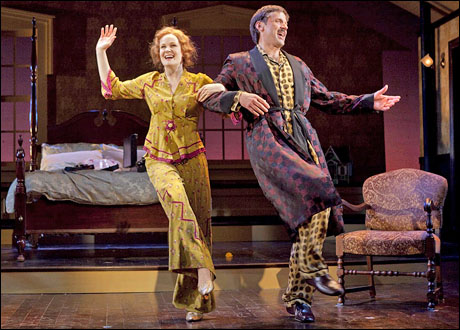
“I Do! I Do!” at the Westport Country Playhouse

“You chew in your sleep.”

There is just something about that line from “Nobody’s Perfect” from the first act of I Do! I Do! that never fails to crack me up. When Michael and Agnes, the couple at the musical’s center list their complaints about the other, this particular one comes entirely out of left field. It’s unexpected, but is met with a big, knowing laugh as it is the sort of minor character trait to drive a spouse or significant other up the wall. It’s just one of the many relatable moments in the tender musical. And it didn’t fail to make me laugh out loud last Saturday when the newly minted KBG (Kate Baldwin Gang – including yours truly) invaded Connecticut to see the show at the Westport Country Playhouse out in Connecticut (our first visit to the esteemed regional theatre).

The theatre is housed in a converted tannery which has housed many estimable productions. Come Back, Little Sheba and The Trip to Bountiful received their world premieres at the house. Its 1940 production of Lynn Riggs’ Green Grow the Lilacs, directed by John Ford, was the inspiration for the Theatre Guild’s eventual musical adaptation of the play (a little thing called Oklahoma!).

We arrived in Westport at 5:30 and were immediately taken with the theatre’s exterior: this “red barn” both large and  warmly inviting. After getting our bearings, we made our way next door to the Dressing Room, a homegrown restaurant started in 2006 by chef Michel Nischan and the late, great Paul Newman, who was a great champion of the Westport Playhouse. Everything on the menu is local, natural and organic and might I add quite delicious (the mac and cheese came with cured pork, ’nuff said). The pleasant experience spilled over into the theatre lobby as we scanned the production stills and window cards on the walls, amazed at the major theatre and film stars who had worked at the Playhouse. After some a minor farce regarding our seats just as the show was starting, we settled into the center orchestra of the gorgeous theatre for the show. (We didn’t realize we had different seats; the house staff was nothing short of patient and helpful).

I Do! I Do! is a two person musical based on Jan de Hartog’s The Fourposter, a portrait, or perhaps more appropriately, a crocheted sampler of a 50 year marriage. The action is set entirely in Michael and Agnes’ bedroom, as they sing and dance their way through the moments, great and small, which define wedded life. The show opened in 1966 starring Mary Martin and Robert Preston. It was a bit unusual at the time: a big Broadway musical with a cast of two and a unit set. Producer David Merrick liked the idea because it was cost effective. Reviews were strong and the show ran 560 performances, winning a Tony for Preston. The show also offered the gentle ballad “My Cup Runneth Over,” which became a pop hit for Ed Ames. (The song also sent the older audience into a tittering frenzy of recognition at the top of the second act, much to our amusement).

Kate Baldwin and Lewis Cleale are headlining in this sparkling production directed by Susan H. Schulman and choreographed by Michael Lichtefeld. Kate, fresh from the Menier Chocolate Factory’s Paradise Found and a Tony nomination for Finian’s Rainbow, is nothing short of captivating as Agnes. This performance is just another rung on the ladder to her inevitable musical theatre super-stardom. There is a strength and tenderness to her Agnes, which is thrillingly sung and exceptionally acted. Ms. Baldwin radiates with that same effusive presence which made a stage legend out of Ms. Martin.

Cleale is a perfect foil, tenderly romantic and consistently hard-headed. Michael isn’t the greatest husband, but Cleale imbues him with such humanity that even at his worst (and oh, Michael can be a real bonehead), it’s impossible not to care for him. Their chemistry is infectious and playful. One of the high points of the show comes in the second act toetapper “When the Kids Get Married” in which she plays the violin and he the saxophone – quite badly (and complete with a shave-and-a-haircut ride out). I have to admit I just sat there for two hours, smiling unabashedly. If there was a flaw in the evening’s performance, it was lost on me. This I Do! I Do! is utter charm from start to finish.

It’s a period piece, so some of the sensibilities feel a bit dated but it doesn’t detract from its smartly constructed book and lovely score. Wilson Chin’s unit set perfectly complements both the piece and the production, with some truly striking period flourishes. Devin Painter’s costume design is period perfect; especially in Baldwin’s period costumes. This production utilizes the two piano reduction created for the 1996 off-Broadway revival, and it fits the piece and the venue quite well. I know it seems unlikely, but I wouldn’t object if this production came to NY. Due to popular demand, the show has been extended through September 4 and believe me, you don’t want to miss this one. Oh – and Westport is now definitely a place I want to revisit, again and again.

Quote of the Day: Showstopper

At the world premiere in New Haven, the audience eruption following “The Rain in Spain” stopped the show dead, as they say. The hysteria continued unabated, [Rex] Harrison and [Robert] Coote sitting in frozen astonishment: nothing like this ever happened in drawing room comedy! Finally Miss Andrews – who at twenty already knew her around – grabbed her colleagues by the elbows (the number ended with them all collapsed on the couch), dragged them down to the apron, and led them in a bow. And the rest, as they say, is history. (At future performances, Mr. Harrison controlled all bows).

-Steven Suskin discussing My Fair Lady in his essential Opening Night on Broadway, which looks at what the major critics had to say about all musicals of the Golden Age

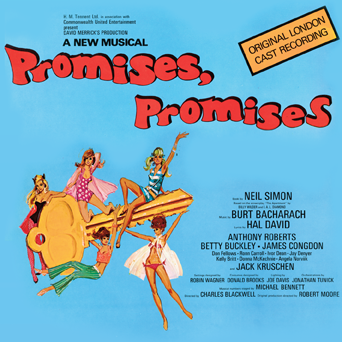
“Promises, Promises” – Original London Cast Recording

Just when it seemed as though there wouldn’t be anything more to say about Promises, Promises cast albums, Bruce Kimmel went ahead and released the long unavailable original London cast album on CD. Kimmel’s label, Kritzerland, recently made a splash with the 2 disc limited edition of the original Broadway album a couple months ago, which was so popular a second single disc edition was pressed. Sony Masterworks released a revival cast album which has been selling well. But for die hard fans, this is one of those rare cast albums that’s been long awaited. I, for one, lived with an mp3 rip of a good quality LP for the last couple of years and was one of those folks crying out for a CD.  The good news is that it’s been entirely worth the wait, the bad news is the limited pressing of 1,000 CDs has sold out (they did in a flash!)

Producers didn’t waste much time in bringing Promises, Promises to London. It opened at the Prince of Wales Theatre in 1969, running a respectable 560 performances. Tony Roberts was Chuck Baxter. He does a decent job, if he’s not nearly as distinctive as Jerry Orbach. Betty Buckley and she sings the hell out of the score as Fran, easily the best sung on record. Her “Knowing When to Leave” is definitive, particularly the way she crescendos from head voice pianissimo to full out belt on the last line. Jack Kruschen, who played the doctor in The Apartment reprised his role in this production. Donna McKechnie flew to London to recreate the showstopping “Turkey Lurkey Time” for six weeks, but apparently this album was recorded after she left. (Her name is credited on the album cover, but inside the credit goes to Alix Kirsta).

Like the Kritzerland release of the OBC, the London album has also been placed in show order. It was produced similarly to the first, but offers an entirely different listening experience. The inherent idiosyncrasies make this London recording required listening. The pit singers are much clearer, especially in the overture. But the thing that really struck me, and it was probably the remix that helped me realize this, was the percussion. I have no idea who the drummer was, but his or her work really just pops on the album, especially in “Turkey Lurkey Time.”

One of my main quibbles with both the original Broadway and London albums is that “A Fact Can Be a Beautiful Thing” doesn’t have its dance break or big finish, both recordings repeat the refrain as they fade out. As a sort of consolation, Mr. Kimmel has included the song from the Italian cast album in its entirety as a bonus after the title song. Kimmel once again supplies the liner notes which covers much of the same area as the Broadway Promises, but gives a concise history of the London run.

As I said, the CD is sold out (though you may still be able to snag a copy on Footlight Records) so if you’ve missed out, I hope you’ve got a friend who’ll be nice and let you borrow their copy. You’ll definitely want to give this one a spin.

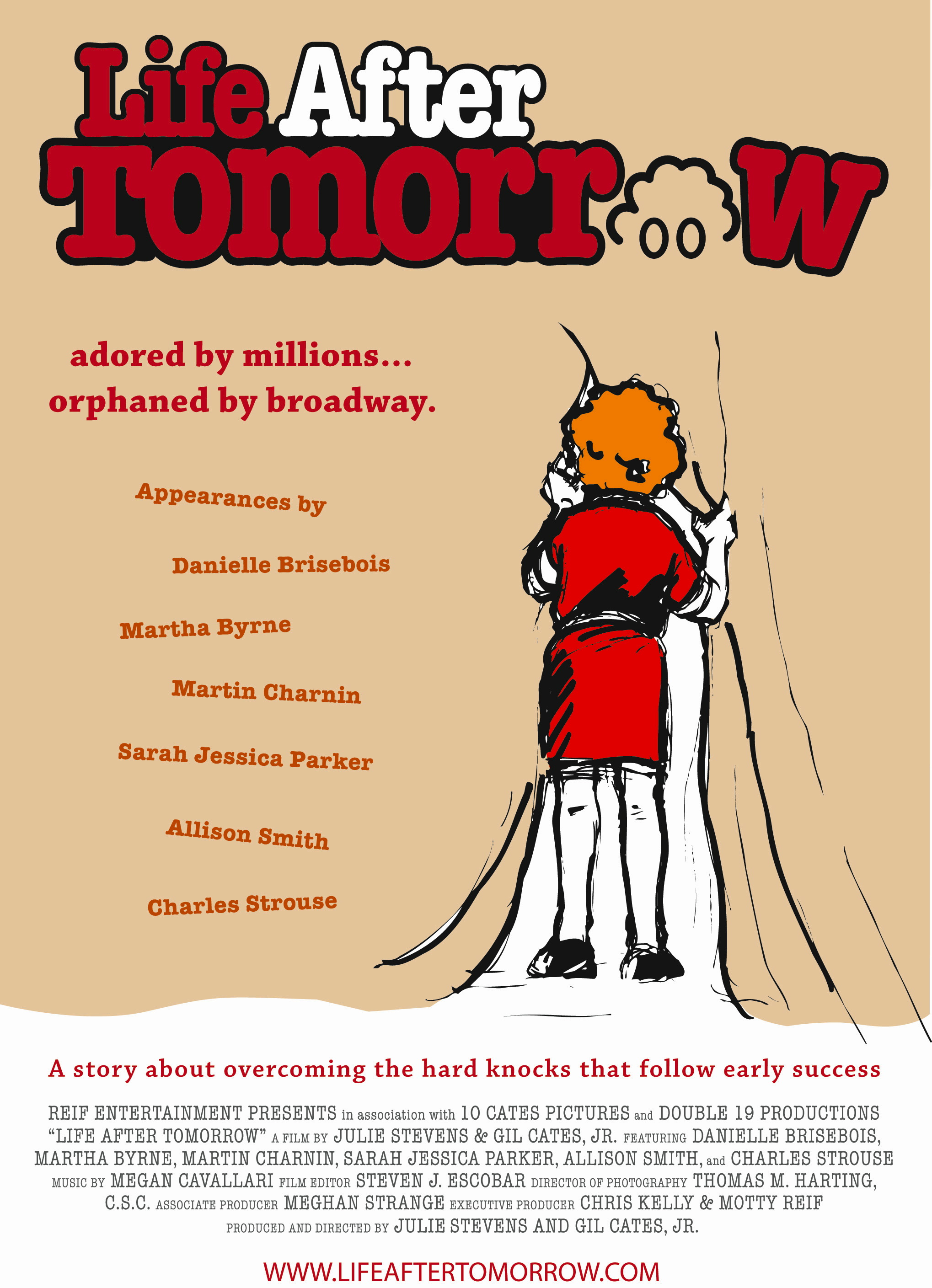
Catching up with “Life After Tomorrow”

Annie doesn’t quite rank as one of my favorite musicals, as my first experience with the show was decidedly less than stellar. So I admit I was somewhat reluctant to watch the 2006 documentary Life After Tomorrow, a chronicle of the actresses who played the title role and other orphans in various professional productions. The film was conceived and co-directed by Julie Stevens (Gil Cates, Jr. was the other director), who was an orphan in the original production and pulls together 40 or so alumni of the production together to talk about what it was like to be a part of the musical. In some respects the documentary is a sobering look into the world of professional theatre in the United States, in others it’s like watching a train derail. Annie is a significant part of these ladies’ lives, for better and for worse.

Interestingly enough, Andrea McArdle and Aileen Quinn – arguably the two most prolific actresses to have played America’s favorite redheaded orphan – were not involved with this documentary. However, other actresses were more than willing to talk about the experiences of performing the show, the burden of being prepubescent breadwinners and the reality check when they were abruptly no longer part of Annie. The girls were told they were too tall, too developed, too…whatever to continue in the show and were replaced. One of the women who plays Annie on tour talks about her last night, coming offstage and her replacement being whisked into her costume for photo call in the lobby as fans cheered the replacement and not her.

It’s rare that a musical becomes a cultural phenomenon. I’d say the biggest in recent memory would be Wicked, which has has found a solid fanbase in the same demographic that devoured Annie over thirty years ago. There have been countless television appearances, personal appearances, various professional productions all over the world, two film adaptations, a best selling original cast album and a woefully misguided sequel. The show of “Tomorrow” will long continue to linger on in public consciousness, quite possibly more than the comic strip upon which it was based.

The negative experiences had by cast members are particularly compelling, as they provide a sobering view at how show business isn’t necessarily all that appealing. Kristen Vigard, who was replaced by Andrea McArdle when the show was trying out in Goodspeed, has clearly not gotten over that career blow (and coming at such an impressionable age, it’s no surprise). History was repeated in 1997 when the 20th anniversary production replaced its leading actress with another orphan two stops pre-Broadway. However, it’s not all negative: one of the great success stories of an Annie alum is Sarah Jessica Parker, who’s gone to what is arguably the most successful career of any of the girls talks at lenght and at ease about being in the show. (Alyssa Milano and Molly Ringwald were also in productions, but they weren’t interviewed).

The experiences discussed run the gamut from fun (Henry Winkler visiting at the height of Happy Days) to the nasty (original cast member Robyn Finn was the recipient of an offensively anti-Semitic hate letter – from a fellow orphan!) There were tales of heckling hookers down the street, going to Studio 54 multiple nights a week (including seven year old Danielle Brisebois – where the hell were the parents?!). The parents could be problematic – going on the road and living it up, with affairs, partying and clashing. These same parents are discussed from varying degree from supporting and loving to cum laude graduates from Madame Rose’s school. There were no child handlers as there are these days, so the education was practically nonexistent. Chorus members and principles were resentful that these children were paid more than they, and took it out on them – one unnamed Hannigan actually hit the girls onstage.

Then there are the men. A replacement in the original production and a star of Annie 2: Miss Hannigan’s Revenge, Harve Presnell offers his insight from a professional’s perspective. Musical director Peter Howard, composer Charles Strouse and lyricist & director Martin Charnin talk about the musical with great fondness, but seemingly unaware the impact the show had on the girls after the fact. There is a brief look into the casting process, but not nearly enough for my liking. For many of these girls, Annie was the experience of a lifetime; something that was never repeated. Whereas for these men, it was another chapter in their long and varied careers of bringing shows to Broadway.

One of the more unexpected aspects of the entire film was Jon Merrill, who is considered the show’s number one fan. Mr. Merrill, who insisted he was neither gay nor a pedophile, talked about the impact of the show on him from “It’s a Hard Knock Life” and how it inspired him to start “Annie People,” a newsletter for fans of the show. He says he no longer wears costumes to the show, or stands with a clipboard at the stage door waiting for interviews, but still enjoys the show. It’s not odd to love a show, but he paints an unusual portrait of himself wearing Annie sweatshirts and surrounded by Annie memorabilia. I have to admit, it was odd watching him pull little girls’ costumes from the 1982 film out of his closet.

The documentary ends with the interviewees recreating “Tomorrow,” some quite exceptional, some clearly showing that longevity in show business was not guaranteed. They get together for reunions and reminisce, talk about their experiences – and they’re right: this is an incredibly unique bond that they share. The choreography and lyrics are muscle memory and they can step right back into “You’re Never Fully Dressed Without a Smile” without thinking twice.

It’s a fascinating but all-too-brief 73 minutes. There is a lot here, but it seems as though there could have been a lot more. Personally, I’d be fascinated to hear more about McArdle’s experiences with the show, and also why she chose not to participated in this film. I was also curious to know about the actresses playing Miss Hannigan, specifically the one and only Dorothy Loudon, who bested McArdle for the Tony that year. Loudon isn’t even mentioned here and that, to me, is a crime. Other Hannigans of note include Alice Ghostley, Kathleen Freeman and June Havoc, who is seen briefly consoling one of the girls on closing night.

Annie turns 35 in 2012. A second Broadway revival is planned and I’m certain interest in the original production will once again surface. The cast will be coming out of the woodwork once again to discuss their experiences. Bet your bottom dollar – did I really just say that? – there will be some sort of national casting contest/campaign to drum up press. I do hope that those kids involved will be handled with greater care, and those in charge can learn from the past.

Oh – and one of the great things about this documentary is that it’s available to watch online for free:

%CODE1%

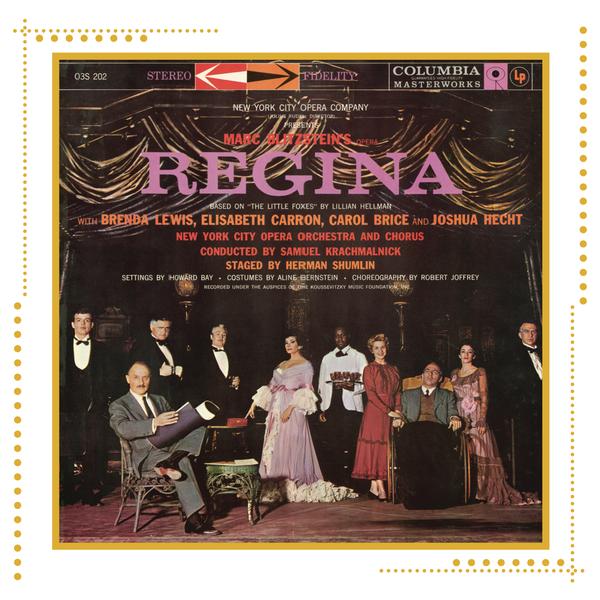
“Regina” – The 1958 NYCO Cast Recording

Long considered a Holy Grail recording by musical theatre enthusiasts, the 1958 NYCO cast album of Marc Blitzstein‘s Regina has been released by Masterworks Broadway for the first time since its LP release. An opera based on Lillian Hellman’s The Little Foxes, Regina premiered on Broadway in 1949, running  a mere 56 performances. While other Broadway operas, such as Street Scene and The Consul received original cast albums (even if they were highlights), Regina didn’t get recorded for nine years. (Though there is a piano only recording of certain musical numbers recorded after the original closed).

The Little Foxes, one of Hellman’s most famous plays, is a melodramatic study of an avaricious, desperate Southern aristocracy in decline. Tallulah Bankhead played the role of Regina Hubbard Giddens, who finds herself at odds with her brothers and husband, the result of patriarchal societal mores. She fights the gender oppression as best she can, doing what she must to get what she wants but at a considerable cost. Due to its extreme characters and heightened emotions (to say nothing of its malicious cynicism), it’s ideal for operatic consideration. (I won’t go into the plot details here. You’d have more fun seeing the film or a local production than reading a synopsis).

The opera was culled from obscurity by the City Opera in 1958 which made some alterations from the Broadway production. Blitzstein envisioned a three act opera utilizing musical idioms prevalent to the American South at the turn of the 20th century. On Broadway, he was forced to edit the piece to two acts and Hellman was very stringent regarding the dramatic structure. For NYCO, the opera was returned to its three act form, but there were some more revisions and the excision of an onstage Dixie band. The show was first performed in 1953, and revived in 1958 when Columbia stepped in to record. It may not be the complete opera, but it’s a lively 2 disc recording from the first notes of its prologue to its unbelievably breathtaking finale.

Brenda Lewis, who played Birdie in the original Broadway production, graduates to the role of Regina and sings the role with a dramatic intensity worthy of her predecessors in the play. She is especially memorable with the insistent “The Best Thing of All.” Her performance builds to a fever pitch as she does battle with her dying husband with “Do You Wish We Had Wed Years Ago?” and all but explodes with the climactic high C during the “Gallop” as she ominously tells him “I’ll be waiting.”  Regina is fascinating: she’s conniving, ruthless, steely, determined and flirtatious all in one fell swoop. Lewis is nothing short of extraordinary.

And then there’s Birdie, the fading southern belle who receives malicious abuse from her unloving husband and son while dreaming of her childhood. The role is a show stealer, and is pretty much the audience favorite. Patricia Collinge, who originated the role in the original production preserved her performance in the classic 1941 William Wyler screen adaptation, presents a characterization of such startling realism and honesty, that she all but steals the film from star Bette Davis and was Oscar nominated. Here in Regina, the part also walks away with the best of the score, most especially her confessional aria in the third act “Lionnet…Lionnet.” This showstopper sets to music one of the most famous monologues from the play, where Birdie admits her alcoholism to her beloved niece. She also admits that her husband married her for her family’s estate and that she hates her own son. It’s a glorious piece of dramatic writing, and soprano Elizabeth Carron is glorious.

The supporting cast is superb. Loren Driscoll sings the role of Birdie’s disagreeable son Leo (and would go onto sing “One Kind Word” in Blitzstein’s Juno the following year). Joshua Hecht’s bass makes an imperious impression as Regina’s husband Horace. George S. Irving and Emile Renan are excellent as the two conniving and deceitful brothers. Carol Brice (The Grass Harp) lends her supple contralto to the expanded role of Addie, the family’s housekeeper, while I would have much preferred Broadway original William Warfield singing the role of Cal. Helen Strine, as Regina and Ben’s daughter Zan, sings the recitative with a youthfulness that disappears during her one major number.

I’ve heard the score before, on a 1992 recording from the Scottish opera. Most interestingly, I didn’t care for the piece at all. But with this recording, it’s like hearing the work for the first time. The opera comes alive in a way the restored version does not (the only things I really remember from that one is the end of the “Gallop” and Birdie’s aria. Hearing it on this NYCO album leads me to wonder – isn’t it about time we had the chance to see Regina in NY again? If there’s a case to be made for another production at NYCO (or anyone else who might consider it), it’s this riveting cast album. The album is available as a digital download or CD-R via ArkivMusic.

Liz Callaway sings “Meadowlark”

David Merrick hated this song so much that he went into the orchestra pit during the out of town tryout of The Baker’s Wife and stole the sheet music. I don’t think he had any clue that this one song, “Meadowlark,” would be the stand out hit from his then-ailing show. The producer went around muttering about this “bird song,” dismissing it as a show killer, even if it provided the heroine with a major act one finale showstopper. Patti LuPone was the first to record it (Carole Demas was the first to sing it before Merrick fired her), then Betty Buckley also put her dramatic stamp on it, even so much as influencing composer Stephen Schwartz to make a minor adaptation in the published sheet music. Pretty soon it became a staple of many musical theatre actresses, and it became one of those numbers that makes its way into audition rooms, recitals; you name it. There are lots of noted renditions and I manage to have several favorites. This is just one other one of them, sung by the delightful Liz Callaway, who is a favorite of Schwartz. This particular performance is at Carnegie Hall, though I am uncertain of the date.  Tony nominee Callaway, who was part of the original casts of Merrily We Roll Along, Baby and Miss Saigon, hasn’t been on Broadway since The Look of Love in 2003 and I think she’s way overdue for a return. Enjoy.

%CODE1%