As it was at the overture and shall be at the exit music, bliss without end. Amen.

Theatre Aficionado at Large

Tag: Jan Maxwell

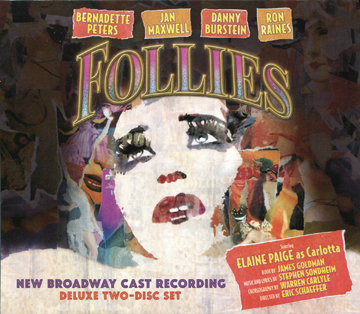
“Follies” – The New Broadway Cast Recording

Though the acclaimed revival of Follies will end its limited engagement on January 22, the landmark production has produced a staggering cast album, recorded by PS Classics and is without question a must-have and must-hear. The lavish 2-disc set captures is almost complete, capturing most of the score (more on that later) with its original orchestration intact (rare for any musical these days, most especially for a Sondheim show). It also may be the greatest album PS Classics has ever released; regardless of whether you agree with me or not, it is a spectacular achievement.

There are already four official recordings of Follies available on the market. There’s the devastatingly truncated original that preserves some incredible snippets of the performances (particularly Alexis Smith’s “Could I Leave You?” and Dorothy Collins’ “Losing My Mind”), the original London cast with its considerable changes, as well as the famed live concert recording Follies in Concert (or as I think of it, Follies without Context) and the most complete reading of the score, including cut material, the 1998 PaperMill production.

This latest Follies is as essential as these four. While I can’t say the album is definitive (the production and this recording lack the dance specialty “Bolero d’Amore”), it comes quite close. The album carefully captures the show in a way that in some ways improves upon the stage production, most specifically the inclusion of elements from the original 1971 libretto. In effect, the album is more like a radio play. Much of what is spoken is contained on separate tracks so you can program those out if you’re not a fan of that on cast albums (and knowing the friends I have, there are many who are not).

The disc captures the best of what’s onstage: Danny Burstein’s staggering portrayal of Buddy Plummer, with “The Right Girl” and especially “The God-Why-Don’t-You-Love-Me Blues.” Jan Maxwell’s brittle sophistication shines through, and the way she lands “GUESS!” in “Could I Leave You?” is one of the most satisfying things I have ever heard. Bernadette Peters tones down some of the more neurotic aspects of her onstage character for a more solidly sung performance on disc. Meanwhile, Ron Raines lends gravitas and his large baritone voice to Ben Stone’s mid-life crisis.

Onto the featured players, Elaine Paige sings a socko “I’m Still Here,” while Terri White tears into “Who’s That Woman?” which includes all the ad libs tossed around during the dance sequences. Rosalind Elias and Leah Horowitz are in glorious voice on “One More Kiss” while Susan Watson, Don Correia, the glamorous Mary Beth Peil and Jayne Houdyshell tear into the Montage trio. Every song is a gem, and each one has been recorded with great care.

One of the stars of this production, and subsequent recording, is the 28 piece orchestra conducted by James Moore. This production marked the first time I had seen a Sondheim production on Broadway using the original orchestration, and does it make all the difference. Kudos to Tommy Krasker and the team at PS Classics, as this recording brings out the colors and nuances in Jonathan Tunick’s brilliant charts with great clarity.

The double disc album is beautifully packaged by PS Classics, with a lavish booklet including an essay from NY1′s Patrick Pancheco, a personal note from album producer Tommy Krasker and a plot synopsis by Sean Patrick Flahaven. Also included are the show’s complete lyrics, as well as the dialogue heard throughout. Interspersed are some stunning photographs of the production. I don’t remember the last time a cast album was as stunning to look at as well as hear.

“Follies” on Broadway

A timpani drumroll, a series of minor chords and then seemingly out of nowhere, a showgirl appears. This tall, lithe yet shadowy figure seems frozen in time and space, but as the music takes on a dreamlike quality, she starts to move. But slowly, ethereally; as if of another world. This is the first image of Follies and it seems that for the next two hours, I’m holding my breath in theatrical limbo. The evening is supposed to be a happy reunion of members of the Weismann Follies, but the stage of the dilapidated Weismann Theatre becomes an area for delusions to be exorcised, regrets to be revealed and for the uneasy acceptance that life doesn’t always turn out how we want it to.

Bold and beautiful, flawlessly flawed, Follies is a show with a cult following unlike any other musical I can think of (flops need not apply). The 1971 musical all but shocked audiences with its  unsettling portrait of unhappy marriages and the disillusionment of middle age. There are ardent fans and ardent detractors, and it seems that whenever a production comes to NY, it becomes the talk of the town. Every song, character, line, production becomes the source of dissection and debate; comparisons abound. This marks the second time I have seen Follies live, and I realize that every time I have seen or will see the show, it will be at a different point of my life and that will inform my impact on my life. I have seen this production twice now: its first preview and its opening night.

The original Follies was a benchmark in grand production values and pushing the envelope of what a musical could be. Stephen Sondheim’s score has entered the upper echelon of musical theatre, with an astonishing mixture of pastiche and character numbers.  James Goldman’s book, always a bone of contention for many, is like a surreal Altmanesque puzzle. There are characters roaming in and out, some performing their old numbers, while two main couples confront some unfinished business that has left their respective marriages unpleasant.

Bernadette Peters, while not ideal for Sally, offers a fascinating portrait of depression and mental illness. When she enters at the top of the show and timidly tells the waiter, “I’m so glad I came,” you’re not convinced she is. Sally is a tough sell, and always has been: she’s delusional, angry and disappointed at her life. She arrives at the reunion with one goal: to take Ben, for whom she’s held a torch for thirty years, from Phyllis. Peters starts the show in a darker place than anyone else who’s done the part. Jan Maxwell is a couth delight as Phyllis, brittle, sophisticated and yet the only one of the four who is willing to fight for the relationship. She’s less aloof than one usually expects in the role, but delivers exceptionally on the dialogue and especially in the searing “Could I Leave You?” Ron Raines lends his sonorous baritone to the emotionally stunted Ben. Standing out among this main quartet is Danny Burstein, a revelation as Buddy, Sally’s sad-sack husband. His pain and rage come to a head in “The Right Girl” and brings down the house with “Buddy’s Blues,” but even when he’s not speaking he’s saying oh so much. It’s a performance that will not soon be forgotten.

Starry support comes from grande dame Elaine Paige as Carlotta, strutting around the stage in a sexy blue dress and dropping one-liners like Mae West. Ms. Paige delivers the triumphant anthem “I’m Still Here” with an intensity that seethes with anger and defiance, scoring a mammoth showstopper. (One quibble about a lyric change in this particular song: I hate that Brenda Frazier has been replaced by Shirley Temple. The former is a pointed comment about the fleeting nature of fame, while the latter just feels like a cheap shot). Rosalind Elias, the former Metropolitan star is making a spectacular Broadway debut at 82 as Heidi Schiller, offering one of the evening’s most arresting showstoppers in “One More Kiss” (shared with Leah Horowitz).

Lots of old pros are on hand: Terri White, belting to the rafters and schooling the chorines in hoofing, leads the ladies in rousing “Who’s That Woman?” Susan Watson (on Broadway for the first time since No No Nanette), Don Correia, Mary Beth Peil and Jayne Houdyshell deliver a dynamite “Rain on the Roof/Ah Paree/Broadway Baby” montage. Florence Lacey and Colleen Fitzpatrick add color to ensemble.

Then there are the ghosts, the younger versions of the party-goers, showgirls who float in and out ethereally. Nick Verina has a baritone that perfectly complements Raines. Lora Lee Gayer has created a Young Sally who is uncannily similar to her older counterpart. Erin N. Moore makes quite an impression as Young Stella, as does Kiira Schmidt who practically steals “Buddy’s Blues” as Margie (wait for her slide!)

Eric Schaeffer’s direction is simple and too realistic, with a lot of moments placed in-one which tends to be a bit static. Some of his best work involves the ghosts, especially the moments where past and present intermingle or collide. Warren Carlyle’s choreography is stellar, if lacking in invention. “Who’s That Woman?” is a joyous showstopper but “The Story of Lucy and Jessie” doesn’t quite build as it should (though it’s better now than it was at the first preview). Gregg Barnes costumes are eye popping in their period detail and grandeur, contrasting well with Derek McLane’s eerie set. The literal unit set depicting the dilapidated stage is brilliant, but his Loveland motif is a bit underwhelming. McLane also deserves credit for effectively shrouding the gauche Marquis Theatre interior. Natasha Katz’s lighting design is sheer perfection. James Moore leads the dazzling 28 piece orchestra in Jonathan Tunick’s sublime original orchestrations, some of the most beautiful ever arranged for musical theatre. This alone is worth the price of admission.

The production would be better served if it was performed without an intermission: the tension organically simmers throughout the evening until it explodes into “Loveland.” Stopping for fifteen minutes kills that momentum. Also, it would be nice to see a production of Follies that actually uses the full original text. Various lines and pieces that have been excised add more layers to the characters, most especially several illuminating moments for Phyllis and Sally. But any quibbles I may have for this particular production are meaningless. Each time Follies reaches its sobering conclusion, I look forward to the next opportunity to see the show. The revival is currently scheduled as a limited engagement with a closing date of January 22. Whatever you do, do not miss it.

My Favorite Performances, 2010

Kate Baldwin, I Do! I Do!  I couldn’t have asked for a better first experience at the esteemed Westport Country Playhouse. I had never seen the Schmidt and Jones musical of the Jan de Hartog’s The Fourposter, which offers an intimate portrait of a fifty-year marriage. Her performance was exquisite, with an earnest but achingly honest portrait of an early 20th century wife. Its sensibilities may be of another time, but through her performance she brought out elements of the play’s universality. It was not difficult to fall in love with her as she was flirting with, arguing with or encouraging her not-always-appreciative husband Michael (expertly played by Lewis Cleale).

Joshua Henry, The Scottsboro BoysI didn’t see the show at the Vineyard Theatre earlier in the year, and can only base my thoughts of Brandon Victor Dixon based on his stellar performance on the original cast album. But seeing Henry onstage at the Lyceum is something I will never forget. His performance was tough, grounded and always riveting and I find when I listen to the sublime cast album I miss some of his vocal flourishes and power. If there’s justice in the world (and the musical itself expertly showed there isn’t always), Henry will be adding a Tony nomination to his resume this spring.

Annette McLaughlin, Brief Encounter.  I was swept away by this adaptation of Noel Coward’s play Still Life and eponymous film adaptation, even though I wish I had seen it from the orchesta section or in its more intimate venue at St Ann’s. The entire cast is superlative, but as the tall, lithe cafe proprietress Beryl, McLaughlin grabbed my attention almost immediately. She is always on the periphery of the main relationship of the star-crossed lovers, but help add some levity and perspective with her timing, delivery (“sau-cay”) and musical abilities. I was so thoroughly charmed by the experience, but most especially with her exceptional supporting turn.

Jan Maxwell, Lend Me a Tenor.  It has yet to be proven that there is something that Jan Maxwell cannot do. I’ve seen her in a searing period melodrama, an elegant period comedy-drama and then her supporting all-out farce turn in Lend Me a Tenor, the funniest performance in this rather amusing revival of Ken Ludwig’s contemporary favorite. The play itself, admittedly, isn’t that funny. But Maxwell took the script and had a field day with it. Her character’s jealous mood swings and violent temper made for some of the play’s best moments. A mere hiss stopped the show dead in its tracks. Much of her time is spent off-stage and she was missed. She followed this farce with an acclaimed turn as a stroke victim in Wings at Second Stage. Again – this woman can do everything and I look forward to her Phyllis Rogers Stone in Follies at the Kennedy Center next spring.

Janet McTeer, God of Carnage.  I had seen and enjoyed the original Broadway cast with Jeff Daniels, Hope Davis, James Gandolfini and Marcia Gay Harden, but didn’t feel compelled to see the play again. It’s an amusing play, but it’s really an actor’s play and its enjoyment hinges on the performances on display. However, I dropped everything when I heard that Janet McTeer, who originated the role of Veronique in the original London cast, would be stepping into the Americanized Veronica for the Broadway production. She was utterly superb – and this was the first performance this company had given. I was fascinated by her from the moment she entered to her exit, every flourish and nuance compelling. Funny and fierce, she was better than her Tony-winning counterpart and as a whole made the play even more interesting to watch.

Donna Murphy, Anyone Can Whistle.  “Ooh I could think all night!” If Encores productions were eligible for Tony Awards, we wouldn’t have never had any of the post-Tony controversy regarding Catherine Zeta-Jones’ win for A Little Night Music. Donna Murphy would have (and dare I say, should have) walked away with every award in sight for her gut-busting performance as evil Mayoress Cora Hoover-Hooper in this concert version of Anyone Can Whistle (even the way she said her own name reduced the audience into laughter). Every gesture, every nuance, every note – everything she did on that stage was so fascinating and so damned funny. As a result of this performance, I am convinced that she should be our next Mame.

Bernadette Peters, A Little Night Music.  Replacing a Tony-winning star is one of the toughest gigs on Broadway. Sometimes the performer is an improvement on the original, but that’s a rarity. However, in this case, the replacement was not only an improvement but also somehow transformed the entire production into a must-see. A Little Night Music somehow fell into the hands of Trevor Nunn, who did his best to ruin it. While the sublime Angela Lansbury was the reason to see it when it opened, the rest of the ensemble lacked cohesiveness. Every actor seemed to be in a different production, some even seemed to be in another theatre entirely. Somehow Bernadette’s presence made them a unified presence and while the revival still has its considerable shortcomings (and length), she gave the production the credibility it needed from the beginning. And her near-definitive performance of “Send in the Clowns” is worth the price of admission. If the Tonys hadn’t botched the replacement category, Bernadette would win in a heartbeat.

Hat’s Off! Additional Kennedy Center “Follies” casting announced

Whenever a major production of Follies is announced, it immediately becomes an event. The casting news, the production team, the venue – everything about the show is manna for the most die hard Sondheim fanatics. When the show was announced for Encores! four years ago, I remember there were some who felt it wasn’t an appropriate choice for the venue, but that didn’t curb audience enthusiasm. The production sold out its entire weekend run, with such a demand that they added an extra performance. Talk about a Broadway transfer came about, but it wasn’t to be.

Now rumors of this 2011 Kennedy Center revival have been stirring for about a year now, with various names being tossed about as possible contenders for the wide range of available roles. Those same folks who busted down the doors to get into the City Center are now gearing up to take on DC next spring. Already, the production has been extended and will be running at the Eisenhower Theatre from May 7 – June 9, 2011.

The first name to be officially announced sent ripples of excitement through the theatre world: Bernadette Peters will be playing Sally. BroadwayWorld announced that joining her would be John Dossett as Ben, Danny Burstein as Buddy and Kim Cattrall as Phyllis. Casting for those two leading man roles is still yet to be made public, however, Cattrall will not be a part of the production. Instead, the formidable Jan Maxwell – who is one of the great theatre actresses of our time – will be playing the aloof Phyllis, who cuts loose in “The Story of Lucy and Jessie.”

Additional cast members include Elaine Paige, making her first stateside appearance in a musical since her acclaimed 2004 run in NYCO’s Sweeney Todd, will be Carlotta and will belt out the showstopper of showstoppers, “I’m Still Here.” Tony winner Linda Lavin takes on Hattie Walker and “Broadway Baby” in the montage. Terri White, who stopped the show nightly in the all-too-brief revival of Finian’s Rainbow last season, is Stella Deems and will lead the ladies in “Who’s That Woman?”

Susan Watson, one of the foremost ingenues of the 1960s, will be playing Emily Whitman. Watson made her Broadway debut fifty years ago as the teenage Kim McAfee in the original company of Bye Bye Birdie. She also appeared on Broadway in Carnival, Ben Franklin in Paris and No No Nanette. Florence Lacey, whose thrilling belt graced Broadway in Hello, Dolly! and The Grand Tour, will be Sandra Crane. Régine will be Solange La Fitte. Also joining the cast will be opera singer Rosalind Elias as Heidi, Terrence Currier as Theodore Whitman and David Sabin as Dimitri Weissman. Additional casting is pending.

Eric Schaeffer is directing. Warren Carlyle will choreograph. James Moore (of my beloved Ragtime revival) will serve as musical director, conducting the Kennedy Center’s 28 piece orchestra using Jonathan Tunick‘s original orchestrations. Derek McLane will design the set, Gregg Barnes will design the costumes and Natasha Katz will design the lighting.

Tickets go on sale to Kennedy Center members on January 24 and to the general public on January 30. It appears I may just have to clear my entire schedule for the lusty month of May. If you want me, you can find me at the Kennedy Center. And I can tell you I won’t be alone…

Drama Desk Awards: Tuesday Night Quarterbacking

The Drama Desk Awards, held Sunday evening, were once again shown via web cast on Theatermania. I recall the time they used to show them on PBS, but I guess that’s ancient history at this point. Anyway, this year the quality of the live stream was better than ever. However, from a technical standpoint there were some unusual shots, angles and closeups. I know it takes place in a glorified high school auditorium, but can’t they place the winners closer to the stage? Most of the time was filled up waiting for them as the presenters looked out during what seemed dead air.

The ceremony itself was rather uninteresting on the whole. Patti LuPone was an adequate host, who got in a couple of laughs but was really just there to keep things moving (at a clip). No performances, nothing too too exciting in terms of winners. The onstage pianist played far too many bizarre pieces, most jarringly “Don’t Fence Me In” every time Fences won an award. Many of the wins had me nonplussed; I was genuinely bored at a second tie between Montego Glover and Catherine Zeta-Jones for Best Actress in a Musical. (They shared the prize with the OCC too). Let’s not go for the trifecta on that front, folks. However, there a couple of surprises including Christopher Fitzgerald’s win for Finian’s Rainbow. Santino Fontana’s unexpected win for Brighton Beach Memoirs provided the most memorable of all acceptance speeches. He was genuinely shocked and completely amazed, and it added to its charm

Another surprised winner was Jan Maxwell, who won for Best Actress in a Play for her superlative comic turn in The Royal Family. She’s likely to be bested by Viola Davis in Fences (who was a Featured winner here) at the Tonys, so it was nice to see her recognized here for that work (Maxwell is a Drama Desk regular, but a Tony bridesmaid). She was very emotional and immediately apologized, “I’m sorry, I’m usually an aloof bitch. Surprises get to me.”

Martha Plimpton inadvertently established a memorable running gag following a spirited non sequitur about Mitzi Gaynor complimenting her shoes. Other Mitzi comments would follow, but the biggest laugh went to Outstanding Solo Performance winner Jim Brochu who started his acceptance with “Oh, and Mitzi Gaynor just told me to go fuck myself.” Brochu, who won for his turn as Zero Mostel in Zero Hour declared F. Scott Fitzgerald a big fat liar, stating, “there are second acts.”

For a ceremony that boasts recognition of Broadway, Off-Broadway and Off-Off Broadway, the deck seems quite stacked in favor of Broadway. I’m not saying it’s a crime, but it just seems that you’re more likely to get it if you’re a Main Stem show. There were five major Off-Broadway wins – The Scottsboro Boys won for lyrics, Bloody Bloody Andrew Jackson won for its book and When the Rain Stops Falling won for its sound design. Love Loss and What I Wore took home Unique Theatrical Experience and Zero Hour won Outstanding Solo Performance. Other than that, it was all Broadway. Scottsboro and Yank! are now ineligible for Drama Desks next year, so automatically next year’s nominations should be interesting.

Seeing as it was the Lost finale, there were fewer fellow watchers on Twitter and environs this year. However, participants inside the auditorium were encouraged to tweet so that kept it somewhat interesting throughout the night. Let’s hope the Tony Awards are more interesting.

Quote of the Day: Ben Brantley on Jan Maxwell


Speaking of the “Royal Family,” I’m especially heartened that Jan Maxwell was nominated for best actress for her smart, delicate and eccentrically witty performance in that play, as well as for her supporting work in “Lend Me a Tenor.” Ms. Maxwell is one of the best and most undervalued actresses we now have in the New York Theater, and if this helps keep her in our line of vision, I’m all for it. And I hope she wears a really terrific dress to the Golden Globes – I mean, the Tonys. Psst, Ms. Maxwell, I know somebody who works at Chanel.

- Ben Brantley, in his Tony nominations round-up

Posted on May 4, 2010 at 2:12 pm.

"Lend Me a Tenor"


Leaving the Music Box Theatre after seeing the infectious new revival of Lend Me a Tenor, I found myself unable to stop humming “La Donna è Mobile,” the famed aria from Rigoletto. No matter what I did or what song I played, it remained at the back of mind – buoyant, effervescent and melodic. The aria is heard as the house lights go down and curtain comes up on Ken Ludwig’s popular farce, instantly grabbing you and immersing you into the roller coaster ride of sidesplitting comedy about to enfold onstage. Like that aria, this new production sings out with gusto that will leave you buoyant, effervescent and smiling long after you have left the theatre.

The original production was a big hit in 1989. Starring Victor Garber, Tovah Feldshuh, and Tony-winning Phil Bosco, it ran for over a year and instantly became a staple in stock and community productions. (Its world premiere was in London in 1986). The plot in brief: the Cleveland Grand Opera is expecting a world-renowned Italian tenor for their gala. When he becomes indisposed, hijinks, misunderstandings and a hell of a lot of door slamming ensues. As a farce, the play itself is merely good, not great. Ludwig’s text as a whole feels more like a rough draft of a greater comedy that has yet to be realized. There are some missed opportunities (especially with the Bellhop, who should have more to do) and its ending seems somewhat abrupt and rushed. However, this production is so laugh out loud hilarious and features a top notch ensemble of actors, that it’s incredibly easy to both forget and forgive the shortcomings of its writing.

Anthony LaPaglia shines as Tito, the egomaniacal tenor in question whose propensity for women and booze causes most of the evening’s chaos, and is especially memorable for the fearlessness of his physicality, particularly in the scene where he gives the impressionable would-be tenor Max a lesson in voice and relaxation. It must be seen for full effect. Tony Shalhoub is in full cigar-chomping mode as the temperamental producer Sanders. Jay Klaitz is a comic revelation as the endearing Bellhop (and operaphile). Movie star Justin Bartha makes an impressive Broadway debut as the nebbishy Max, who vacillates between the sadsack producer’s assistant and confident opera diva when masquerading as Tito with considerable aplomb.

Mary Catherine Garrison winningly proves that ingenues have dirty dreams as Saunders’ daughter and Max’s girlfriend, and whose scream in the second act is one of the funniest moments I’ve seen on this or any other stage. The ever-reliable Jennifer Laura Thompson, always a welcome presence, taps into her quirky comic skills as the seductively ambitious diva Diana. Brooke Adams is far too striking to convince as a dowdy, past-her-prime matron, but the actress – mercilessly decked out like the Chrysler building – scores some big laughs.

Jan Maxwell effortlessly walks away with the entire evening as Maria, Tito’s fiery, jealous wife. Maxwell, who was last seen giving a bravura star turn in the shimmering revival of The Royal Family, hits another home run as she rages, seethes and breaks down with an exaggerated Italian accent. Whenever she is onstage she is in total command, somehow maintaining her character’s elegance in spite of her antics. She brought the first act to a crashing halt by merely hissing. After the disappointments of To Be or Not to Be and Coram Boy (which deserved to be a hit), it is especially welcoming to see Maxwell having such a banner season. Ms. Maxwell is one of the unquestionable treasures of the NY theatre scene, equally adept in both plays and musicals. If there is a God, Maxwell should be nominated for a Tony (for this and The Royal Family) – and she should win.

Then, of course, there is the director. Stanley Tucci, in his first Broadway directing gig, is as gifted a director as he is actor. His task is not an easy one; staging a successful farce is incredibly difficult as it involves laser-sharp timing from the loudest door slam to the tiniest gesture. His work here is infectious and inventive, bringing lightning pace and visual gigs, but also a certain touch of humanity that wouldn’t normally seem possible in pure farce. Tucci’s directorial touch is solid 14 karat gold. Anyone sitting center orchestra should also watch out for flying objects – all spit takes and such gags are directed out at the audience, a rather zany, inspired touch from a genius actor turned director.

John Lee Beatty’s sumptuous set captures the elegance of a posh hotel suite in the 30s, so vividly realized its as though a penthouse was cut in half and placed onstage. Martin Pakledinaz has once again outdone himself with his period costumes. His eye-popping outfits worn by his leading ladies are especially memorable (the image of Jan Maxwell casting off her fur-lined wrap is a vivid image that will aways stick with me).

Lend Me a Tenor is undoubtedly the hit comedy of the season, and the funniest thing this side of The Norman Conquests. I look forward to making another visit, especially to revel in the genius of Ms. Maxwell, but also in appreciation of Mr. Tucci’s immense achievement. Oh – and for that tour de force curtain call, which is worth the price of admission alone.

My Favorite Performances, 2009

Jayne Atkinson, Blithe Spirit. The character of Mrs. Ruth Condomine in the Noel Coward classic isn’t usually the wife audiences leave the theatre talking about. That honor tends to go to the actress playing the devilishly deceased first wife Elvira. The model of upper classic British waspishness, Atkinson gave one of the most underrated and truly memorable performances last season. As Ruth, the actress dominated her scenes with Rupert Everett and Christine Ebersole with tweedy precision and gave a performance that got funnier and more vivid throughout the run of the play.

Jon Michael Hill, Superior Donuts. I recall hearing from friends when the play first opened at Steppenwolf, that Mr. Hill was a name to remember. His performance as the idealistic and almost fatally flawed Franco was the spark plug that really gave Tracy Letts’ new (and gentler) comedy its legs. His chemistry with star Michael McKean was genuine, but it was the younger actor in his first major Broadway role who walked away with this show in his pocket. It’s a performance that will one day give those who’ve seen it bragging rights.

Angela Lansbury, Blithe Spirit and A Little Night Music. It’s a rare thing to be able to put an actor on your list twice, especially when one is a five-time Tony winning octagenarian. Ms. Lansbury is riding high on her late-career renaissance on Broadway. While reviews for both productions have been mixed-to-positive, Lansbury has received nothing but love letters from the critics. Playing two very different Madame’s: the daffy, endearing Madame Arcati in Noel Coward’s classic and the austere, disapproving matriarch nee courtesan in Stephen Sondheim’s musical revival, Lansbury is the epitome of a star. She exudes grace, poise, charm and a rare star presence that outshines her fellow cast members (in both productions). She’s already now in line for another Tony nomination and the possibility of a record-breaking sixth win.

Stephen Mangan, The Norman Conquests. Mangan’s titanic comic performance in the Ayckbourn trilogy may be the greatest I’ve ever seen in all my years of theatregoing. Mangan’s ability to take the irritable nature of Norman and garner the audience’s sympathy and affection was nothing short of breathtaking, a stand out among one of the most uniformly excellent ensembles seen on Broadway this decade. As I’ve said before, all due respect to Joe Turner’s Roger Robinson, the Tony Award should have gone to Mangan. At the end of the third play in the trilogy, he exasperatedly shouts “I only wanted to make you happy.” Mr. Mangan’s performance did, and how.

Jan Maxwell, The Royal Family. The stylish revival of the Kaufman-Ferber classic about a Barrymore-esque acting dynasty in NYC earned Maxwell some of the best notices of her already auspicious career as the flighty Julie Cavendish, the center of her eccentric family upon whom all burdens rest. In a bravura moment in the second act, Maxwell stopped the show both time I saw it with a comic monologue/breakdown that ended with the elegant, sophisticated Maxwell doing a faceplant into the lip of the stage. However, for evidence of her reality onstage, one only had to look at her reaction in the final moments as the actress finds her mother dead in the living room. I first saw the actress in her memorable turn in the short-lived Coram Boy in 2007. Fortunately, she gets to bring the funny to the upcoming revival of Lend Me a Tenor this March. (Honorable mention to Rosemary Harris for providing such comic support to Maxwell, and by providing an haunting eleven o’clock moment during the final scene of the play).

Janet McTeer and Harriet Walter, Mary Stuart. In this instance, I feel you can’t have one without the other. They are only onstage together for about ten minutes of the play’s three hour running time, but whenever one is onstage alone, the other is still deeply present. Both performances resonated with gusto: McTeer had the showier title role, with heightened, crowd-pleasing intensity while Walter had the quieter, albeit more interesting role of Elizabeth I. The symbiosis of their towering performances is what made the Donmar import a must-see revival last season.

Jason O’Connell, The Complete Works of William Shakespeare (Abridged). This year marked my first visit to Boscobel and the Hudson Valley Shakespeare Festival. I had also never before seen this comic romp through the Bard’s entire folio, with room for improvisation, camp, cross-dressing and even audience participation. Performed by three actors (with one caustic prop mistress), O’Connell stood out with his comic flair and energy. The actor was the epitome of outrageous one moment, and the next stunned the audience to rapturous silence with a breathtaking delivery of “What a piece of work is man.” Now, here I must also give an honorable mention to another performance of his: he was also playing Benedick in Much Ado About Nothing in rep at the same time. His performance there was also quite memorable and distinctly funny, but it was in the Complete Works that he really stood out. I look forward to going back to HVSF next summer to see what Mr. O’Connell will have in store for audiences.

Phylicia Rashad, August: Osage County. To say Rashad was a revelation as the pill-poppin’, chain-smokin’ mother from hell in Tracy Letts’ brilliant three act drama would be a colossal understatement. Ms. Rashad finished out the Broadway run of the Tony and Pulitzer winner with a riveting and often terrifying performance, with nuances and touches that opened my eyes to parts of the script I thought I knew backwards and forwards. I will never forget being at the final Broadway performance; the one and only time Rashad played opposite Tony-winning Mattie Fae Rondi Reed.

Thomas Sadoski, Reasons to be Pretty. If there’s one thing you should never do, it’s tell your best friend you like your girlfriend because she has a regular face, not a pretty face. Sadoski’s Greg learns that the hard way when he says that about Marin Ireland, which sets off a series of introspective, self-affirming events that turns the well-read, non-confrontational slacker into a man. LaBute’s play is stinging, vicious and often violent. While Ireland walked away a critics’ darling over her performance, which involved a gasp-inducing monologue at a mall food court, it was Sadoski who was the heart and soul of the play, leaving a lasting impression as he gives his job the proverbial figure and grows up as the lights fade out.

"Am I Center…?"

By the time the curtain came down on the Manhattan Theatre Club revival of The Royal Family, I just wanted to be member of the Cavendish family, or to work for them (this is one of those plays where the staff is an extension of the nuclear). No matter how egocentric or childish these actors behave, there is never a shortness of heart. Even the most exasperating family member is accepted and embraced as part of this circle that is based in love, family and of course, the traditions of the theatre.

This is most evident toward the end of the play, when the entire family is gathered around looking at plans for a brand new play. There is excitement about the idea of putting on a new show, what it will look like, what it could be. It’s an excitement so rich you understand how this family functions. However, while they are busy bonding over their art, two suitors are shown as clear outsiders who stand around aimlessly and stand out like sore thumbs. They don’t understand the marriage between actor and craft, and they never will. The play simultaneously lampoons and celebrates what makes theatre the unique world it is.

I was incredibly optimistic about The Royal Family, a comedy-drama about a celebrated acting family written by George S. Kaufman and Edna Ferber. Now, I had never read nor seen the play before. All I knew was its history. It premiered on Broadway in 1927, where it was a big success with audiences who would readily make the satiric connections with the Barrymore family. The Barrymores themselves had varying reactions. John went backstage to congratulate Fredric March on his performance in a Los Angeles production. Lionel declined to comment, while Ethel unsuccessfully sued. That didn’t quell the popularity of the show. It premiered in London as Theatre Royal, so as not to draw parallels with the British royalty, with Laurence Olivier. It was made into the film The Royal Family of Broadway in 1930, with March recreating his stage triumph as Tony Cavendish (based on John) to the tune of an Oscar nomination. It’s probably best known to today’s audiences by its exceptionally well-received 1975 Broadway revival. Ellis Rabb won a Tony for his direction (and quickly assumed the role of Tony) and it starred Rosemary Harris and Eva Le Gallienne as daughter and matriarch of the eccentric stage dynasty.

Reflecting one of the play’s themes, the torch has passed. Harris is again starring on Broadway in The Royal Family, except this time she is stepping into the role of Fanny Cavendish, the matriarch. Jan Maxwell, one of Broadway’s greatest treasures is playing her daughter Julie. They are joined by Tony Roberts, Reg Rogers, Larry Pine, John Glover, Ana Gasteyer, Kelli Barrett in one of the loveliest revivals you’re likely to see this year.

The MTC has spared no expense in making this revival a feast for the eyes and ears. When the curtain rose on John Lee Beatty’s lavish unit set, a two-tier upscale Manhattan living room ripe with ornate period decor, the audience first gasped, then broke into enthusiastic applause. Complementing the scenery are the sumptuous costumes designed by multiple Tony-winner Catherine Zuber. The incidental music was supplied by Maury Yeston.

The show isn’t just a display of visual wonderment. Director Doug Hughes has done incredibly well by the script, finding a way to stage an 82 year old play without making it feel dated. The play does run three acts, and gets bogged down in the first act with exposition. However, don’t let that deter you – the second and third acts contain the best and most impressionable moments of the evening and are dominated by Ms. Harris and Ms. Maxwell.

I first saw Maxwell in the woefully short-lived Coram Boy (which I saw twice) and have been an ardent fan ever since. She doesn’t fail here, scoring magnificently as the middle-aged stage star of the family, upon whom much of the familial responsibility rests. She has a second shot at love with a man that got away many years ago because of the emphasis on her career, and seriously considers giving it all up for him. But a star through and through, Julie knows how to make an entrance and at one point while being melodramatic interrupts herself to ask “Am I center…?” before carrying on.

A highlight of the theatre season is watching Julie become unhinged late in the second act. It is here that Maxwell delivers the most brilliantly executed comic monologue I have ever seen in my life. It’s impossible for anyone to successfully describe it in print, but you will never forget the image of Maxwell face-planted against the lip of the Friedman stage. I’ve never seen a comic moment genuinely stop a show like it does here. All I know is that I was still awestruck when the lights came up at second intermission several minutes later.

The other indelible moment belongs to Harris, who is the matriarch who has been kept from performing due to illness. Throughout the play she patiently observes the family around her, accepts their idiosyncrasies as normal, and gets to deliver some choice Kaufman zingers. But Fanny is the heart of the play. It is her apartment in which everyone gathers and where the dramas and comedies of this family are acted out for one another. Fanny herself is something of a calming, elegant contrast to the insanity around her. Aching for the unlikely chance to return to the stage, Harris dominates the third act with an eleven o’clock moment that will haunt and move you from here to eternity. The final tableau is a most striking and affecting stage visual that will stay with you long after you’ve left the theatre.

While there are many other 82 year old plays that we are likely to never see again, this one works and holds up rather well, dated references considered. Most of that is due to its delicious depiction of actors and the playwrights’ sly satiric portrait of how they live. The play may never again get the laughs it got in 1927 when audiences was more readily aware of the Barrymores and their status within the New York theatre community. But it comes back to Hughes who imbues the entire production with class and elegance in its staging and characterization. However, underneath the slick superficial surface of show-biz is a loving family that is drawn together by its unique association with acting. As Gwen weighs giving up acting for marriage and family, Fanny drolly proclaims, “Marriage isn’t a career, it’s an incident.” Fanny and Julie then speak so eloquently of the privilege to do what they do that you begin to question your own career choice.

There has been a lot of press about Tony Roberts falling ill onstage during last Sunday’s matinee, but he was back onstage in time for Thursday night’s opening. He provides a voice of reason for the entire family as their long time manager. Reg Rogers is a favorite as the outrageous Tony, always on the run for drinking too much and womanizing. His eccentricity and larger than life personality are complemented by quieter moments where he’s with his mother and you get a glimpse at the loving child underneath all the trappings. The entire ensemble works very well with one another. Gasteyer, if a bit monotone, is perfectly gauche as Kitty. Glover’s character is trying to hang onto the last shreds of his dignity, while descending the show business ladder. Even the household staff have fully formed, interesting characters in spite of their brief stage time.

The production at the Friedman is such a tremendous hit that it’s already extended its limited engagement, but the revival is closing on November 29. You can bet that I will be going back again.

Posted on October 9, 2009 at 9:11 pm.
A place where I can rant and rave about theatre,
theatre history, plus books, film and anything
else that strikes me as entertaining, interesting
or important. Feel free to chime in. If you'd like
me to have a look at your show or have any
interest in advertising, feel free to contact me. Membership
director of the Independent Theater Bloggers Association.

Photo by Kari Geltemeyer

Walking Among My Yesterdays - 2011

1/19 - Avenue Q

1/25 - Knickerbocker Holiday (Collegiate Chorale)

1/30 - Chicago (Fan Day)

2/13 - La Cage Aux Folles

3/8 - Kate Baldwin & Sheldon Harnick: She Loves Him (Feinstein's)

3/12 - Kate Baldwin & Sheldon Harnick: She Loves Him (Feinstein's)

3/30 - How to Succeed in Business Without Really Trying

4/6 - High

4/20 - Born Yesterday

4/27  - The People in the Picture

5/4 - Sister Act

5/4 - The Normal Heart

5/11 - Lombardi

5/19 - Something Wonderful: An Evening of Broadway (Carnegie Hall)

6/3 - Marilyn Maye: It's Maye in May (Feinstein's)

7/14 - Kate Baldwin & Sheldon Harnick: She Loves Him CD release (Feinstein's)

7/27 - Around the World in 80 Days (HVSF)

8/2 - Hamlet (HVSF)

8/7 - Follies (first preview)

8/20 - Jerusalem

8/27 - Sammy Gets Mugged (Fringe)

9/4 - Master Class (closing)

9/11 - Mary Poppins

9/12 - Follies (opening night)

9/16 - The Life and Death of King John (NY Shakespeare Exchange)

10/10 - Give Our Regards to Broadway (Manhattan School of Music)

10/16 - Broadway Originals (Town Hall)

10/17 - Carole Demas: Summer Nights (Laurie Beechman Theatre)

10/26 - Hugh Jackman: Back on Broadway

10/27 - Follies

10/30 - Chinglish

11/12 - Follies

11/18 - Annie Get Your Gun (Walter Panas Players)

Walking Among My Yesterdays - 2010

  • 1/3 - Ragtime
  • 1/20 - Tyne Daly: The Second Time Around (Feinstein's)
  • 2/6 - Betty Buckley: For the Love of Broadway! (Feinstein's)
  • 2/7 - Fanny (Encores!)
  • 2/27 - Yank!
  • 3/2 - God of Carnage
  • 3/8 - Kate Baldwin at Birdland
  • 4/3 - Lend Me a Tenor
  • 4/11 - Anyone Can Whistle (Encores!)
  • 4/23 - Collected Stories
  • 5/19 - Mitzi Gaynor: The Razzle Dazzle Years (Feinstein's)
  • 5/26 - Next Fall
  • 6/20 - A Little Night Music
  • 6/25 - The Bomb-itty of Errors (HVSF)
  • 7/31 - A Little Night Music
  • 8/21 - I Do! I Do! (Westport Country Playhouse)
  • 8/27 - Our Town (Barrow Street)
  • 9/25 - Brief Encounter
  • 10/7 - The Scottsboro Boys (first preview)
  • 11/6 - Lucky to Be Me: The Music of Leonard Bernstein (City Opera)
  • 11/19 - NY Pops' Stephen Sondheim Birthday Bash (Carnegie Hall)
  • 12/12 - The Scottsboro Boys (closing)

Member

Miscellaneous Links

Newsodrome - Theatre News

Blog Directory & Search engine Blogged.com Add to Technorati Favorites

Profile Visitor Map - Click to view visits
Make your own visitor map

Archives

Kevin’s Favorite Things

Kevin on Twitter