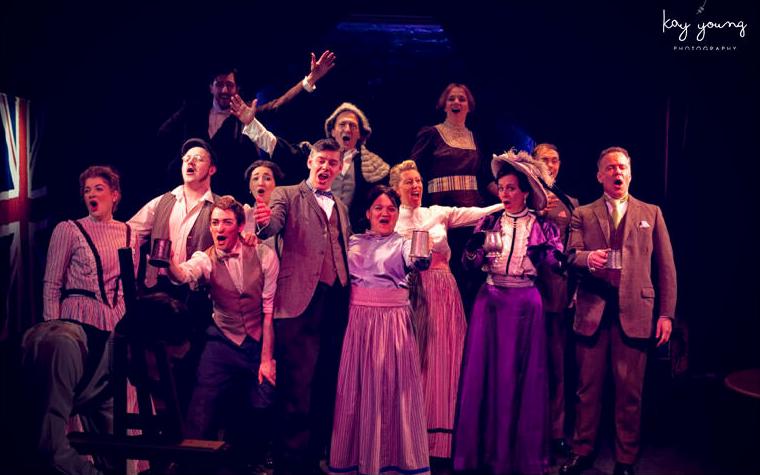
One of the joys of Netflix (and possibly its downfall as well) is finding shows streaming in their entirety. One of these shows is the British hit Keeping Up Appearances starring the one and only Patricia Routledge as the one and only Hyacinth Bucket, the irrepressible social climbing snob. While the writing is rarely up to the quality of the cast, the show is often quite funny with Hyacinth getting carried away with herself and foiled by her down-to-earth relatives and friends. One of my favorite episodes is the one where she was desperate to get a part in a local production of The Boy Friend and spontaneously burst into song at the drop of a hat.
Routledge was the subject of an episode of the BBC series Funny Women, which profiled some of the funnier female stars of British stage and television, including Maureen Lipman and Prunella Scales. I relish in every opportunity I have to see Routledge’s film and TV work, as I was not yet born when her stage career was at its peak in the mid-70s and early 80s. Even if the shows themselves failed (as was the case with her Broadway career), critics and audiences fell in love with the vivacious comic soprano. She won a Tony for Darling of the Day, which lasted 31 performances in 1968 (and should be the next Jule Styne score heard at Encores!). The star could have taken the audience home in her pocket after her memorable “Duet for One” in the otherwise loathed 1600 Pennsylvania Avenue (which ran only 7 performances).
The half hour episode briefly touches on her whole career, but focuses mostly on her TV work featuring interviews with the Ms. Routledge, Alan Bennett, Michael Frayn, Nigel Hawthorne and TV leading men Clive Swift and Dominic Monaghan. One of the things I especially loved was that people came up to Hawthorne after a gala performance and exclaimed “I never knew Patricia Routledge could sing!” I’ve had the same conversation myself many, many times. (And I would just love to have the entire clip of her singing “I Want to Sing in Opera”). Enjoy.
Here’s a press shot of Patricia Routledge in her Tony-winning performance as Alice Challice in the failed Jule Styne-Yip Harburg musical Darling of the Day. The show lasted 31 performances at the George Abbott Theater (now the site of the Michelangelo Hotel) in 1968. In spite of the musical’s fast failure (which lost an astronomical $750,000), there are many merits within the show and score; friends and fellow bloggers know that I have long championed a revival.
Alice Challice is something of an unsung heroine of the musical theatre. She’s warm, vibrant, vivacious and pragmatic – a young widow living quietly in Putney who refuses to conform to the loneliness of widowhood. Endeavoring to get married, she uses a marriage broker to establish a correspondence with a nobleman artist’s valet. The role calls for a sensible, yet fun-loving comic soprano, “youngish,” whose material runs the gamut from tender ballads to raucous music hall numbers. There aren’t too many theatre fans familiar with Alice, but if they were it’s likely they would fall madly in love with her.
The show, which was a troubled vehicle for Vincent Price (!), failed rather miserably. It was based on Arnold Bennett’s comic novel Buried Alive about a shy British artist (Price) who switches identities with his dead valet “get out of the world alive” In doing so, he also takes up the deceased’s association with the Widow Challice, with whom he falls in love. An expectedly convoluted farce ensues where he paints under his pseudonym and is found out by snobbish art dealers, when all hell breaks loose.
Out of town reception was rather bleak, with critical pans in Toronto and Boston (in the latter city, Peter Filichia said it was one of the worst musicals he had ever seen, but much improved when he saw it in NY). There was a lack of steady direction, with four directors, two choreographers and five bookwriters. (Nunnally Johnson removed his name prior to opening night leaving the libretto without a credit). In spite of all this trouble the musical actually received a surprising amount of positive reviews. The only full-out pan was the estimable New York Times. Clive Barnes opted out of reviewing the show for the paper and it went to second stringer Dan Sullivan instead, who filed his wholly negative assessment. Barnes himself actually visited the show shortly thereafter and looked on it favorably. The Times also had Walter Kerr in the show’s corner, offering his Sunday column as a valentine to her many abilities. Kerr gave the leading lady one of my favorite pull-quotes of all time: “If you don’t catch her act now, you’ll someday want to kill yourself.” (He immediately added “I’ll help you.”)
Lying in the rubble of the show was Routledge’s Tony win (an award she shared with Leslie Uggams of Hallelujah, Baby!) is the show’s original cast album, which is a charming delight and showcases two major assets – Routledge and the elegant and vibrant score by Styne and Harburg (Styne considered this his “Lerner & Loewe” score and his second favorite of his own musicals behind Gypsy). The show has been rather well-received recently in a couple of engagements at Mufti, which saw revisions made to the book and score in an attempt to refurbish the vehicle. Those revisions were supervised by Erik Haagensen, playwright and Backstage critic, who also made an attempt to fix Routledge’s other failed Broadway musical, 1600 Pennsylvania Avenue in the early 1990s.
There was a shoddy live recording made of the show’s opening night performance which plays like a raucous hit. The audience lapped up the stars, doling out entrance applause for the two above the title, as well as character actress Brenda Forbes. The most vociferous reactions were reserved for Routledge, who stopped the show with her first number “It’s Enough to Make a Lady Fall in Love, as well as her reflective “That Something Extra Special” towards the end of the first act. The actress all but reduced the theatre to rubble with her eleven o’clock number “Not on Your Nellie.” During her ovation for the latter (which lasted a full minute), she can be heard very faintly asking incredulously “Is this all for me?” then after a beat pleading the audience “Ladies and gentlemen, if you please.” The audience took this as a cue to give one more cheer before allowing the company to the continue.
As I sit here writing, I realize that the musical opened on this day forty-two years ago. It’s a show that isn’t licensed for stock/amateur performances and has had very few revivals, the RCA cast album has been out of print for many years, but has resurfaced recently via ArkivMusic. The show remains off the beaten path, a lost gem that has brought me a great deal of joy.
Should Encores! (as I want to hear those vibrant orchestrations from Ralph Burns) take up the show, there is only one person in my estimation who should play Alice Challice (and I have Ken Mandelbaum’s agreement on this front) and that is Victoria Clark. What strikes me the most about this particular press shot is the uncanny resemblance between Clark and Routledge, as they share a similar voice type, sensibility and the honor of the Best Actress in a Musical Tony. By extension, I think David Hyde Pierce is ideal for the artist. Then I’d toss in Gavin Lee for the music hall numbers, and Edward Hibbert and Judy Kaye as the noblesse-oblige for good measure.
Darling of the Day is a gem just aching for rediscovery.
Christmas came early this year. It started in October when Kate Baldwin released her sublime solo CD “Let’s See What Happens.” The album features Baldwin singing the songs of Lane & Harburg, the men responsible for her current success in the Broadway revival if Finian’s Rainbow, and is a disc that I find myself listening to on a regular basis. I treated myself to a rather luxurious Christmas present: an evening at Feinstein’s hearing Kate singing selections from her album.
Truth be told, I actually met Kate Baldwin the person before I became familiar with Kate Baldwin the artist. We were introduced to one another by SarahB last November at Birdland, where she and I simultaneously geeked out when Jonathan Tunick conducted the Broadway Moonlighters in the Merrily We Roll Along overture. I’d be lying if I said I wasn’t somewhat star struck by her warm, gracious and effusive personality.
The first opportunity I had to see the actress at work was in the Encores! presentation of Finian’s Rainbow last March. There was something ethereal in the moment she opened her mouth to sing the first few measures of “How Are Things in Glocca Mora?” The quality of the vocal timbre, the tone, vibrato and underlying emotion were fused in this beguiling sense of entrancement. Her understated, showstopping delivery was one of the highlights of the musical, which charmed enough critics to warrant a Broadway transfer. Kate Baldwin entered, as she calls it, “Leading Lady Land.”
While Baldwin has amassed some impressive credits over the past ten years, she has remained mostly on the periphery. She has appeared in some shows off-Broadwayand Encores, but mostly understudied major roles on Broadway in Thoroughly Modern Millie and Wonderful Town,plus noted turns in Opening Doors at Carnegie Hall and at Wall to Wall Sondheim. In regional theatres around the country, she has had the opportunity to play many of the classic musical theatre heroines: Nellie in South Pacific, Maria in The Sound of Music, Marian the Librarian in The Music Man, Amalia in She Loves Me, etc, etc. and so forth. Kate is a performer of such versatility that she can easily be both ingenue and soubrette. In fact, were she born in the Golden Age of musical theatre, the creators of these shows would have breaking down her door to write for her. It is the unexpected and deserved success of Finian’s Rainbow that has catapulted her into the big leagues and is likely to be a serious contender for a Tony nomination this spring.
Sarah informed me of Kate’s plan to record a solo album, which would homage the canons of both Burton Lane and Yip Harburg, the men responsible for the Finian’s score. It was the news that she would record “That Something Extra Special” from Darling of the Day had me about as thrilled as you can imagine. That show, which featured Harburg’s lyrics set to Jule Styne’s music, is one of my all-time favorite scores. It was a fast failure in 1968, but earned Patricia Routledge a Tony, and became a cult favorite of many musical theatre enthusiasts, Baldwin included.
On the night of the first preview of Finian’s Rainbow, I had the pleasure of talking with Kate about the songs on her album, our mutual admiration for Patricia Routledge and many long-forgotten scores that languish in obscurity. There is a great similarity between her and the great Maureen O’Hara. Both are feisty, independent yet always feminine (and both excellent singers) Such is the case I think Encores! should revive Donnybrook! (the underrated musical version of The Quiet Man) for her. She is also exceptionally well-versed in the history of musical theatre, and is one of the few people able to keep up with my inherent esoteric rambling. (Like true musical theatre geeks we finished each other’s sentences about various shows and various composers). One of the beautiful things about her solo album is that most of the song selections are obscure gems that have long been waiting for rediscovery.
The album was released in October by PS Classics, just before opening to unanimous raves from the NY critics. The disc is a necessity for any musical theatre fan. Not only is it an auspicious debut effort, but it’s also one of the best solo albums I’ve heard in quite some time. The first cut is the aforementioned “That Something Extra Special,” which establishes the intimate tone for what’s to come, and is also an apt description of Kate’s vocal styling. Kate possesses a voice that is as at ease in soprano ballads as it is in uptempo jazz. She also enlisted many of the friends she’s made for orchestrations, including Jason Robert Brown, Rob Berman (her musical director and pianist at Feinstein’s), Georgia Stitt, and EGOT winning Jonathan Tunick (who also played clarinet for one of the cuts – even Benny Goodman would eat his heart out!).
It’s hard to pick out favorites, as I don’t think there is a single track on the album that I don’t enjoy. But my love goes out to the combination of “Let’s See What Happens,” also from Darling of the Day and “Open Your Eyes” from Royal Wedding, combined in a simple, elegant piano arrangement by Berman (who fuses the songs with the unexpected but brilliant “Emperor’s Waltz” by Johann Strauss). There are upbeat readings of “Come Back to Me” from On a Clear Day You Can See Forever (Lerner & Lane), “I Like the Likes of You” from Ziegfeld Follies of 1934 (Vernon Duke & Harburg) and “Have Feet, Will Dance” from the 1957 TV musical Junior Miss (Lane & Dorothy Fields). Contrasting are plaintive readings of “Here’s to Your Allusions” from the infamous Flahooley (Sammy Fain & Harburg) and “Paris is a Lonely Town” from Gay Purr-ee (Harold Arlen & Harburg). She also plants the tongue firmly in cheek as she takes on Lena Horne’s unusual eleven o’clock number “I Don’t Think I’ll End It All Today” from Jamaica (Arlen & Harburg), an infectious calypso dismissing suicide. The album ends with a stunning “The World in My Arms,” originally from Hold on to Your Hats (Lane & Harburg). Her reading of the song is so intimate and so personal, it’s like stumbling across a love letter that fell out of the pages of a diary.
Being at Feinstein’s last night felt like a sort of throwback as we watched Kate Baldwin the Broadway star became Kate Baldwin the chanteuse. It was her first time performing at the venue, and apparently her first attempt at cabaret. She delighted with her effortless charm and offbeat sense of humor, all the while radiating a luminescent star quality. Her banter included lots of love for her husband, the equally charming and gracious Graham Rowat, as well as stories from her musical theatre background. The audience was smitten from the very start and laughed amiably as she recreated her high school performance as Evita (completely with all operatic head voice and absolutely no chest voice), a summer camp performance as Gloria Rasputin in Bye Bye Birdie as well as stories about looking up various fans on Facebook.
She set list for the evening contained mostly gems from the CD, delivered with the same intimacy and compelling intelligence found on the record (did I mention she referred to it as her “record” all evening? Points for period charm). Poised, patrician and elegant she was at ease with a ballad as she was with an uptempo number; transforming before our very eyes into a girl singer along the likes of Rosemary Clooney. She also added a few numbers not found on the album: “Too Late Now,” the gorgeous ballad by Lerner & Lane from Royal Wedding and a charming rendition of “The Merry Old Land of Oz” from, well, you know, but that included some tongue in cheek nods to other’s songs in Finian’s Rainbow. She also interrupted herself during Cy Coleman & Dorothy Fields’ “I’m the Bravest Individual” from Sweet Charity to relay amusingly self-deprecating anecdotes of the unintentionally back-handed compliments she’s received over the years. Which leads me to a question: when will Ms. Baldwin record an album of Coleman songs?
Kate ended her set with “The World in Your Arms,” which is, as I have been known to put it, musical theatre zen. Her encore was the delicate arrangement of “How Are Things in Glocca Mora?” from her album, which brought the enchanted crowd to its feet. If Mr. Feinstein is smart, he should already be arranging her next engagement before the Cafe Carlyle and Metropolitan snatch her up (which given her exceptional year, is an inevitability).
The season of Kate Baldwin, as Sarah has dubbed it, continues as Kate, Cheyenne Jackson and the cast of Finian’s recentlyrecorded their revival cast album, which will be released by PS Classics early next year. Last night wasn’t just Kate’s first time at Feinstein’s, but also mine. (I even wore a suit for the occasion, and those who know me well know that’s a feat in itself). I couldn’t imagine a better first experience than hearing Kate, while sharing more laughs and good times with those good and crazy people, my friends Sarah, Kari and Roxie. Fortunately, this time no one yelled at us, nor did Roxie yell at anyone famous. So in all, it was an evening I shall never forget. Oh – and one more innocent confession: I’m a little bit in love with Kate Baldwin. (I hope you don’t mind, Graham). But truth be told, is there anyone out there who isn’t?
As promised, I spent some time in the campus library at SUNY New Paltz investigating their periodicals that consist of theatre reviews from the major news sources, mostly in the newspaper, but also some from transcriptions from television newscasts. (Which unfortunately meant that there was nothing about out of town shows in these volumes, so there was no Prettybelle for me to bring back for our beloved Sarah).
Here is the round-up on Patricia Routledge in 1600 Pennsylvania Avenue and Darling of the Day:
1600 Pennsylvania Avenue – 1976
“…and Patricia Routledge was often deliciously funny (although in an accent usually doggedly and oddly British) as all the First Ladies.”
- Clive Barnes, NY Times
“On the evidence of 1600 Pennsylvania Avenue, last night’s musical at the Hellinger, both the show and history would have been more fun if our Presidents had been women.
Certainly the liveliest sally of the evening, which whisks us through a hundred-year tour of the White House, is provided by Patricia Routledge who, as Rutherford B. Hayes is taking the oath of office, plays both a fluttery Lucy Hayes and a caustic Julia Grant in a Leonard Bernstein-Alan Jay Lerner number called ‘Duet for One.’
That’s fun.”
- Douglass Watt, NY Daily News
“But Lerner’s book was potted historyballs and his lyrics swing dizzyingly between very bad and very good, the best being a one-person duet in which Patricia Routledge played both the outgoing First Lady, boozy Mrs. U.S. Grant, and the incoming one, flibberty Mrs. Rutherford B. Hayes. Ms. Routledge would have stopped the show, if there had been one to stop.”
- Jack Kroll, Newsweek
“The second and best of the two acts contains a glorious piece of vocal and histrionic foolery by Patricia Routledge. It occurs in a number called ‘Duet for One.’ With a toss of her head and an instant transformation of manners, Miss Routledge alternates between a feisty Julia Grant and a mincing Lucy Hayes. The resultant hilarity is worthy of Bea Lillie. You can’t do better than that.”
- John Beaufort, Christian Science Monitor
“And only once did a song hint at any real sass: The estimable Patricia Routledge, playing all of the Presidents’ wives to Ken Howard’s recurring husbands, was relieved of her whining matronly duties just long enough to engage herself in a one-woman duet in which a very blunt Julia Grant made mincemeat of a successor so refined that her very fingers were made of ‘delicate bamboo.’”
- Walter Kerr, Sunday NY Times, Stage View: “Moralizing is a Bore; But Good Music Helps”
Darling of the Day – 1968
“And then the widow, depressed on learning that she has wed a great artist instead of a lowly valet, repairs to the pub, gets tipsy all alone, and begins an ebullient song, ‘Not on Your Nellie,’ which is a real showstopper. This is Patricia Routledge in her prime.”
- John Chapman, NY Daily News
“Miss Routledge, who really can sing, has more to work with as the young widow slightly past her prime, and it is a joy to watch her. With those rosy cheeks and that comfortable bosom, she makes you think inevitably of buttered toast, crisp linen and good smells from the kitchen. Every artist’s dream wife-mother, in short: all common sense and unselfish solicitude.
But a lively wench with a couple of beers in her. The high point of Darling of the Day is a thumping good production number in the local pub (‘Not on Your Nellie’), in which Miss Routledge, somewhat sozzled, kicks up her heels with a bunch of boys. It would stop a livelier show; it starts this one, for a moment.”
- Dan Sullivan, NY Times
“Darling of the Day is a superior musical comedy, and Miss Routledge is a treasure.”
- Richard Watts, Jr., NY Post
“No such problems with Patricia Routledge, who played the wife as if an apple on a string, rosy bouncing and delicious. Miss Routledge had all the musicality the show hadn’t, not merely because of a strong singing voice (which could be legitimate when she chose) but because of her consuming sense of music and performing. She may have been the commoner but she had all the class.”
- Martin Gottfried, Women’s Wear Daily
“The chief attraction of the evening is the English actress Patricia Routledge, who secures her man through a matrimonial agency. Miss Routledge, equipped with a genuine English accent of the class and area she is supposed to represent (although Professor Henry Higgins might argue about it), is a joy all the way through. She is brisk, fresh and appealing, a comfortable yet lively youngish woman who can kick up her heels with a beer or two in the pub when the occasion arises. She projects a sort of jaunty domesticity in her pretty little Putney cottage.”
- Richard P. Cooke, The Wall Street Journal
(and my personal favorite:)
“And when she hiccups her way into a showstoppers called “Not on Your Nellie” – this is a real showstopper, not a clamoring bargain-basement job that has figured out all the pressure points – she hiccups like a woodwind stealing into the pit at dawn. Becoming a coloratura in her cups, she lets you know the cups are mint Sevres. It’s all needlepoint, and nifty, and I warn you: If you don’t catch her act now, you’ll someday want to kill yourself. I’ll help you.”
- Walter Kerr, Sunday NY Times, Stage View: “Patricia is My Darling”
Kevin Daly did Encores! a favor by casting Darling of the Day for them. Now all that Encores! has to do is do the show. Daly wisely chose David Hyde Pierce as Priam Farll, Victoria Clark as Alice Challice, Judy Kaye as Lady Vale, and Gavin Lee as Alfie. I’m interested; aren’t you? Hope the powers-that-be at City Center are listening.
So it has been 525, 600 minutes since I inaugurated the “Theatre Aficionado at Large” blog. First of all, I’ll write this inane sentence for those who know me in order to give them a chance to get over the fact that I have referenced Rent for the first time in my writing. Anyway, it started one year ago today. It seems that a brief retrospective on the first year of blogging is absolutely obligatory and I would not want to overlook the opportunity to look back and contemplate the experience.
It had started on Sept. 30 of last year. I was at the Sunday evening performance of Spring Awakening and went to Starbucks with Sarah and Noah afterward. It was during our discourse that both insisted that I should be writing – and Sarah especially insisted that I should jump on the blog bandwagon. I’d been keeping up with her blog for the few months prior and it certainly seemed like an interesting. Anyway, I thought about it for a couple of days and this site was born. I had no expectations, I just figured I’d do it.
Truth be told, I never thought that my blog would have any sort of longevity, which is why the first few several months didn’t have that many posts. I wasn’t sure exactly what I would write about, nor if I would have the time or discipline to keep it up. So the person most surprised that I’m keeping this up is me.
Blogging has proven a most incredible opportunity. I have met so many people who’ve become an integral part of my life whether it be here online or over brunch in Joe Allen’s. There’s this unending generosity of spirit and conversation that ensues whenever we meet, greeting strangers like old friends and carrying on as if these friendships had existed always. There’s also the added bonus that none of the bloggers I’ve encountered so far have likened themselves to the cattier posters on the All That Chat and Broadwayworld messageboards. Suffice it to say, it’s nice to be able to share what I know and what I think with such stellar company. So to Esther, Steve & Doug, Chris, Alicia, Kari, Eric, Jimmy, the immortal Roxie and especially my beloved Lady Iris, Sarah, thanks for a merciful year. And to all of you, thanks for reading. You have no idea how much that means to me.
Now if this blog entry were a musical, this would be heading into a raucous eleven o’clocker right now. And if you haven’t guessed it already, I feel Patricia Routledge summed it up best with hers in Darling of the Day. Enjoy.
Also note: The song is also among the tracks in my brand new shiny playlist courtesy of BroadwaySpace in the upper right hand corner. So now you can listen to some of your favorites – and mine as you read.
Back in 2005, Musicals in Mufti mounted an encore presentation of Darling of the Day with revisions by Erik Haagensen (who also made an attempt to fix the other big Patricia Routledge musical, 1600 Pennsylvania Avenue). Here is an article on the show by Peter Filichia wrote at that time which I found entertaining and informative.
Every six months, the booksellers at B&N receive what is called the “Employee Appreciation Discount” which gives us 40% off on books for a period of about a week. I was hell-bent on not buying anything, but my impulsive-compulsive whimsy took me to the computer screen to search for items of interest. One of the things I decided to do was look up some books that were later musicals or movies.
I read three of those recently (among two other books – the Strouse memoir and A Separate Peace by John Knowles): The Flower Drum Song by C.Y. Lee, The World of Henry Orient by Nora Johnson and Buried Alive by Arnold Bennett. Obviously the first was the basis for Flower Drum Song, the second, the 1967 Bob Merrill flop Henry, Sweet Henry (which came about from the popularity of the 1964 film adaptation)and my beloved 1968 disaster Darling of the Day.
As I read through the books, it fascinated me to see what the original creators came up with in terms of plot and character. Particularly FDS. In the book, the plot follows Wang Ta from his failed romance with the sluttish Linda Tow to his guilt-laden affair with the obsessive Helen Chao (who does one further than tell love to look away, she kills herself) and finally his romance with May Li, a Chinese immigrant, who is much more outspoken and not as charming as the character presented in the musical (the 2002 Hwang revisal need not apply). However, the themes of tradition and culture when juxtaposed with a generational gap (add to that the East vs. West friction), you see where Rodgers and Hammerstein found their musical. Keeping the characters and certain plot elements, they made their musical a decidedly lighter and more comic piece.
The World of Henry Orient and Buried Alive were pre-paid print on demand orders. They are books not regularly carried by the store and are non-returnable, so its got to be paid for and shipped to your home. I enjoyed that – you want a book, they print it especially for you – it’s kinda nice. Henry Orient, I think, should go onto the middle school reading lists. It’s a remarkably sophisticated coming of age story about two imaginative and quirky pubescent girls whose friendship revolves around their fascination with a second-rate pianist. However, the plot isn’t enough to carry a full-scale musical (not to mention the decision to take the relatively minor character of Lillian Kafritz and build her up with two glorious, but extraneous, showstoppers, but of course that’s what happens when you write a role for the fantastic Alice Playten).
Buried Alive is a delightful light British prose, with the farcical plot elements of a famed painter switching places with his dead valet. However, one of the major changes between Buried and Darling is the character of Priam Farll. In the book, most of his actions stem from an incredible introversion as opposed to the Henry Higgins-like disgust with British class society of the musical. Fortunately they kept the social commentary about the class society (Yip Harburg had a field day) in adaptation. However, the song “Butler in the Abbey” presents a finale that doesn’t possibly make sense. In the musical, its decided that the idea a valet has been buried in Westminster Abbey would bring ruination to England, and the final decision is to let Priam Farll go on being Henry Leek in Putney, with a decidedly Gilbertian tone. In the book, with more realism and great humor, the author playfully describes the media circus the trial creates throughout England, satirizing everyone along the way.
I’ve also started to list the books I’ve recently read under the aptly titled “A Trip to the Library” toward the right of the blog posts. Just feel like sharing!!
Let it be known, I love my flops. I have been fascinated by them for years, ever since my interest in Broadway musicals became deeply profound in late 2000, early 2001 and I decided I wanted every recording ever made. That was the year I first sampled Sondheim; Bernstein (aside from West Side Story) and I heard my first genuine flop score: Candide. This fascination continued to grow until I wanted to hear every possible score out there. I never realized that I would hear some of the songs on this list, but I have been fortunately blessed to know them.
Here are a few of my favorite flop numbers, perhaps the first in a series of blogs, perhaps not. We’ll see. Order is random; just as they come to me.
“One More Walk Around the Garden” – Carmelina(Burton Lane-Alan Jay Lerner; 1979; St. James: 17 performances) An adaptation of the popular Gina Lollobrigida film, Buona Sera, Mrs. Campbell(one woman; her daughter; the three former WWII GI’s who could be the father – elements conspicuously present in Mamma Mia) features this hauntingly simplistic and poignantly nostalgic trio for the three soldiers as they reminisce. Achingly beautiful.
“Sur Le Quais” – Lolita, My Love(John Barry- Alan Jay Lerner; 1971; closed closed out of town in Boston) Dorothy Loudon‘s performance as Charlotte Haze is perhaps the greatest thing this ill-fated adaptation of Vladimir Nabokov‘s extraordinary novel has to offer. In looking at the material as an example of creating an adaptation, it works well; the pederasty is just plain uncomfortable to stomach when dramatized, especially in a musical. Loudon stopped the show with this Gallic-flavored romp with Humbert midway through the first act.
“Duet for One (The First Lady of the Land)” – 1600 Pennsylvania Avenue(Leonard Bernstein- Alan Jay Lerner; 1976; Mark Hellinger: 7 performances) A musical covering race relations and the first one hundred years of the White House. Lofty ambitions basically did the show in the from beginning. With a libretto that plays more like a musical revue than a book show; and two actors (Ken Howard and the divine Patricia Routledge) serving as each President and First Lady, the show’s strength is in its performers and its score. There is not enough time in a 2 1/2 hour musical to possibly cover all the ground that I’m sure the creative team hoped to. The show never completely gelled; much was changed and revised and the show was a critical and financial disaster in NY, lasting a week; and Bernstein refused to allow the original cast album to be made, which is unfortunate. In this act two showstopper, one of the most daunting and brilliantly conceived in a flop or hit, Routledge switches between the characters of Julia Grant and Lucy Hayes at the inauguration of Rutherford B. Hayes. For almost nine minutes; we get the history of the election, the end of the era of Reconstruction and racial commentary thrown in among the barbed insults the character hurl at one another. She’s a schizophrenic marvel as she created two clearly delineated characters while utilizing a chest resonance for one and a coloratura soprano for the other. Genius.
“Glitter and Be Gay” – Candide(Leonard Bernstein-Richard Wilbur, John LaTouche, & Dorothy Parker; 1956; Martin Beck: 73 performances). Sure, it’s gone on to glory in opera repertories and numerous revivals around the world – and its overture is a popular favorite among classical orchestras. But Candide was a pretty hefty flop in 1956, dividing critics (still does) and just not pulling in the business. Barbara Cook, that legend divine, received one of the most difficult piece for sopranos in the musical theatre canon (hell, and opera) with this demanding coloratura soprano aria. Not only are you expected to hit high Eb’s above C, you must also be witty, satiric and hilarious. Eight times a week. It goes without saying that Cook’s rendition is definitive.
“It’s Enough to Make a Lady Fall in Love”/”Let’s See What Happens”/”Not on Your Nellie” – Darling of the Day(Jules Styne-E.Y. Harburg; 1968; George Abbott: 32 performances). See my yesterday’s post.
“He Had Refinement” – A Tree Grows in Brooklyn(Arthur Schwartz-Dorothy Fields; 1951; Alvin: 267 performances). Speculation as to the failure of this problematic yet endearing musical of the Betty Smithnovel (brilliant bildungsroman I might add; yes I was an English major) was due to the rearrangement in structure, with the novel’s protagonist Francie taking a back seat to the parents (this included her absence from the entire first act as well). Also Shirley Booth, who received top billing for her part as Cissy, a secondary character, seemed to have thrown off the balance of the show because she walked away with it in her pocket. The force that is Booth displayed her requisite earthy charm, gracious down-to-earth humor and effortless star quality throughout the evening. The most memorable of these moments was her loving recollection of her “first Harry” in laugh out loud hilarious “He Had Refinement.” (An honorable mention here to the glorious yet underrated act one finale, the soaring “I’ll Buy You a Star”).
“And I Was Beautiful” – Dear World(Jerry Herman; 1969; Mark Hellinger: 132 performances). There is much to enjoy in Herman’s score: the showstopping “I Don’t Want to Know,” the intricate trio “The Tea Party,” “Kiss Her Now” and “I’ve Never Said I Love You” could all fit the bill here, but for me it is this devastating ballad about the loss of love – and the effects time has on said loss – sung by a resplendent Angela Lansbury as the Madwoman of Chaillot.
“Sez I/If It Isn’t Everything” – Donnybrook!(Johnny Burke; 1961; 46th Street: 68 performances) The musical version of the highly popular The Quiet Mandidn’t fare well on Broadway, but possesses a delightful score, with performances from Art Lund, Joan Fagan, Eddie Foy Jr and the ever reliable Susan Johnson. Ellen Roe Danaher (Mary Kate in the film), played by Fagan, sings this spirited Celtic jig, one of the liveliest numbers to ever open a musical, in which she explains to her family her philosophies on love – and how she hasn’t found the right man. Think of it as a fiery, belty Irish cousin to Brigadoon’s “Waitin’ for My Dearie” and Oklahoma!’s “Many a New Day.”
“A Time for Singing” – A Time for Singing(John Morris-Gerald Freedman; 1966; Broadway: 41 performances). Tessie O’Shea leads this exuberant title song here; a musical adaptation of How Green Was My Valleythat has a woefully unknown gem of a score. Nothing but sheer joy emanates from this song. Encores!, come on!
“Please Hello” – Pacific Overtures. (Stephen Sondheim; 1976; Winter Garden: 193 performances). Only Sondheim could write a showstopper that effectively told the history of Western imperialism in Japan in the 19th century. He cleverly uses a musical style from each country represented to characterize the national diplomacy (Sousa march for the US, Gilbert and Sullivan patter for England, can-can for France, etc.). It’s a nine minute history lesson that works wonders.
If I could, I would post each song on here, but I don’t think that’s possible.
A place where I can rant and rave about theatre, theatre history, plus books, film and anything else that strikes me as entertaining, interesting or important. Feel free to chime in. If you'd like me to have a look at your show or have any interest in advertising, feel free to contact me. Membership director of the Independent Theater Bloggers Association.